Best Practices for Scaling ROAS-Positive Digital Ads Without Killing Performance
Scaling ad spend without wrecking ROAS isn’t about bigger budgets, it’s about fixing the tracking, creative, and inventory gaps that surface only once you push volume…
TL;DR: ROAS drops when you scale because the algorithm exhausts your highest-intent audience, creative fatigue accelerates as frequency climbs, and attribution gets noisier as touchpoints multiply. Protect ROAS-positive scaling by increasing budgets no more than 20-30% every 3-4 days, matching creative production to spend growth, choosing vertical or horizontal scaling based on saturation signals, and tracking MER alongside platform-reported ROAS to catch attribution drift before it looks like a performance problem.
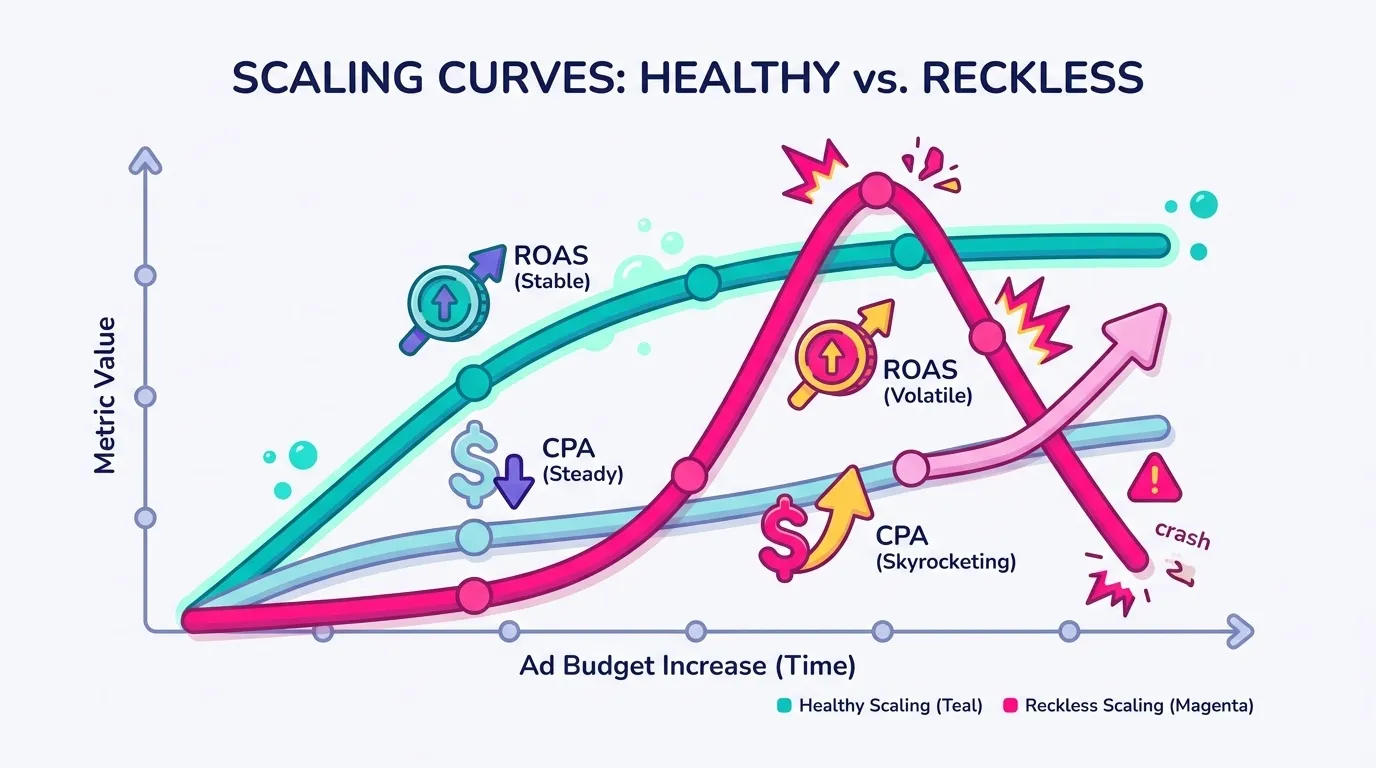
Your ROAS held steady for months. $8-10k a month, a clean 5x, predictable. Then you doubled the budget to push for growth, and within two weeks the whole thing wobbled. CPA crept up, ROAS slid from 5x to 3.2x, and now you’re not sure if you broke something or if this is just “what happens” when you scale.
I’ve had that exact conversation with a dozen founders this year. It’s the single most common growth trap in eCommerce PPC, and it’s almost entirely avoidable.
The Real Cause: Scaling Debt, Not Bad Budgeting
Most “how to scale ROAS ads” content out there recycles the same three tips: increase budget by X%, test new audiences, refresh your creative. None of it explains why performance breaks, because the real cause usually isn’t the budget increase itself. It’s what I call scaling debt: tracking gaps, creative shortages, and inventory issues that were invisible at $10k/month and become impossible to ignore at $30k/month. The account didn’t get worse. The spend just got big enough to expose what was already fragile.
This article walks through the full system: how to check if your account is actually ready to scale, the pacing rules we use with clients, when to scale horizontally versus vertically, why creative supply quietly kills more scaled campaigns than anything else, and how to keep your attribution honest once the numbers get bigger. We close with a step-by-step framework you can run on repeat. For a broader look at how we structure accounts before scaling even enters the conversation, our guide on PPC campaign management for e-commerce brands is a good companion read.
None of this is a hack. It’s a system, and like most systems, it only works if you run it consistently, not just when performance dips. We’ve built our whole approach to CRO and PPC around that idea: it’s a mindset, not a one-time fix.
What “Scaling Without Killing Performance” Actually Means
ROAS-positive scaling means increasing spend while keeping the efficiency ratio that made the campaign profitable in the first place largely intact. Not identical, that’s rarely realistic, but within a range you’d still call healthy. That distinction matters more than it sounds.
Most brands don’t scale this way. They treat ad spend like a volume dial, expecting revenue to climb in a straight line as budget goes up. It doesn’t work like that, and it never has. Google Ads and Meta both allocate budget by chasing the next-best available impression, and once you’ve saturated the cheapest, highest-intent inventory, every additional dollar buys something slightly less efficient.
This is exactly where MER (Marketing Efficiency Ratio, total revenue divided by total marketing spend) earns its place as the guardrail metric, not platform-reported ROAS. As spend and touchpoints multiply, platform ROAS increasingly reflects the platform’s own attribution logic more than reality. MER doesn’t care which channel gets the credit. It just tells you if the business made money. We’ll come back to this in more depth in the tracking section, because it’s the single biggest blind spot I see in scaling accounts.
There’s also a trade-off DTC brands need to make consciously instead of by accident: sometimes lower ROAS at higher volume is still the better outcome. Take a brand spending $10k/month at 5x ROAS ($50k revenue) versus the same brand spending $30k/month at 3.5x ($105k revenue). The ROAS “dropped,” but the business made more than double the gross revenue. If margin still supports that ratio, that’s not a failure, that’s growth.
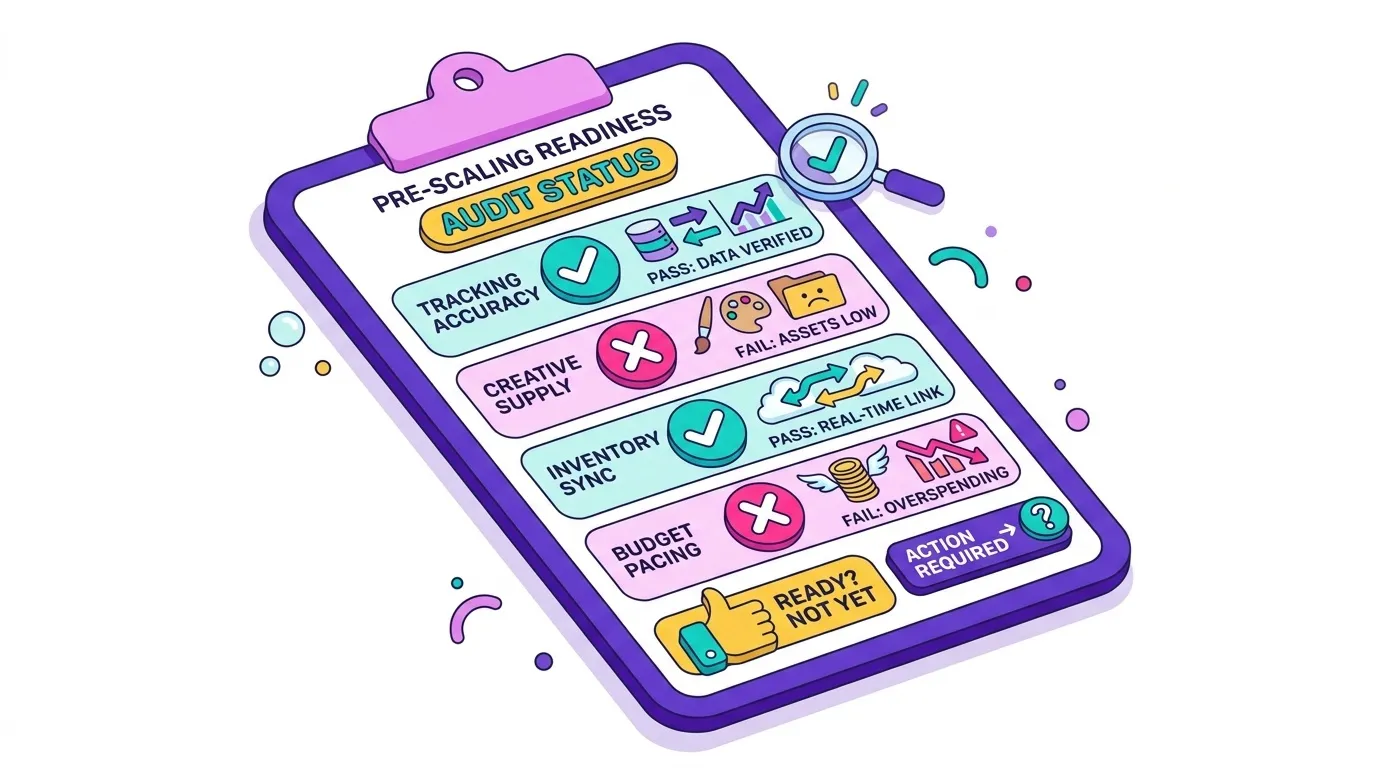
Signal Check: Is Your Account Actually Ready to Scale?
Most failed scaling attempts don’t start with a bad budget decision. They start earlier than that, with a campaign that looks stable but isn’t actually stable yet. Skipping this diagnostic step is the single most common mistake I see, more common even than scaling too fast.
CPA/ROAS Stability Over a 14-30 Day Window
A single good week is not a scaling signal. It’s noise. Before touching the budget, look at a 14 to 30 day window minimum, because that’s roughly the timeframe needed to smooth out day-of-week variance, promo spikes, and algorithm learning fluctuations.
What “stable” actually looks like is CPA and ROAS moving within a narrow band week over week, not swinging wildly between a great Tuesday and a terrible Thursday. If your ROAS chart looks like a heartbeat monitor, that’s not a stable account. It’s a lucky one.
Practically, I’d check three things before scaling: has CPA held within a reasonable range for three or more consecutive weeks, is current spend already fully allocated (not capped by budget), and is weekly conversion volume statistically meaningful. Google and Meta both generally want 30-50 conversions per week per ad set to optimize confidently, and below that threshold, “performance” is often just variance dressed up as a trend. Our CPA calculator is a quick way to formalize this check across your campaigns.
Creative and Audience Saturation Signals
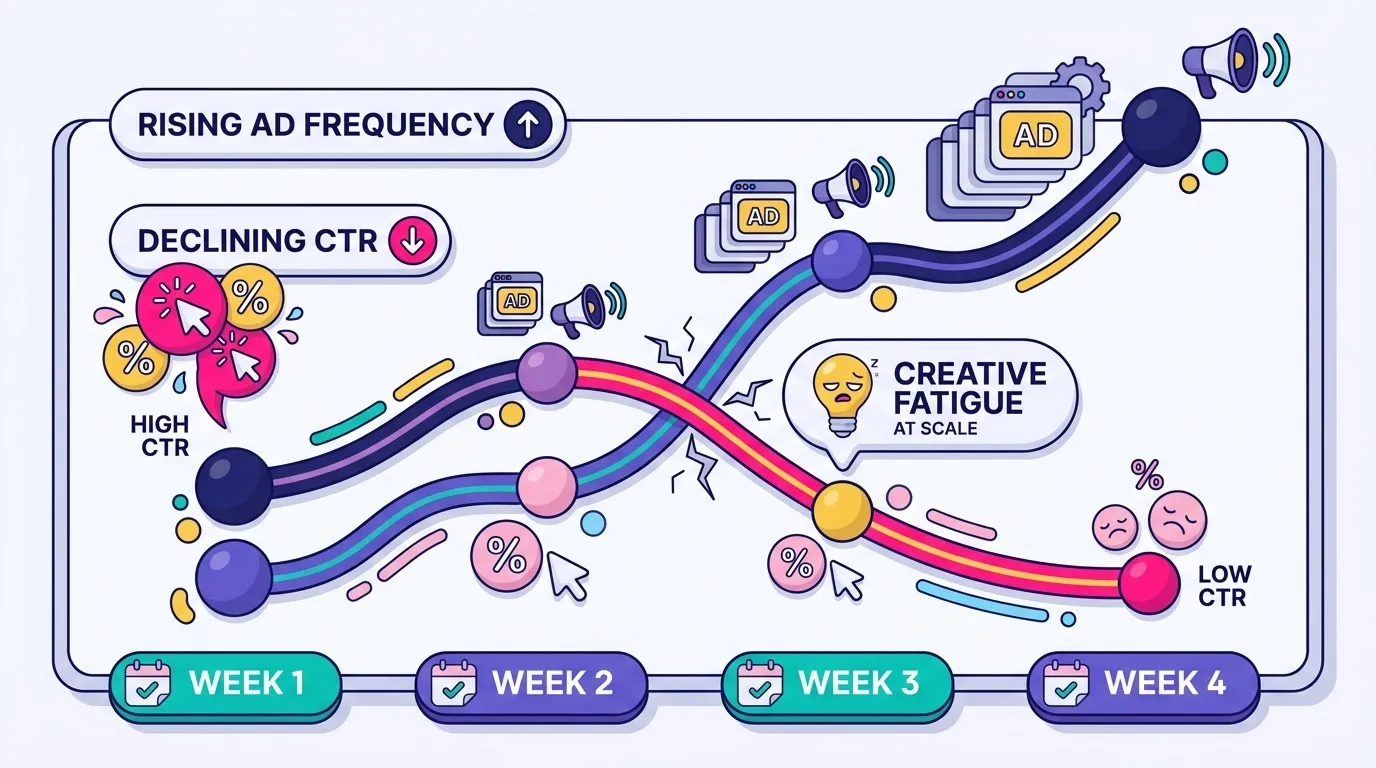
Frequency and CTR decay are the earliest warning signs of saturation, and they show up well before ROAS actually collapses. If you catch them early, scaling becomes safer. If you ignore them, scaling makes them worse, fast.
On Meta specifically, I get nervous once frequency creeps above 2.5 to 3 within a rolling 7-day window. That’s when the same people are seeing the same ad often enough that fatigue starts eating into CTR and conversion rate, even if overall ROAS hasn’t visibly dropped yet. CTR decay tends to follow a fairly predictable curve: strong in week one, softening in week two, and noticeably weaker by week three or four at consistent spend.
It’s worth flagging early that saturation isn’t purely an audience problem. It’s also a creative supply problem, and we’ll get into that in detail a bit further down, because it’s genuinely one of the most fixable causes of scaling failure once you know to look for it.
Here’s the part marketers underrate: scaling isn’t just a media buying decision, it’s an operations stress test. Can your fulfillment team actually handle 2-3x the order volume without shipping delays? Can customer service keep response times reasonable when ticket volume triples?
Inventory sync matters more than people think. A best-seller going out of stock mid-scale, or fulfillment falling two days behind, doesn’t just hurt CX, it directly drags down performance because Google and Meta both penalize accounts (via feed disapprovals or negative reviews) that create a bad post-click experience.
There’s also a data maturity question worth asking honestly: is your LTV and repeat purchase data mature enough to inform this decision, or are you still scaling purely off first-purchase ROAS? A beauty brand with strong replenishment rates can often justify scaling into a lower first-touch ROAS because the second and third order recover the margin. A brand with no repeat data yet doesn’t have that cushion, and should scale more conservatively. Tracking accuracy is the last piece of backend readiness, and it deserves its own section, because it’s usually the quiet reason “the numbers stopped making sense” once spend went up. If you haven’t run a full audit recently, our step-by-step PPC audit guide is the right starting point before any budget conversation.
The 20% Rule: How to Increase Budgets Without Triggering an Algorithm Reset
Once the signal check comes back clean, the next question is how much to increase budget by, and how often. This is where we apply what I call the 20% rule: increase budgets by no more than 20-30% every 3-4 days, rather than doubling spend overnight because the CFO wants Q4 numbers.
Why Sudden Budget Jumps Trigger an Algorithm Reset
The mechanics behind this are straightforward. Both Google Ads and Meta Ads treat large, sudden budget jumps as a signal that something has fundamentally changed about the campaign. That can push the campaign back into a learning or exploration phase, where the algorithm widens targeting and re-tests delivery paths, temporarily destabilizing CPA and ROAS exactly when you least want it.
What that reset looks like in practice: broader, less qualified audience exploration, higher CPMs as the algorithm tests new inventory, and inconsistent day-to-day delivery. According to Google’s own Ads help documentation on the Smart Bidding learning period, campaigns typically need a few days to a week of stable settings to re-converge after a significant change. Meta’s own guidance on the Advantage+ learning phase follows a similar logic.
The 3-Day Performance Lag Rule
This is also where we apply a second heuristic internally: the 3-day performance lag rule. Wait at least 72 hours after any budget change before reacting to a dip. Early post-change data is noisy almost by definition, and I’ve seen too many accounts get “fixed” (read: reverted or over-corrected) based on 24 hours of data that would have stabilized on its own by day three.
The Scaling Cadence in Practice
In practice, the cadence looks like this: day 0, increase 20%. Days 1-3, monitor without touching anything. Day 4, if CPA/ROAS held, increase another 20%. Repeat. It’s not a one-time push, it’s a rhythm, closer to a weekly ritual than a single decision. That patience is uncomfortable for a lot of founders who want results now, but it’s consistently the difference between scaling that holds and scaling that snaps back.
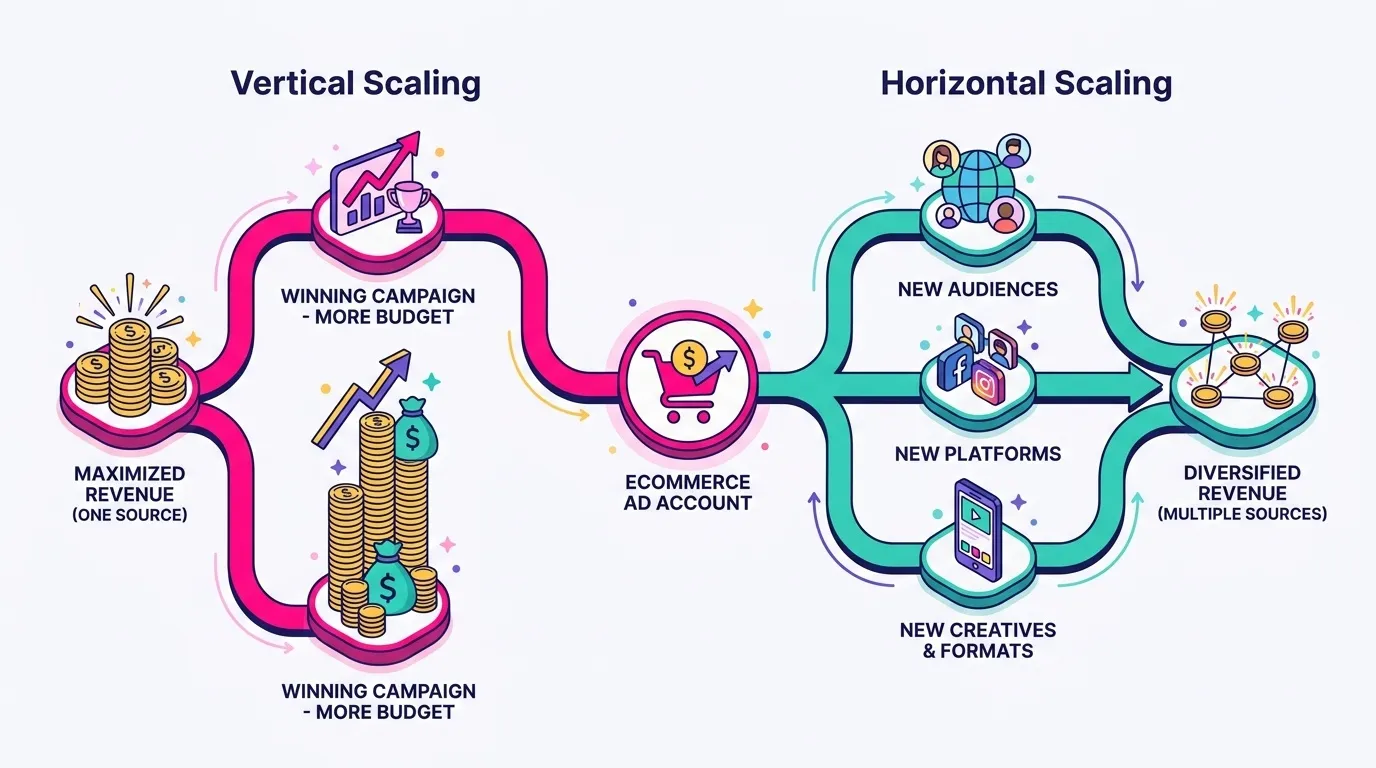
Horizontal vs. Vertical Scaling: Choosing the Right Lever
Pacing tells you how fast to increase spend. It doesn’t tell you where that new spend should go. That’s a separate decision, and it’s one most accounts get wrong by default rather than by choice.
Vertical Scaling: Increasing Budget on Winning Campaigns
Vertical scaling means pouring more budget into a campaign that’s already working. It makes sense when the campaign hasn’t hit saturation signals yet and the addressable audience pool is still large relative to current spend, meaning there’s genuinely more qualified inventory left to buy.
The risk is that vertical scaling has a ceiling, and it arrives faster than most people expect. Past a certain point you’re feeding the same finite audience pool more money, and diminishing returns kick in hard, because there simply aren’t more high-intent people to reach within that segment.
Horizontal Scaling: Expanding to New Audiences, Campaign Types, or Platforms
Horizontal scaling means spreading budget across new territory instead of concentrating it: new lookalike seeds, new interest clusters, adding Performance Max alongside Search, or moving from Meta-only to a Meta plus Google Shopping mix. Our piece on Performance Max for e-commerce covers one of the more effective horizontal levers available to Shopify brands right now.
The trade-off is real. Horizontal scaling protects ROAS longer because you’re not overfeeding one finite pool, but it demands more creative variety, more campaign management overhead, and results take longer to mature since each new segment needs its own learning period.
Decision Table: When to Use Which
Here’s the framework we actually use with clients to decide which lever to pull, based on account maturity signals rather than gut feel.
Signal
Vertical Scaling
Horizontal Scaling
Don’t Scale Yet
CPA/ROAS stability (14-30 days)
Stable, within narrow band
Stable, but audience showing early saturation
Inconsistent, wide swings
Frequency (Meta, 7-day)
Below 2.0
Between 2.0 and 3.0
Above 3.0
Saturation curve trend
Flat, no CTR decay
Early decay signals
Clear, ongoing decay
Creative supply
Adequate for current spend
Needs 2-3 new variants ready
Insufficient, creative debt building
Creative Supply: The Silent Killer of Scaled Campaigns
If I had to pick the single most underestimated cause of ROAS collapse at scale, it’s not budget pacing. It’s creative running out of runway. As budget increases, frequency increases, and the same creative gets shown to the same people more often, which accelerates fatigue and drags down CTR and conversion rate almost regardless of how disciplined your pacing was.
Fatigue timelines differ by platform. On Meta, creative at scale often starts showing fatigue signs within 2-3 weeks, sometimes faster in smaller, well-defined audiences. Google Search tends to decay more slowly since query intent naturally refreshes the audience, but Shopping and Performance Max assets aren’t immune either.
A practical cadence we use: for every 20-30% budget increase, plan at least 2-3 new creative variants entering rotation within that same week. Not next month, that week. Creative production needs to scale in step with spend, not after the fact.
This is where creative debt shows up. Brands that scale spend faster than they scale creative production inevitably see ROAS erode, no matter how disciplined the budget pacing was. You can nail the 20% rule perfectly and still lose efficiency if the same three ad variants are carrying $30k/month of spend. For fashion and beauty brands specifically, mixing UGC with studio content and running an always-on testing queue (rather than a “campaign launch” mentality) is what keeps supply ahead of demand. Our guide on creating successful ad creatives for Meta goes deeper into structuring that pipeline.
Tracking & Attribution: Why Your Data Lies to You at Scale
Here’s an uncomfortable truth: the bigger your spend gets, the less you should trust platform-reported ROAS at face value. Not because the platforms are dishonest, but because attribution windows overlap, view-through impressions get counted generously, and the sheer volume of touchpoints makes self-reported credit noisier.
The baseline fix is server-side tracking, whether that’s Conversions API on Meta or server-side GTM feeding Google Ads. This matters even more post-iOS14 and with ongoing browser privacy changes limiting third-party cookie visibility. Without it, you’re optimizing against a signal that’s already partially blind.
Consent Mode adds another layer. Cookie consent rates directly determine how much conversion data platforms actually see, and lower consent rates in markets like Germany or France can artificially depress reported performance in ways that have nothing to do with campaign quality.
This is exactly why MER earns its place as the more trustworthy north-star metric at scale. It’s calculated from total revenue against total spend, so it can’t be gamed by attribution model quirks or overlapping windows the way platform ROAS can. A useful weekly habit: compare platform-reported ROAS to blended MER, and treat any large, sustained divergence as a tracking-health flag first, not automatically a performance problem. If you want a baseline before the next budget conversation, run your current numbers through our ROAS calculator and MER calculator side by side, and if you haven’t nailed down your break-even point yet, our piece on break-even ROAS is the right foundation.
Structural Pitfalls That Break Scaling (Feed, Inventory, Landing Pages)
Scaling stresses parts of the funnel that simply never mattered much at lower spend. Feed quality, inventory sync, and landing page capacity all fall into this category, and they tend to surface as “unexplained” performance drops that have nothing to do with the campaign itself.
For Shopping and Performance Max campaigns, feed issues at higher volume are common: out-of-stock items still being served, or disapproved products quietly dragging down your overall feed health score as impression volume climbs, a pattern well documented in Google Merchant Center’s own guidance on product disapprovals. At $5k/month, a handful of bad SKUs barely register. At $30k/month, they can meaningfully drag blended performance down.
Landing pages face the same reckoning. A product page that converts fine at 500 visits a day might quietly buckle at 3,000 visits a day, not because the design changed, but because server response times slow under load or checkout starts choking during traffic spikes. That’s a hidden CVR drop that looks like an ad problem but is actually an infrastructure problem.
The fix isn’t glamorous, but it’s non-negotiable: run a feed health check, validate inventory sync, and stress-test page speed under simulated higher load before scaling, not after you notice CPA climbing. This is a natural extension of the audit process we mentioned earlier, and honestly, if landing page capacity is where things break, that’s less a media problem and more a CRO problem, which is exactly why we run those two disciplines together rather than in silos.
Testing Incrementality While You Scale
Here’s the fallacy I see constantly: “more spend, more sales” gets treated as proof that scaling worked. It isn’t. Some of that additional revenue would have happened anyway, through organic traffic, direct visits, or brand search simply cannibalizing what would have converted regardless of the extra ad dollars.
Geo holdout tests are the most reliable practical method for larger accounts. Pause or meaningfully reduce spend in a handful of comparable regions while scaling elsewhere, then compare the revenue delta between test and holdout areas over a few weeks.
For brands without the traffic volume for a full geo test, native conversion lift studies (available on both Meta and Google) offer a lighter-weight alternative, splitting exposed versus unexposed users to isolate incremental impact without needing regional-level data.
A/B testing budget allocation itself, not just creative, using a VWO-style testing mentality applied to spend splits, is another way to validate whether horizontal expansion is genuinely incremental or simply cannibalizing an existing channel. Our Google Ads A/B testing guide covers the testing mechanics in more depth, and it’s worth cross-referencing with our breakdown of retargeting versus remarketing, since cannibalization between prospecting and remarketing is one of the most common incrementality traps at scale.
That said, I’m pragmatic about this. If you don’t have the traffic volume for statistically valid incrementality testing, a heuristic before/after trend comparison against a control period is a perfectly acceptable fallback. Perfect data is rare. Directionally honest data is achievable for almost everyone.
A Scaling Framework You Can Actually Follow (Step-by-Step)
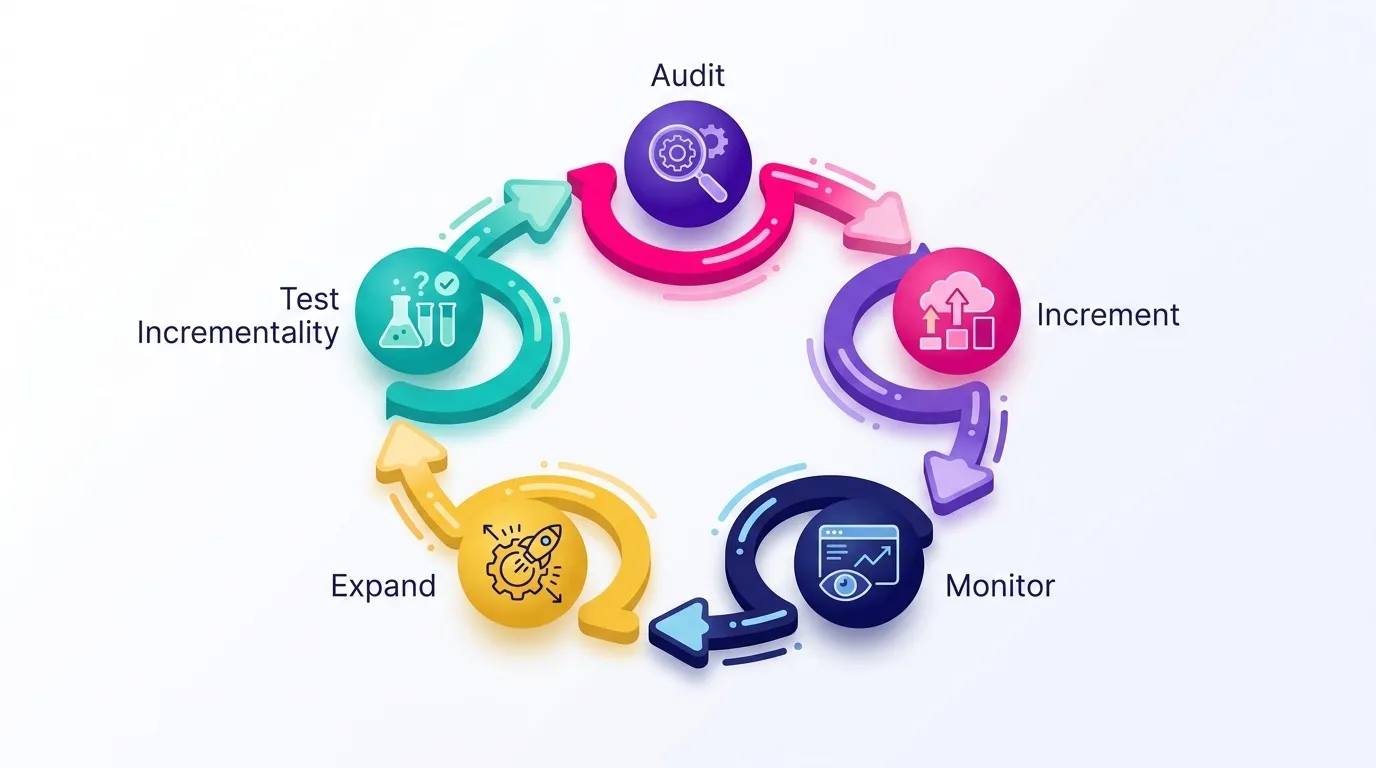
Everything above compresses into one repeatable cycle: Audit, Increment, Monitor, Expand, Test Incrementality. It’s designed to run on a loop, not as a one-time project you check off before the next campaign launch.
Audit comes first, always. Run the readiness signal check: CPA/ROAS stability over 14-30 days, frequency and saturation signals, and backend readiness across inventory, fulfillment, and tracking. Skipping this step is where most scaling attempts go wrong before a single dollar even moves.
Increment applies the 20% rule, choosing vertical or horizontal scaling based on the decision table above. This isn’t a one-off budget bump, it’s the start of a cadence you’ll repeat every 3-4 days if performance holds.
Monitor means applying the 3-day performance lag rule, watching MER alongside platform-reported ROAS rather than either metric alone, and keeping an eye on creative frequency and fatigue signals before they turn into a visible CPA spike.
Expand kicks in once things stabilize: layer in new creative variants, new audience segments, or a new platform, following the horizontal scaling principles rather than just dumping more budget into the same finite pool.
Test Incrementality closes the loop. Periodically validate that scaled spend is genuinely additive using geo holdouts or lift studies, then feed what you learn back into the next Audit phase. Your digital marketing KPIs dashboard and a periodic competitor PPC analysis are both useful inputs to bring into that next audit, since market conditions shift the goalposts too.
When to Bring in Outside Help (Agency Signals)
Everything in this article is doable in-house. I want to be honest about that, because I don’t think the real constraint for most $1M-$20M brands is knowledge. It’s bandwidth. A lean team is already juggling creative production, tracking QA, feed management, and testing, often with one or two people wearing all four hats at once.
A few concrete signals tell me a brand’s scaling has outpaced internal capacity: creative production can’t keep up with the refresh cadence scaling demands, nobody specifically owns tracking QA (it just sort of happens, or doesn’t), incrementality testing keeps getting deprioritized in favor of “just launching the next campaign,” or MER and platform ROAS have been quietly diverging for weeks without anyone actually investigating why.
This is where our agency-as-partner model comes in, and I want to be clear about what that means. It’s not a hand-off of control. It’s an embedded team running the Audit, Increment, Monitor, Expand, Test cycle systematically, with PPC and CRO working in tandem, because landing page capacity and ad scaling are genuinely the same problem addressed from two different sides. We built the team this way on purpose, roughly ten specialists working across paid media, tracking, and conversion, because scaling breaks in more places than any single discipline can fix alone.
If any of those signals sound familiar, that’s usually the moment worth exploring what a proper scaling audit looks like for your account. Our Google Ads for eCommerce Stores & Shopify Brands service page walks through how we structure that work, or you can look at our broader PPC agency approach if paid social and Google are both in the mix.
The Real Test of Scaling: Growth That Doesn’t Break What Works
Scaling isn’t a budget decision. It’s a systems discipline that touches tracking, creative, inventory, and testing all at once, and it only holds together if you treat those pieces as connected rather than separate departments doing separate things.
The fear you started with, ROAS holding at $10k a month and collapsing at $30k, isn’t bad luck. It’s a predictable, well-documented pattern, and every lever in this article exists specifically to prevent it. That’s genuinely good news: if the pattern is predictable, it’s manageable.
This is the same principle behind everything we do at Midsummer, whether it’s a paid media account or a CRO program: the mindset matters more than any single tactic. The brands that treat scaling as a repeatable habit, not a one-time push before a big sales event, are the ones that keep compounding growth instead of hitting a ceiling every time they try to grow.
Ready to scale without the guesswork? Check out our Google Ads for eCommerce services or request a personalized scaling audit.
We’ll dig into your account, find where the scaling debt is hiding, and make sure your budget increases actually turn into profit instead of a bigger, less efficient version of what you already had.
Let’s build a scaling system that holds, side by side.