In the world of digital marketing, understanding who your ideal customers are is the key to creating successful digital marketing campaigns that resonate with your audience…
In the world of digital marketing, understanding who your ideal customers are is the key to creating successful digital marketing campaigns that resonate with your audience.
Without a clear picture of who you’re trying to reach, your marketing efforts can become unfocused, inefficient, and fail to deliver the desired results.
One of the most important tools to help you with this is the concept of a buyer persona.
But what exactly is a buyer persona, and how does it fit into your digital marketing strategy?
In essence, a buyer persona acts as a roadmap for your digital marketing efforts, guiding you toward more targeted, effective, and relevant marketing that generates better engagement, higher conversions, and ultimately, stronger business growth.
Let’s break it down in a simple way.
What Is a Buyer Persona?
A buyer persona is a semi-fictional character that represents your ideal customer based on data and research.
This persona helps you understand your audience better by considering their demographics, behaviors, motivations, challenges, and buying decisions.
Essentially, it’s a snapshot of who your customers are, what they care about, and why they would choose your product or service.
For instance, consider a company that sells eco-friendly products. By creating a persona like “Eco-conscious Emma”, a 30-year-old urban professional who values sustainability, the company can craft messages that resonate with individuals who share similar values and concerns.
In digital marketing, creating detailed buyer personas is crucial because it shapes everything from your ad copy to your content strategy, email marketing campaigns, and beyond.
The more specific and accurate your buyer persona is, the better you can target and connect with the right audience.
Importance in Digital Marketing
As per my experience, a well-crafted buyer persona can make all the difference in how successful your digital marketing efforts are.
Let’s say you’re running a Google Ads campaign for a local bakery.
If your buyer persona includes people aged 25-40, living within a 10-mile radius, who are health-conscious and appreciate organic ingredients, your ad copy will likely focus on promoting fresh, organic baked goods.
I recommend getting as detailed as possible when creating buyer personas.
The more insights you have, whether it’s about age, location, job title, income, goals, pain points, or buying habits, the more relevant your marketing efforts will be.
And that relevance leads to higher engagement and better results.
Crafting Effective Buyer Personas
Crafting a buyer persona involves a mix of market research, data collection, and empathy.
It’s about putting yourself in the shoes of your customers and understanding their needs, challenges, and motivations.
Here’s how you can craft detailed and effective buyer personas for your business:
Collect Data and Insights
Start by looking at your existing customers and audience. Use tools like Google Analytics, surveys, and social media insights to gather demographic information, such as age, gender, income level, location, and occupation.
As per my experience, gathering data from your CRM system or any past customer surveys can provide an excellent starting point for segmentation.
Segment Your Audience
Not all customers are the same, so it’s important to segment them based on shared characteristics.
For instance, your buyer persona might look different for a business-to-consumer (B2C) model compared to a business-to-business (B2B) model. My recommendation is to focus on creating personas for the most prominent and profitable segments of your audience.
Understand Pain Points and Challenges
It’s essential to dive deeper into your persona’s pain points. These are the obstacles or frustrations they are facing that your product or service can solve.
For example, if you’re targeting small business owners, their challenges may include managing cash flow, marketing, and finding reliable vendors. Understanding these challenges allows you to create messaging that directly addresses them.
Define Goals and Motivations
Knowing what your persona wants to achieve is key. What are their goals, both professional and personal?
For example, a persona representing a marketing manager might be focused on increasing lead generation or improving brand awareness. By understanding these goals, you can tailor your marketing to help them achieve success.
Determine Buying Behavior
Understanding how your persona makes buying decisions is critical.
Do they research products thoroughly online before purchasing? Do they trust recommendations from peers? By knowing the steps in their buying process, you can position your product as the solution they’ve been looking for at the right moment.
Add Personal Details
A well-rounded buyer persona also includes more personal traits such as hobbies, interests, and lifestyle.
For example, if your product is a time-saving solution for busy professionals, your persona might enjoy activities like fitness or travel, which you can reference in your campaigns to make your messaging more relatable.
Give Your Persona a Name and Backstory
To make the persona feel real, give it a name and a backstory. This helps you visualize and humanize your target audience, making it easier to craft relevant and personalized marketing strategies.
Example From Personal Experience
The team and I, alongside one client who works in the automotive industry, worked together to create their ideal buyer persona.
Their analytics data from their CRM system helped in building this.
Through a deep analysis, we understood that their main target was male adults aged 18 – 55. These are people actively searching for products that are useful to customize their cars, but also people passionate about motor vehicles and luxury vehicle enthusiasts.
Once done, we created audiences on Google Ads and started creating different campaign types. Day by day, we optimized and achieved a good balance.
The following step was creating lookalike audiences to acquire some new potential customers and broaden our reach. We achieved great results, and this is an example that demonstrates how important targeting the right audience is.
Review and Refine
Buyer personas should evolve over time. As you gather more data from customer feedback, social media interactions, and sales trends, you can refine your personas to ensure they remain accurate and aligned with your audience’s needs.
By synthesizing this information, businesses can develop comprehensive personas that provide deep insights into their customers’ motivations and behaviors.
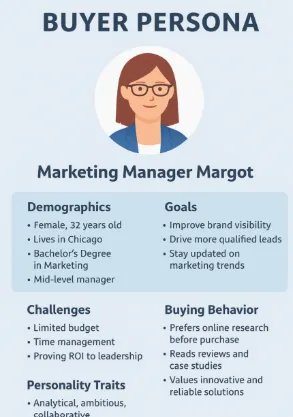
Example of a Buyer Persona
There are many tools that can help you create a buyer persona; just choose the one that best suits your needs.
This is just an example of a buyer persona that I created through the “Make My Persona” tool by Hubspot:
Conclusion
In summary, a buyer persona is a fundamental component of any successful digital marketing strategy.
It allows businesses to move beyond generic marketing tactics and engage with their audience on a more personal and meaningful level.
By investing time and resources into developing accurate buyer personas, companies can enhance their marketing effectiveness, build stronger customer relationships, and ultimately drive business growth.
If you are curious to know more about how we could help you succeed, explore our PPC services or reach out for a custom audit, and we’ll dig deep, clean up the mess, and help your Google Ads account perform the way it should.
Let’s turn those clicks into conversions…together!