Break Even ROAS: How to Calculate and Interpret It
In the world of PPC campaigns, Return on Ad Spend (ROAS) is a key metric to measure your advertising efforts. But when you’re aiming for profitability…
In the world of PPC campaigns, Return on Ad Spend (ROAS) is a key metric to measure your advertising efforts. But when you’re aiming for profitability, it’s essential to understand Break Even ROAS – your financial compass that tells you when your ad spend is neither generating a profit nor incurring a loss.
So, I strongly recommend that you understand this concept really well! The name makes it look like a difficult concept, but it’s not!
Let’s see how to calculate it and how it can work for your campaigns.
What is Break Even ROAS
ROAS isn’t just a fancy marketing acronym; it’s the financial tool that ensures you’re making smart decisions with your advertising budget. At Midsummer Agency, we rely on this number to guide our campaigns. When we’re discussing strategies, there’s always that moment when we realize how much we lean on ROAS to adjust our moves.
A strong ROAS indicates a profitable campaign, but what happens when your ad spend simply breaks even? This is where Break Even ROAS becomes crucial – it tells you the exact point where your campaigns balance costs and total revenue.
So, you’re not making profits, but neither a loss. Somebody would say “Perfectly balanced” – but of course, that’s only a starting point, from that point onward, you’ll have to increase it and start gaining money!
The Break Even ROAS Formula
The formula for calculating Break Even ROAS is very simple:
Break Even ROAS = 1 / Profit Margin
(Yep, that’s it)
Let’s say your profit margin is 50%. That means your Break Even ROAS is 2: for every dollar spent on ads, you need to bring in two dollars to cover costs. Lower profit margins mean a higher Break Even ROAS. So, the higher your margins, the easier it is to break even, at least from this perspective!
Example Calculation
If you have a product with a 20% profit margin, your Break Even ROAS will be: 1 / 0.20 = 5.
This means that for every dollar spent, you need to generate five dollars in revenue just to break even. It’s all about knowing what your numbers are telling you and making adjustments accordingly.
How to Calculate Break Even ROAS
To calculate Break Even ROAS, you’ll need to gather all the data, from product costs to additional expenses like shipping and platform fees. It’s about understanding the full picture of your expenses, not just the product itself. Don’t forget costs like ad platform fees, which can affect your overall profitability.
By using real campaign data, you’ll get a clear understanding of your actual costs, which helps in making informed decisions for your campaigns.
Interpreting Break Even ROAS and Its Implications
Once you have your Break Even ROAS, it’s time to understand what it means for your campaigns. A Break Even ROAS of 2:1 means you’re spending efficiently: for every dollar you spend, you’re earning two back, covering your costs. Good job 👍
But hey, sometimes a ROAS slightly below break even may be acceptable, especially when aiming for long-term customer acquisition or brand growth. It’s like playing chess: occasionally, you want to sacrifice one of your rooks for a bigger win later (a strategy I’ve come to appreciate as a chess fan). Knowing when to take these calculated risks is key.
That’s why the ROAS by itself isn’t enough to calculate if your marketing campaigns are doing well or not!
Interpreting a slightly-below-break-even ROAS is like playing chess: sometimes you have to sacrifice one of your rooks for future success.
Target ROAS in Google Ads and Other Platforms
For me, working at Midsummer Agency meant that I would hear the words “Target ROAS” so many times you can’t imagine!
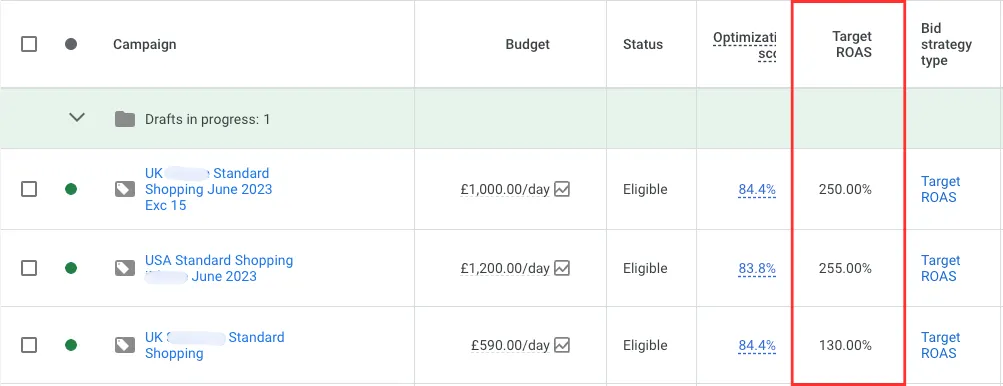
Target ROAS it’s a feature available on platforms like Google Ads. Essentially, it allows you to set a specific target for how much revenue you want to generate for every dollar you spend on ads. Once you set this target, the platform automatically adjusts your bids to help you reach that goal. It’s a great way to ensure your campaigns are working toward a specific profitability target, especially when you have clear financial goals in mind.
That said, while this is a nice tool for automation, it doesn’t mean you can take a completely hands-off approach. The platform will adjust bids based on your set target, but continuous monitoring is still essential. You need to regularly check your campaign performance, make tweaks as needed, and ensure that your goals align with what’s actually happening in the market. This active management is key to ensuring you’re staying on track and optimizing effectively.
Target ROAS in a Google Ads account.
It’s a really helpful feature, but you have to know really well your desired ROAS, and as I said previously, it could be profitable for you to aim for a slightly lower ROAS than the Break Even one. That way, you can push for more purchases knowing you’ll gain more in the long run, thanks to a high customer lifetime value.
Managing a Vast Product Catalog: Tools for Profit Optimization
When your e-commerce store offers thousands of products with varying profit margins, calculating a uniform Break Even ROAS becomes challenging. In such cases, leveraging specialized tools can provide the insights needed to optimize your advertising strategies effectively. Let’s see some examples!
Lifetimely
Lifetimely offers comprehensive analytics by tracking customer lifetime value (LTV), cohort behavior, and profit margins. This tool helps identify which products – and customer segments – are most profitable, guiding your marketing strategies toward sustainable growth.
Profitmetrics
ProfitMetrics enables Profit-Based Bidding by calculating the POAS (Profit on Ad Spend), which considers all costs associated with a product, including shipping and payment fees. This approach ensures that your advertising efforts are aligned with true profitability, allowing for more informed decision-making.
By integrating tools like these, you can get a clear view of your store’s profitability, helping you make smarter decisions that boost both short-term results and long-term growth.
Final Thoughts
Understanding Break Even ROAS is key to managing your ad campaigns and making smarter decisions with your budget. It’s not just about the numbers – it’s about knowing exactly how much you’re spending and how much you’re earning, so you can stay on track.
The concept is easy on paper, so I really hope everything’s clear for you. Here at Midsummer Agency, we’re always excited to dive into these topics with our clients, helping them to improve their strategies. If you have any questions or just want to chat about your campaigns, we’re here for it. We love exchanging ideas!
Feel free to contact us through our website or connect with us on LinkedIn.