Localizing Performance Marketing Goes Well Beyond Translation
Translating your ads is the easy part of going international. Currency, feeds, search intent, bidding signals and creative all shift by market, and ignoring that is…
Translating ad copy is the easy 20% of going international. The other 80% is search intent that shifts by market, feed attributes that get flagged per country, bidding algorithms starved of local conversion signal, and creative that does not travel the way brands assume. That part is what decides whether a second market scales or quietly underperforms the first.
If you run a Shopify DTC brand that just opened a second or third country, this is written for you. I want to cover the four layers that actually change when you cross a border: search intent, creative, bidding architecture and product feeds. Get those right and the new market compounds. Get them wrong and you spend six months blaming the market when the problem sits in your account structure.
Why “translate and launch” is where international campaigns go wrong
When I open an account that recently added a second country, the pattern is almost always the same. The ad copy is in German or French, the landing pages have been run through a translation app, and everything underneath (campaign structure, bidding signals, feed logic, conversion tracking) is still built for the home market. The brand considers itself international. The account does not.
That gap is why international performance marketing gets treated as a content task when it is really an account architecture task. Translation is visible, so it gets budget and sign-off. Architecture is invisible until the data comes back flat.
The difference between translation and localization
Translation changes the words a shopper reads. Localization changes the inputs that both the shopper and the algorithm respond to: the currency and price ladder, the search terms people actually type, the trust signals that make a purchase feel safe, the shipping and returns terms shown before checkout, and the conversion data feeding Smart Bidding. One is a deliverable. The other is a structural decision you make once and maintain forever.
Signs your setup is really one market with subtitles
A quick diagnostic I run early in any audit of a multi-market account:
One Merchant Center feed serving every country, with translated product titles as the only difference
A single Smart Bidding campaign covering multiple countries, split only by a language label or an ad group
No market-level conversion segmentation in GA4, so “revenue” is one blended number
Shipping settings and returns policy copied from the home market into every country
Hit three of those four and you do not have a multi country performance marketing strategy. You have one campaign with extra geography attached.
Search intent doesn’t translate 1:1 across markets
The same product triggers different search behavior depending on where the shopper sits. Category naming conventions differ, modifiers differ, and the balance between branded and generic search differs by how mature the category is in that country. A term that drives a large share of your revenue at home can be close to dead volume in the market next door, while a modifier you never bid on carries the demand there.
Same product, different search behavior
Take a technical outerwear piece. In the US, a large share of the demand arrives through generic category queries with a use-case modifier (think waterproof, packable, commuting). In the UK, the same category skews more toward brand plus category combinations, because a handful of heritage brands own the mental category. In Germany, queries tend to get longer and more specification-heavy, with material and certification terms appearing in the query itself. In Italy, you often see a wider informational layer sitting in front of the transactional one, which changes what a landing page has to do before it can ask for the sale.
None of that comes out of a translation workflow. It comes out of running per-market keyword research from scratch, the same way you did for your first market. Google Search Console filtered by country is the fastest free diagnostic here, and Semrush or SE Ranking will fill in the competitive picture. If you want the full process, our guide to PPC keyword research applies cleanly, you just have to run it once per country rather than once per brand.
Does performance marketing need to be localized per country?
Yes. Search intent, purchase triggers and product naming conventions all change across markets, so a single global keyword and creative set spends budget on queries that do not match local demand. Localization is what aligns your bids and your messaging with how each market actually shops.
Creative localization: what actually needs to change
Translated creative and localized creative are two different deliverables with two different price tags, which is exactly why this is the section where brands push back hardest. Fair enough: creative production cost scales with the number of markets. But the elements that drive performance are not only in the copy layer. Color associations, model representation, the kind of social proof a market trusts, and even the presence of a price in the frame all shift.
Beyond copy
In some markets, direct comparison and price-anchored creative does the heavy lifting. Shoppers want the number, the discount logic and the delta against the alternative, up front. In others, that same approach reads as cheap and the work gets done by testimonial and review-led creative, third-party press mentions, or certifications. In beauty, this plays out sharply: a before-and-after framing that performs in one country can run into a very different regulatory and cultural reception in another, where ingredient transparency and dermatologist endorsement carry the trust instead.
Formats and hooks that travel differently
Format matters as much as message. Rough, phone-shot UGC with a fast hook tends to carry more weight in the US feed, where the format has been normalized for years. In parts of Europe, more editorial and art-directed creative still outperforms, particularly in fashion and home, where the brand itself is part of what the shopper is buying. This is where a “greatest hits” approach falls apart: the set that filled arenas at home does not automatically land on tour, and the band still reworks the setlist for the crowd in front of it.
My honest answer on how far to go is “it depends”, and the variable is market size. For a market doing meaningful revenue, a real creative rebuild pays back. For a smaller test market, targeted swaps get you most of the way: localized hero image, locally sourced testimonial, native-language on-screen text, correct currency on the price overlay. Our guide to Meta ad creatives covers the testing logic, and it holds per market as long as you keep the learnings separate.
Bidding strategy breaks when markets are merged
This is the layer with the clearest technical mechanics, and the one most often ignored. Smart Bidding on both Google Ads and Microsoft Advertising learns from conversion data. When you merge several countries into one campaign, you blend signal from buyers with different price sensitivity, different shipping costs, different competitive pressure and different conversion rates. The algorithm optimizes toward an average shopper who does not exist in any of your markets.
The symptom is a learning phase that drags. When conversion volume is split thin and then recombined into one blended target, I regularly see campaigns take noticeably longer to stabilize, and then settle at a tROAS that overpays in the weak market and underbids in the strong one. Performance Max makes this worse if you let it, because the asset group and signal layer sit inside the same campaign: our breakdown of Performance Max for e-commerce goes deeper on why signal quality matters more than campaign count there.
Campaign structure: split per country or share a budget
Single global campaign
Per-market structure
Bidding
One blended target, diluted signal
Target set per market economics
Budget control
Spend flows to the cheapest clicks
Spend allocated by market priority
Creative
One set, translated
Localized per market
Feed
One feed, country gaps
Country-specific feed and rules
Reporting
Blended ROAS, hard to read
Clean market-level MER and ROAS
Best for
Very low volume test markets
Any market with real conversion volume
The deciding factor is conversion volume. If a market cannot produce enough conversions per campaign to get out of learning in a reasonable window, splitting it into its own campaign just creates a starved campaign, and consolidating is the lesser evil for a while. Once it clears that threshold, split it. Reporting clarity alone usually justifies the move, because a blended ROAS across four countries hides which market is actually funding the account.
I keep a Google Ads script running on multi-market accounts that reports conversion volume per country campaign over a rolling window and flags any campaign bidding on thin data. It takes an hour to build and it catches the problem months before a quarterly review would.
Feed management is where multi-country campaigns quietly fail
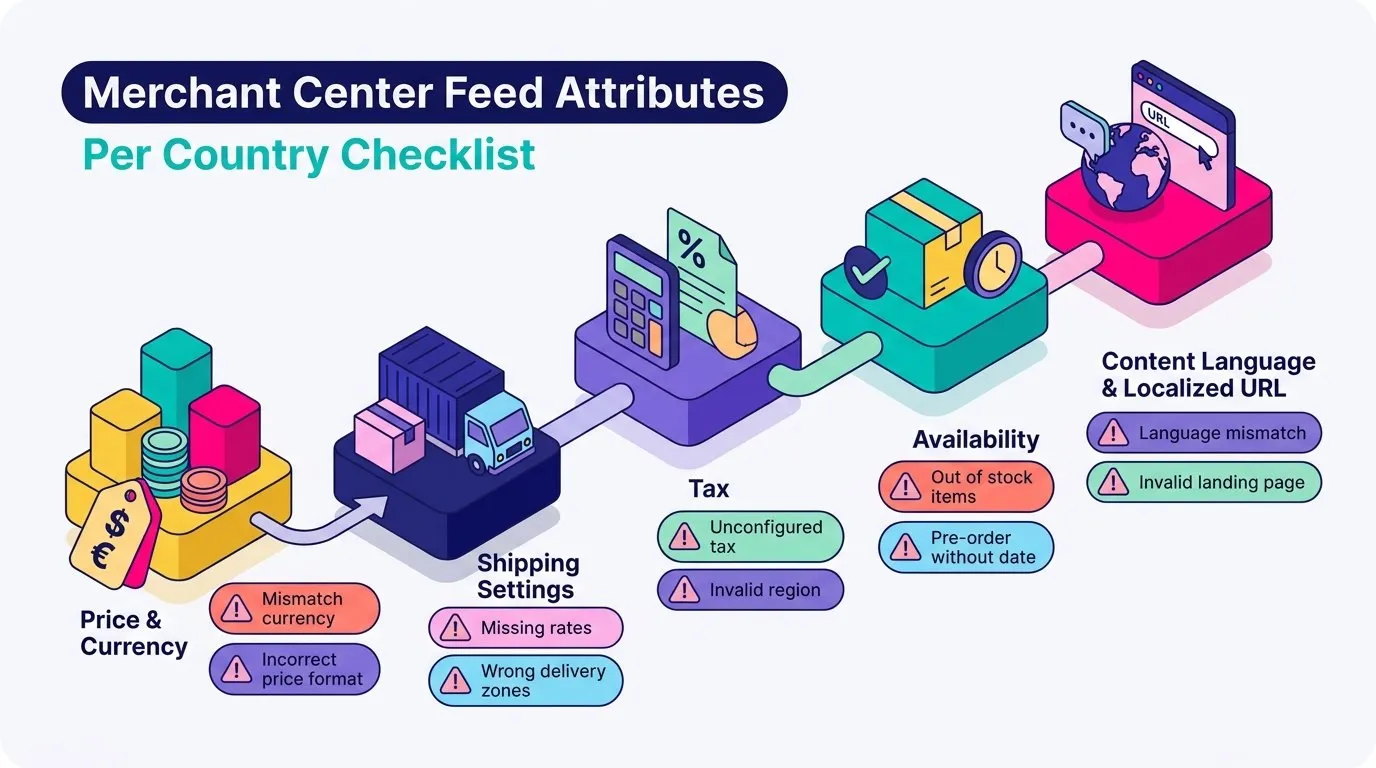
Feeds are the operational layer that breaks silently. Google Merchant Center and Meta Catalog both apply country-specific requirements, and a feed built for one market will generate disapprovals in another without anyone noticing until impressions drop. Price formatting, shipping configuration, GTIN expectations, tax handling and language attributes all have country dimensions.
What actually changes per country
Attribute
What changes across countries
price
Currency, local price ladder, VAT inclusive or exclusive
shipping
Country-specific rates, carriers, delivery windows
availability
Local stock reality, not global inventory
language and content_language
Must match the target country’s feed settings
link
Localized URL with the right market and currency
tax
Required per country in some markets, handled at account level in others
gtin and identifier_exists
Enforcement varies by category and country
Google’s product data specification is the reference document here, and it is worth re-reading per market rather than assuming your existing feed clears it.
Rejection patterns we see on expansion markets
The recurring ones are predictable once you have seen a few:
Shipping settings copied from the home market, producing disapprovals or wildly wrong delivery promises
Prices that do not match the price shown on the localized landing page, which Merchant Center flags fast and which is the single most common cause of item-level suspension on a new market
VAT handled inconsistently between feed and storefront
Language attributes left on the home-market value while the landing page serves another language
Across the accounts we onboard, expansion-market Merchant Center setups carry a visibly higher disapproval rate than the original market, almost always because the feed logic was duplicated rather than rebuilt.
On Shopify, most of this is solvable at the source rather than patched downstream. If your feed foundations need work, start with how Google Merchant Center works with Shopify, and on the social side, Meta’s localization best practice of one catalog with many markets removes a lot of duplicate-catalog maintenance. For accounts running more than three countries, I automate the checks: a script that compares feed rules and shipping settings across country Merchant Center accounts and alerts on drift, because manual parity checking across five accounts is a task nobody does twice.
Building a multi-country structure that scales
Sequencing a launch
The order matters more than the speed. Feed and tracking come before spend: a clean country-level Merchant Center setup, conversion tracking that fires with the right currency, and GA4 configured so you can read the market separately from day one. Then a small spend window to collect genuine local conversion data before you hand anything to an automated bidding strategy. Brands that scale budget first and fix measurement later end up with a learning period built on data they cannot trust, and no way to tell whether the market or the setup is the problem.
What to centralize and what to localize
Centralize reporting. One GA4 property segmented by market and language, one MER view, one source of truth for blended profitability. Localize the execution: bidding strategies and targets per market, creative per market, feed rules per country, keyword sets per language. The mistake runs in both directions. I have seen brands localize reporting into four disconnected dashboards nobody reconciles, and other brands centralize bidding into one campaign that cannot read any market properly.
How we handle this at Midsummer Agency
Our starting point on a multi-market account is a structural audit before anything else: campaign structure per country, feed parity across Merchant Center accounts, conversion volume per market campaign, and GA4 segmentation quality. From there we rebuild rather than duplicate, with per-market campaigns and targets, localized feeds, and Google Ads scripts monitoring per-country anomalies so nobody has to find them manually. Reporting stays centralized on MER and market-level ROAS so the team can see which country is funding growth and which is riding on the home market’s data.
Take an Italian technical apparel brand selling across several European markets and the US. The home market and the US behave differently enough in search intent, price sensitivity and creative response that treating them as one audience would blur both. The discipline is unglamorous: separate signals, separate targets, shared reporting.
A simple framework for prioritizing which markets to localize first
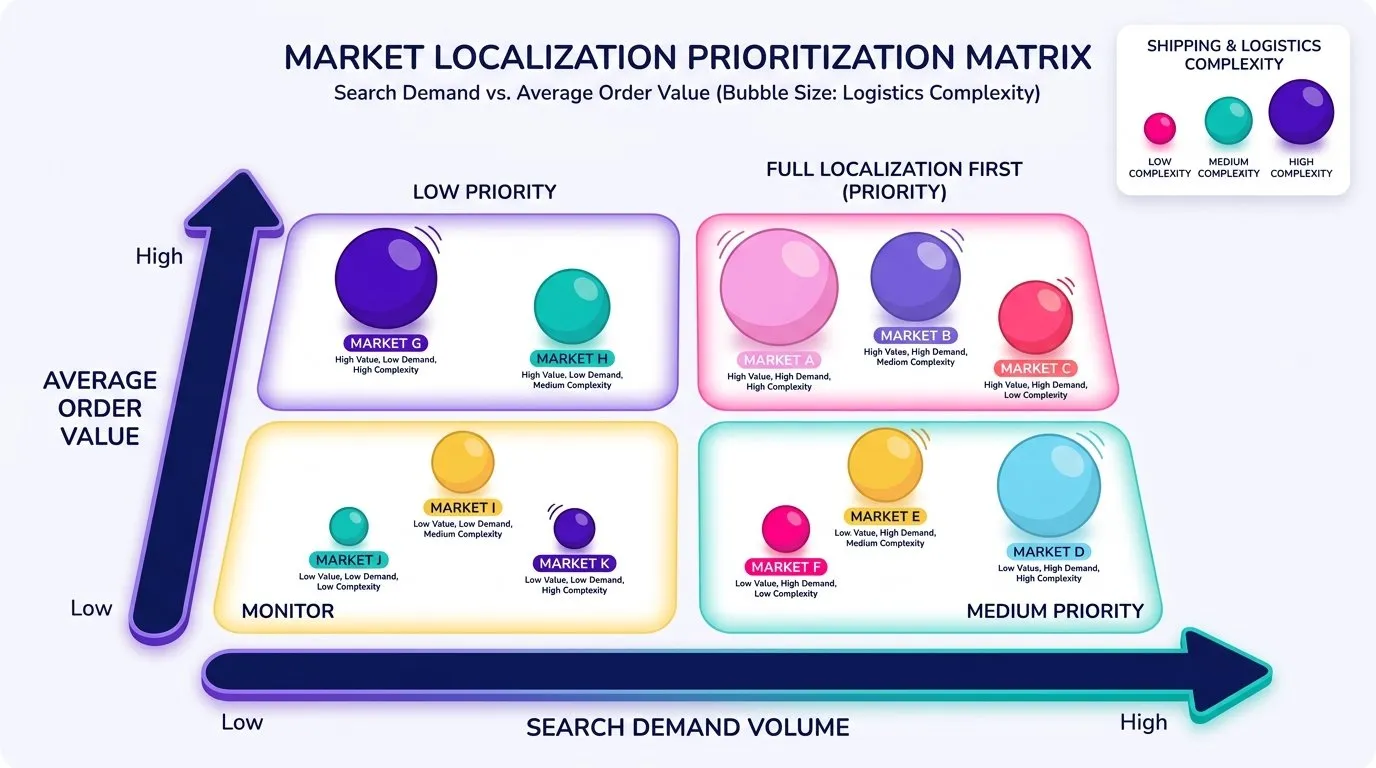
Not every market earns full localization on day one. Before I recommend greenlighting a new country, I look at three variables: search and demand volume for the category in that market, expected average order value, and shipping and logistics complexity (cost, delivery time, returns handling, duties).
Those three get weighed against each other, not scored in isolation. A high-volume, low-AOV market with slow and expensive shipping often ranks below a smaller market with a higher AOV and simple logistics, because the second one reaches profitable unit economics with far less spend and far less operational drag. Feed complexity belongs in the calculation too: a country that forces a separate tax and shipping configuration plus a localized storefront is a bigger lift than the demand data alone suggests.
The practical takeaway is that full localization is a budget decision, so spend it where the math supports it. For secondary markets, partial localization is a perfectly legitimate interim state: fix the feed, split the bidding, swap the hero creative and the currency display, and leave the full creative and content rebuild until the market proves it deserves the investment.
Final thoughts on scaling performance marketing across borders
Translation is a line item. Localization is an architecture decision. The two get confused because the translation is the part everyone can see, and the architecture only shows up in a blended ROAS number that looks fine until you split it by country and find one market subsidizing three.
The brands whose second market performs like a real market, not like a rounding error, are the ones that treat it as its own account from the start: its own conversion signal, its own bidding targets, its own feed logic, its own creative. The work is not glamorous and it does not fit in a translation brief.
If you are planning a market launch or sitting on an expansion market that never quite took off, have a look at how we work as an international digital marketing agency, or send over your account for an audit. We will go through the structure, the feeds and the bidding per market, and tell you plainly which part is holding the new market back.