Picture this: you open Google Search Console on a Tuesday morning, and your rankings look great. Top three for your main category page, position one for a handful of long-tail terms you fought hard for. Then you check organic revenue in GA4, and it’s flat. No flux capacitor required to explain what’s happening here: your shoppers aren’t clicking through anymore, because an AI Overview or a ChatGPT answer already gave them what they needed before they ever reached your listing.
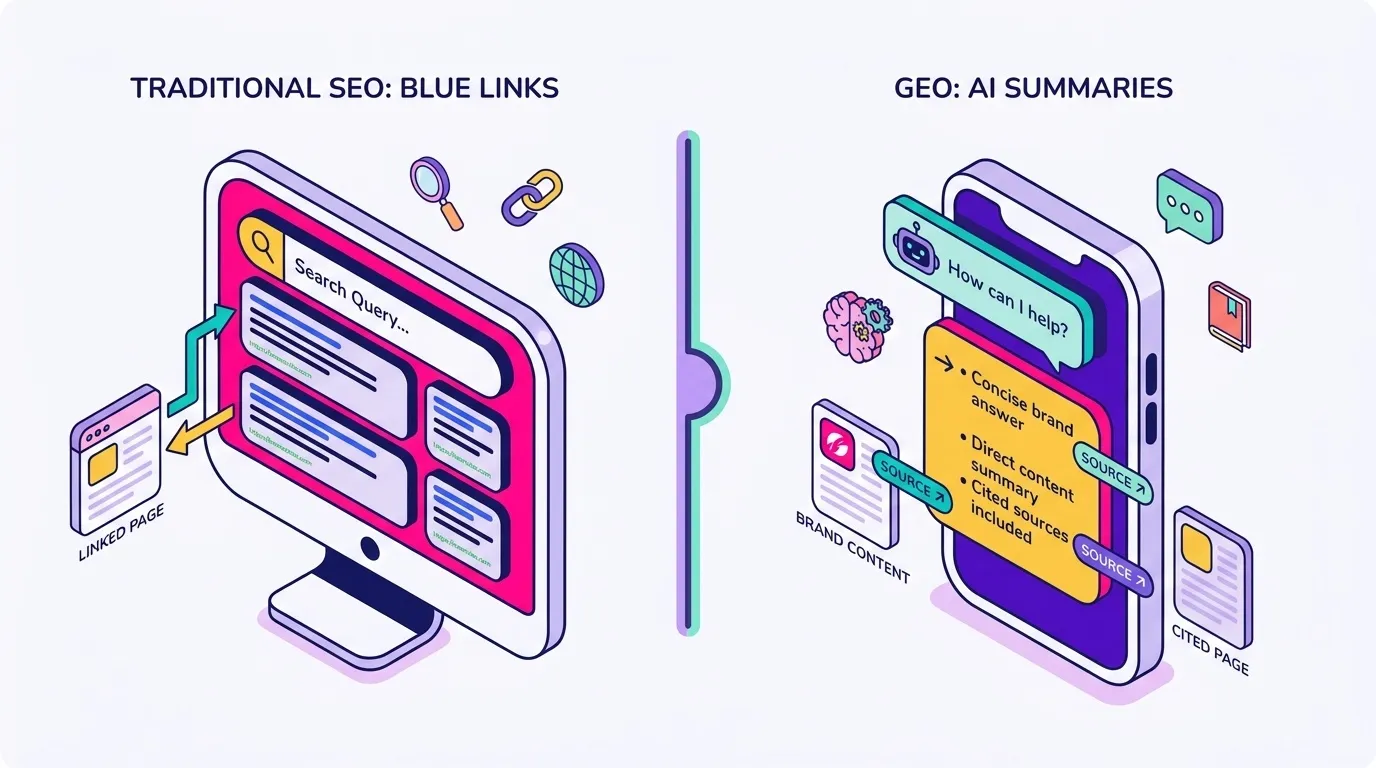
That tension is the whole story of SEO vs GEO. Traditional SEO optimizes for ranking and clicks. Generative Engine Optimization (GEO) optimizes for being cited, quoted, or summarized directly inside AI-generated answers, often without a click ever happening. Sitting in the middle is a third discipline, Answer Engine Optimization (AEO), focused on becoming the direct answer itself, the featured snippet, the voice search result, the “position zero” everyone used to fight over.
For eCommerce brands scaling in that $1M to $20M range, this isn’t an academic distinction. Customer acquisition cost is already rising across every paid channel. If your brand becomes invisible in the AI conversations shoppers are now having before they even open a search engine, you’re losing top-of-funnel awareness you’ll never see in a dashboard, and you’ll end up paying more in ads to compensate for a leak nobody flagged.
In this article, I’ll walk through what SEO and GEO actually mean, build a proper three-way framework with AEO included (something most “SEO vs GEO” content skips), show real patterns of brands adapting versus brands standing still, and close with a checklist you can run against your own Shopify store this week, not “eventually.”
What Is SEO? A Quick Refresher
Let’s start with the discipline you already know, because it’s still the foundation everything else is built on. SEO (Search Engine Optimization) is the practice of optimizing content, site structure, and authority signals so a page ranks higher in traditional search engine results pages. It’s the art and science of convincing Google, and by extension the human on the other end, that your page deserves to be seen.
The Core Optimization Levers
The core levers haven’t changed much in principle, even if the tactics have matured. Keyword targeting tells search engines what a page is about. Backlinks and domain authority signal that other credible sites vouch for you. Technical health, things like site speed, crawlability, and Core Web Vitals, ensures the experience holds up once someone lands. And increasingly, E-E-A-T (Experience, Expertise, Authoritativeness, Trustworthiness) determines whether Google trusts the person or brand behind the content in the first place, a framework Google itself has formalized in its own guidelines on creating helpful, people-first content.
The traditional success loop is simple and, for over two decades, reliable: rank well, get clicked, drive traffic to the site, convert that traffic into revenue. The click has always been the fundamental unit of value in classic SEO. Every KPI, from organic sessions to click-through rate, is built around the assumption that a visible ranking eventually turns into a visit.
However, that loop is starting to show cracks. Even pages sitting in position one are being “answered away” by AI Overviews before a user scrolls past the fold. You can win the ranking battle and still lose the customer, because the answer already satisfied them three inches above your listing. If you want the full playbook on the fundamentals side of this equation, our complete guide to eCommerce SEO breaks down exactly how to build that foundation properly.
What Is GEO (Generative Engine Optimization)?
If SEO is about ranking in a list, GEO is about being the thing an AI system chooses to repeat back to the user. Generative Engine Optimization is the practice of structuring and writing content so it gets retrieved, cited, or summarized by generative AI systems, think ChatGPT, Google Gemini, Perplexity, or Google’s own AI Overviews, when someone asks a question those systems need to answer.
The mechanical difference matters here, and it’s worth sitting with for a second. Traditional search engines rank pages. Large language models don’t rank in the same sense; they retrieve information from multiple sources, synthesize it, and then decide, almost editorially, which sources are worth citing or linking. That decision leans heavily on clarity, structure, and demonstrated authority rather than on the keyword density or backlink profile that used to carry the day.
What Makes Content “GEO-Friendly”
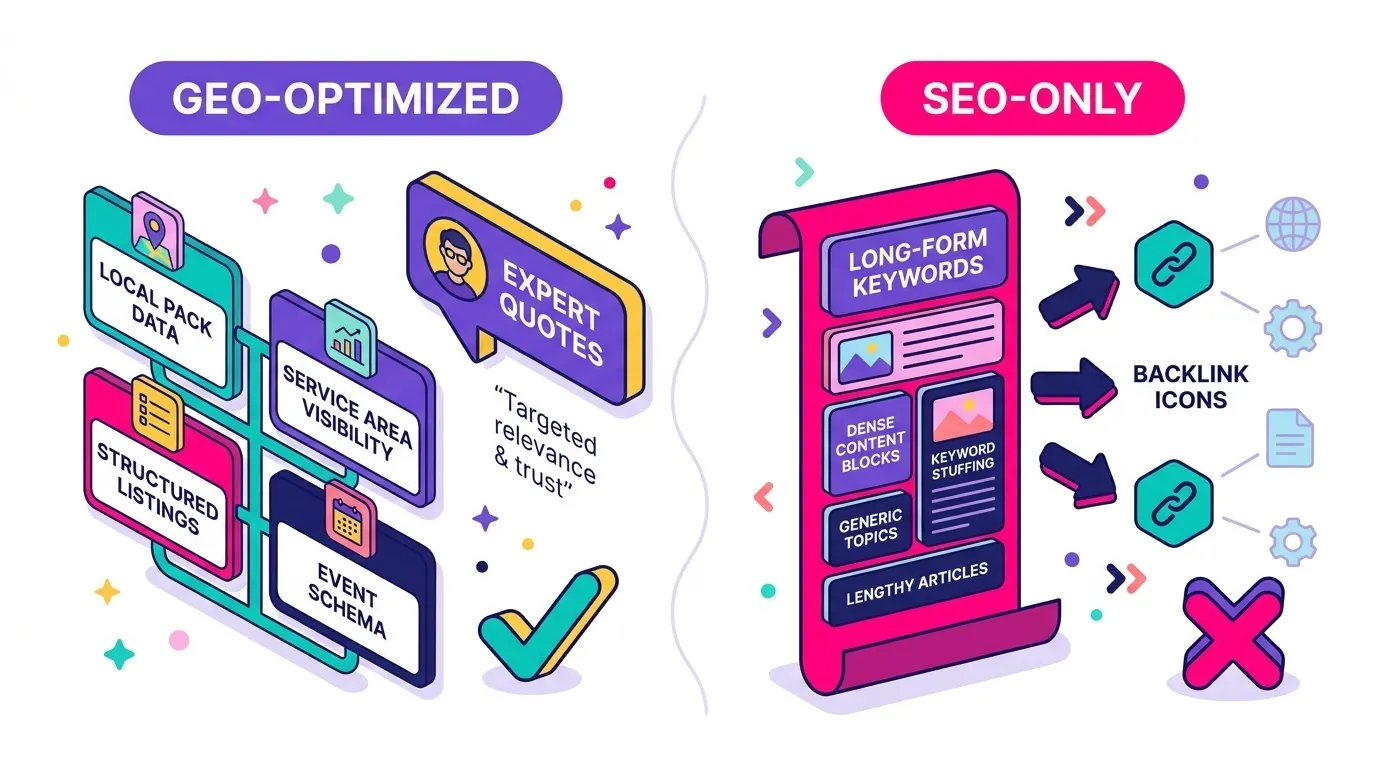
So what actually makes content GEO-friendly? A few concrete things: structured data that removes ambiguity about what a page is and does, clear direct-answer paragraphs that state the point before elaborating on it, entity-rich language that names specific products, ingredients, or concepts rather than vague pronouns, and original data points or quotable statements that a model can lift cleanly without paraphrasing risk.
That last part is the one most brands underestimate. Quotability now matters more than keyword density. AI models are, in a sense, looking for the same thing a good journalist looks for: a clean, well-attributed, fact-based sentence they can pull without distorting the meaning. Long-form copy stuffed with keywords doesn’t help a model summarize you; it just makes the extraction job harder. On the technical side, keep an eye on llms.txt, an emerging standard some sites are adopting to explicitly signal to AI crawlers what content is available and how it should be interpreted. It’s not universal yet, but it’s worth watching the same way robots.txt was worth adopting early.
What is the main difference between SEO and GEO?
SEO optimizes for search engine rankings and clicks. GEO optimizes for being referenced, quoted, or summarized directly inside AI-generated answers, often without a click at all.
SEO vs GEO vs AEO: A Side-by-Side Framework
Most articles on this topic stop at a two-way comparison: SEO versus GEO, full stop. That misses a discipline that’s been quietly growing for years and now sits right between the two: AEO, Answer Engine Optimization. AEO focuses on becoming the direct answer to a specific query, the featured snippet, the voice assistant response, the “position zero” box that’s existed since long before generative AI entered the conversation.
Treating these as three related but distinct disciplines, rather than treating “GEO” as just a rebrand of AEO or a subset of SEO, is genuinely important for building a strategy that doesn’t collapse the moment one algorithm shifts. Each rewards a different kind of signal, favors a different content format, and gets measured by a different set of numbers. Confusing them leads to wasted effort, like optimizing for backlinks when what you actually needed was a tighter FAQ block.
Ranking Signals vs Citation Signals
Here’s where the mechanics genuinely diverge. SEO still rewards backlinks and domain authority, the classic “vote of confidence” model. AEO rewards featured snippet eligibility and clean schema markup, structured enough that Google can lift a paragraph with confidence. GEO rewards semantic relevance and citation frequency, essentially how often and how cleanly a model can pull your content into its own generated response.
Content Format That Wins in Each
The format that performs shifts accordingly. SEO still rewards comprehensive, well-optimized long-form pages that cover a topic thoroughly. AEO rewards concise, structured Q&A content, tight enough to slot into a snippet box. GEO rewards data-rich, quotable, entity-dense paragraphs, the kind of writing that reads well even when lifted out of context and dropped into a chatbot’s response.
Metrics That Matter
The scoreboard changes too, and this trips up a lot of teams still reporting on last year’s KPIs. SEO success still shows up as rankings, organic traffic, and click-through rate in Search Console. AEO success shows up as snippet win rate and voice search appearances. GEO success shows up as share of AI citations and brand mention frequency across generative platforms, numbers that don’t live inside GA4 by default.
That tooling gap is worth naming directly. GA4 and Search Console remain perfectly valid for tracking SEO and AEO performance. GEO, on the other hand, requires new monitoring habits: manually checking AI Overview appearances for your priority queries, running prompt tests across ChatGPT and Perplexity, and building a citation audit that didn’t exist as a concept two years ago. We covered exactly how Google AI Overview is affecting SEO in more depth if you want the mechanics behind why this shift is happening in the first place. For a broader look at which numbers actually deserve a place on your dashboard as these disciplines multiply, our rundown of essential digital marketing KPIs is a useful starting point before you build new GEO-specific reports from scratch.
Dimension
SEO
AEO
GEO
Goal
Rank high in search results
Become the direct answer (snippet, voice)
Be cited/summarized in AI-generated answers
Content Format
Comprehensive long-form pages
Concise, structured Q&A
Data-rich, quotable, entity-dense paragraphs
Ranking Signal
Backlinks, domain authority, keywords
Schema markup, snippet eligibility
Semantic relevance, citation frequency
Key Metric
Rankings, organic traffic, CTR
Snippet win rate, voice results
Share of AI citations, brand mentions
Tools
GA4, Search Console, Semrush
Search Console, schema testing tools
Manual AI prompt audits, citation tracking
Timeline
Established, incremental gains
Established, competitive but stable
Emerging, fast-moving, less standardized
Why Is Generative Engine Optimization Important for eCommerce?
Here’s the stake stated plainly, because it deserves to be said without hedging: if your brand isn’t cited in AI answers, you’re invisible during a research phase that’s becoming more common every quarter, and that invisibility happens before a single ad dollar gets spent trying to reach that same shopper.
Zero-Click Search and the Shrinking Blue-Link Real Estate
AI Overviews and chat-based answers are physically compressing the search results page. Even when your page ranks well, there’s simply less scrollable real estate above the fold before a user reaches you, because a generated answer is sitting where the top organic result used to live. Industry researchers, including Gartner, have pointed to a meaningful decline in traditional search engine volume as chatbots and AI agents absorb queries that used to route through a browser search bar.
That creates a genuine paradox worth sitting with: a brand can technically “win” SEO, hold position one, and still lose the customer entirely if the AI-generated answer above that listing fully satisfies the query. Ranking well no longer guarantees being seen, let alone clicked.
Shoppers Are Asking ChatGPT and Gemini for Product Recommendations
The behavior shift underneath this is straightforward. Shoppers now ask AI assistants questions like “best clean skincare for combination skin” or “most durable carry-on luggage for frequent flyers” in a single conversational turn, replacing what used to be a Google search followed by three or four blog articles read side by side. The research phase hasn’t disappeared. It’s just moved somewhere your analytics can’t easily see.
Consequently, this connects directly to a pain point every DTC founder already loses sleep over: rising CAC. When a brand is invisible in that AI research layer, it doesn’t just lose “organic traffic” in the abstract, it loses a genuinely free, high-intent discovery moment. The brand then has to buy that same attention back through paid social or search ads, which pushes acquisition costs up further to compensate for a channel that used to convert without a media budget attached.
For this reason, GEO isn’t a trend piece to file away for “someday.” It’s a top-of-funnel visibility issue with a direct, measurable downstream effect on paid media efficiency and blended MER. Brands that treat it as optional are, in effect, quietly subsidizing their AI-answer invisibility with ad spend. If you want a related read on where visibility commonly leaks before it ever reaches this stage, the top eCommerce SEO mistakes we see most often is a good companion piece.
Examples of Companies Using GEO vs Traditional SEO
Theory is useful, but patterns are more convincing. Some brands have already adapted their content structure specifically to earn AI citations. Others remain focused purely on classic ranking tactics, and the gap between the two groups is starting to show.
Brands Winning AI Citations Through Structured, Expert-Authored Content
The pattern among GEO-forward brands is fairly consistent once you know what to look for: original data, clear comparison tables, quotes attributed to a named expert or founder, and FAQ-style direct answers that an AI model can lift cleanly without needing to interpret or reword much. A DTC skincare brand that publishes an ingredient-concentration comparison guide (say, “retinol vs bakuchiol for sensitive skin,” complete with a data table and a dermatologist quote) gives a model exactly the kind of clean, attributable material it wants to cite when someone asks “what’s a gentler alternative to retinol.” The same pattern shows up in home goods brands publishing material-durability comparisons, or supplement brands publishing dosage-and-ingredient breakdowns instead of just marketing copy.
Pattern to watch: brands earning AI citations tend to publish content that reads like a reference document, not an ad. Structured comparisons, named experts, and specific numbers travel well inside generative answers. Vague brand storytelling doesn’t.
Brands Still Purely SEO-Optimized and What They’re Missing
On the other hand, plenty of established, otherwise well-run brands remain heavy on keyword-optimized long-form content and backlink-building, without a single concise, extractable answer block or a line of structured data anywhere on the page. These brands frequently still rank well, and their organic traffic can look perfectly healthy on a monthly report.
The gap only becomes visible when you check citation rate specifically, meaning how often that brand’s content actually gets surfaced or quoted inside AI-generated responses for its category terms. SEO-only brands often show up at or near zero there, even while their SERP rankings hold steady. That’s not a crisis today. But it is a slow accumulation of zero equity in a layer of search behavior that keeps growing its share of the overall research journey, and equity built later is always more expensive to build than equity built early.
GEO vs Traditional SEO: Ecommerce Performance Impact
This is where the question every performance-minded reader actually cares about lives: how does this shift affect measurable eCommerce performance, not just theoretical visibility?
What Changes in Traffic, Attribution, and Conversion Paths
GEO-driven visibility often doesn’t show up as a clean session in GA4, and that’s the uncomfortable part for anyone used to a tidy attribution model. A user might see your brand mentioned inside a ChatGPT answer, form an impression, close the tab, and then search your brand name directly on Google two days later, or type your URL straight into the browser. That later visit gets logged as branded organic or direct traffic. The AI citation that actually triggered the awareness leaves no trace in the reports at all.
Contrast that with the traditional organic funnel, which is fully trackable end to end: search, click, landing page, convert, all visible in a single GA4 path. The AI-referral funnel looks structurally different: prompt, AI-generated answer with a citation, brand awareness formed, later direct or branded visit, harder to attribute but often carrying higher intent by the time the visit happens.
Why AI Citations Carry a Trust Premium
There’s a trust implication worth naming here too. Being cited inside an AI answer functions a lot like a third-party endorsement, arguably a higher-trust touchpoint than a ranked blue link, precisely because the user didn’t have to sift through options themselves; the AI already did some of that filtering. It’s less trackable, sure, but it may be doing more persuasion work per impression than a standard organic click ever did.
So how should brands adjust their measurement expectations? Start tracking branded search volume as a leading indicator of AI-driven awareness lift, manually monitor AI Overview appearances for priority category terms, and treat GEO less like a last-click acquisition channel and more like an upper-funnel trust investment, closer in spirit to how you’d evaluate a podcast sponsorship than a Google Shopping campaign. Tools like GA4 and Microsoft Clarity still matter here; they just need to be read with this new context in mind rather than expected to capture the whole picture on their own.
Aspect
Traditional Organic Funnel
AI-Referral Funnel
Path
Search → click → landing page → convert
Prompt → AI answer with citation → awareness → later direct/branded visit
Trackability
Fully trackable in GA4
Largely invisible, appears as direct/branded traffic
No. And I want to be direct about that, because the “vs” in this article’s title is about understanding the differences between these disciplines, not about picking a side in a competition that doesn’t actually exist.
SEO and GEO share the same foundation. Both reward structured data, topical authority, clear writing, and genuine, demonstrable expertise. E-E-A-T isn’t an SEO-only concept anymore; a model deciding whether to cite you is running its own informal version of the same trust check Google has been formalizing in its structured data guidelines for years.
The real difference isn’t quality bar, it’s distribution layer. SEO gets you found inside the search results page. GEO gets you found inside the answer itself, sometimes before the results page is even rendered. Same underlying substance, different delivery mechanism.
Here’s the practical takeaway that should actually make this feel manageable rather than overwhelming: if you already invest in strong, well-structured, authoritative SEO content, you’re roughly 70% of the way to being GEO-ready already. This is a refinement of what you’re doing, not a rebuild from zero. Our guide on building an effective SEO content strategy is a good place to check whether that base layer is as solid as it needs to be before layering GEO tactics on top.
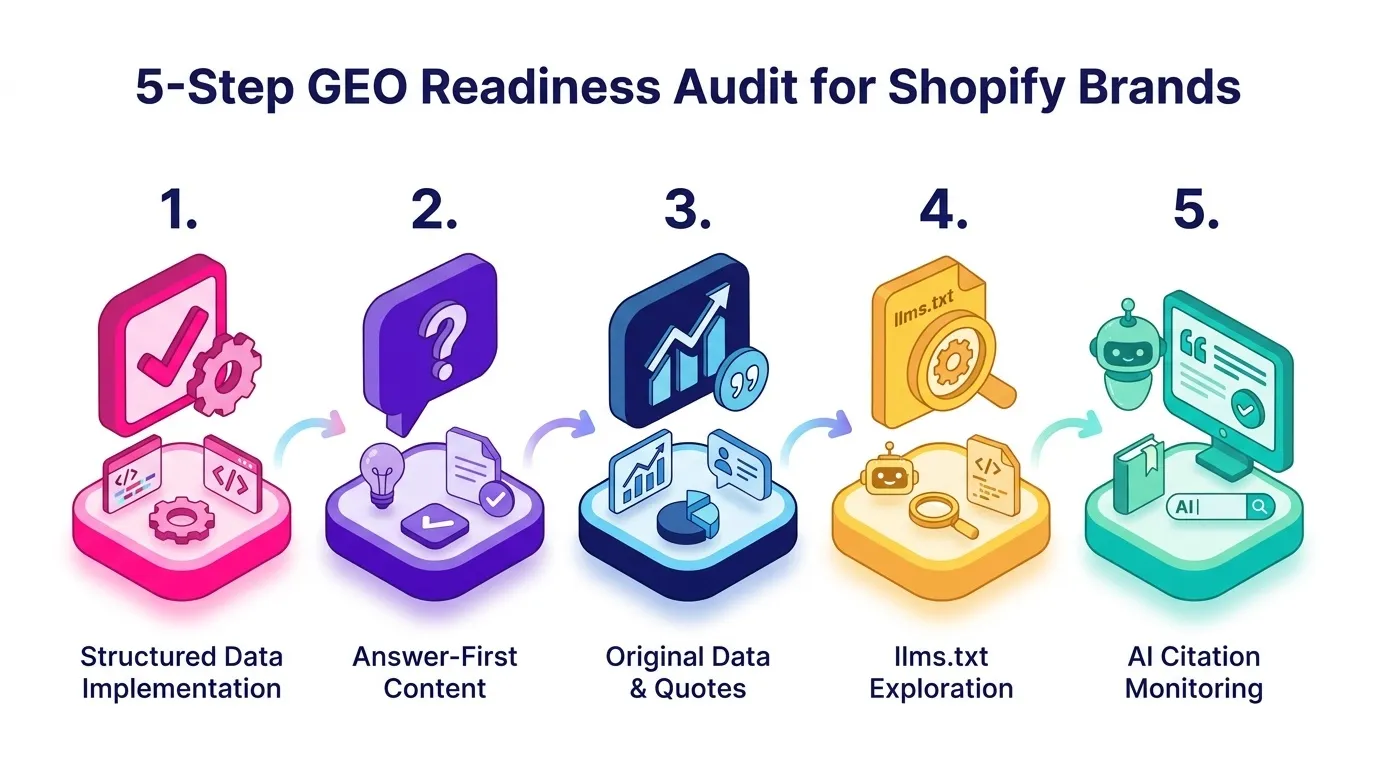
How to Start Optimizing for GEO: A Practical Checklist
Consider this a starting point, not a full site overhaul. The goal here is low-lift, high-impact actions you can realistically run this week, not a six-month roadmap that never gets prioritized.
1. Implement structured data. Product schema, FAQ schema, and Article schema give AI crawlers an unambiguous way to parse what your page actually is and what it’s claiming, rather than making a model guess. This pairs particularly well with broader product page optimization efforts, since a well-structured page tends to satisfy both shoppers and AI crawlers at once.
2. Rewrite key pages with answer-first paragraphs. Put the direct answer near the top of the page, before the elaboration. This helps AI models extract value quickly, and it helps impatient human skimmers too, which is a nice two-for-one.
3. Publish original data, quotes, or proprietary insights. Something a model can’t get from a competitor’s page is something worth citing. A proprietary customer survey, an internal benchmark, a founder quote with a specific number attached, these all raise citation likelihood meaningfully.
4. Explore llms.txt implementation. It’s optional and still emerging, but forward-looking brands are already testing it as a way to explicitly signal what content is available to AI crawlers and how it should be read.
5. Start manually monitoring AI citations. Run your top branded and category queries through ChatGPT, Perplexity, and Google’s AI Overviews on a recurring basis. You’re establishing a citation-rate baseline, the same way you once established a rank-tracking baseline for SEO.
If this checklist surfaces a bigger restructuring need, particularly around URL architecture or content consolidation, our complete SEO migration guide covers how to do that without losing the rankings you’ve already earned. And if conversational AI is becoming a discovery channel for your category, it’s worth glancing at how chatbot marketing strategies are already being used on the lead-gen side, the underlying logic transfers surprisingly well to eCommerce.
FAQ: Quick Answers on SEO, AEO, and GEO
Is GEO replacing SEO?
No. GEO is an additional optimization layer for AI-generated answers. SEO remains essential for traditional search visibility and click-through traffic, and the two are expected to keep operating side by side.
Do I need entirely new content for GEO, or can I reformat existing content?
Most brands can adapt existing high-quality content rather than starting from scratch. Add structured data, direct-answer paragraphs, and at least one original data point, and you’ve covered most of the gap.
How do I measure GEO success?
Track AI Overview and chat citation appearances manually, monitor branded search volume for lift, and treat GEO as an upper-funnel trust metric rather than a last-click conversion channel.
What’s the difference between AEO and GEO?
AEO focuses on becoming the direct answer to a specific query, like a featured snippet. GEO focuses on being cited or referenced within broader, conversational AI-generated responses.
Final Thoughts: Building a Search Strategy That Works for Both Humans and AI
SEO and GEO aren’t rivals fighting for the same budget line. They’re two layers of the same visibility strategy, and ignoring either one leaves real growth sitting on the table, growth that’s currently going to whichever competitor bothered to structure their content properly.
As AI-assisted research keeps expanding its share of how people shop, and there’s no realistic scenario where that trend reverses, brands that invest early in structured, quotable, authoritative content will compound a visibility advantage that gets genuinely difficult for latecomers to close. This isn’t a sprint you can catch up on in a quarter; it’s closer to compound interest.
Our own approach at Midsummer stays true to what we tell every client: start with what’s measurable today, not what’s speculative. That means AI Overview tracking and citation audits before chasing every emerging tactic that shows up in a LinkedIn thread. It’s the same heuristic-first mindset we apply to Conversion Rate Optimization, applied here to a newer, faster-moving layer of search.
Where to Start This Week
If you’re not sure where your brand currently stands in AI-generated answers, that’s genuinely the right place to start, not with a full GEO overhaul. Take a look at our guide to setting up AI Overview tracking, run it against your top five category queries, and see what comes back. That single exercise will tell you more about your real visibility than another week of rank-tracking ever could.
Ready to understand exactly where your store stands, across both traditional SEO and this new AI-answer layer? Revisit our complete guide to eCommerce SEO to check your foundation, or explore Midsummer’s SEO and GEO services if you’d rather have a team run the audit and build the roadmap with you.
We’ll dig into your current rankings, your technical foundation, and your actual citation footprint across AI Overviews and chat assistants, then tell you plainly what’s working, what’s leaking, and what to fix first.
Let’s make sure your brand gets found, wherever the question is actually being asked.