

Paid Social
Meta Catalog Ads: How to Leverage Advantage+ for Sales Growth
Explore how Meta Advantage+ Catalog Ads can help boost your ecommerce sales, optimize ad performance, and drive higher conversion rates.
Read MoreMeta no longer recommends one catalog per market. Here’s why a single localized catalog performs better for multi-country campaigns, and how to restructure yours without breaking…


Meta no longer recommends a separate catalog for each country or market. The current best practice is one single catalog with localized overrides (language, currency, price, availability, shipping) applied at item level. The reason is signal, not tidiness: splitting the same products across multiple catalogs splits the conversion data Advantage+ campaigns learn from, which stretches the learning phase in every market at once instead of only in the small ones.
If you sell into three or more countries from one Shopify store, there’s a decent chance your Meta setup is built on advice that Meta itself has now walked back. This article covers what changed in catalog localization, the signal mechanics behind the change, how the override logic maps onto Shopify Markets, and a migration path that doesn’t torch your retargeting. It also covers the part nobody writes about: what stays painfully manual after consolidation.
Most multi-market accounts I inherit contain the same artifact: four or five catalogs, each one holding near-identical SKUs, each feeding its own market-specific ad sets. DE catalog, FR catalog, UK catalog, “EU rest”, and usually one orphan catalog nobody can explain. Somebody built that carefully, and at the time they were following best practice. Now that same structure is the thing Meta tells you to undo.
The old guidance was simple enough to follow and expensive to maintain: one catalog per market or per language, each with its own feed file or feed app connection, each with its own refresh schedule, its own error log, its own sync problems. The new guidance collapses all of it. You keep one catalog as the source of truth, then apply localized values per country and language at the item level.
Structurally, the difference is where the market-specific information lives. In the old model, the market was the catalog: five markets, five feeds, five sets of product IDs, five places where a price change could go wrong. In the new model, the market is a layer on top of a single product record, so one SKU keeps one identity and simply carries different values depending on who sees it. The product data stays in one place. Only the overrides multiply.
| Catalog per market (old) | Single localized catalog (new) | |
|---|---|---|
| Product identity | Same SKU duplicated across catalogs with different IDs | One SKU, one ID, one record |
| Feed sources | One feed per market, each with its own sync and error log | One primary feed plus localization overrides |
| Conversion signal | Split per catalog, each one learning on a fraction of volume | Pooled at item level across all markets |
| Maintenance | Price or stock change replicated manually in N places | Changed once, overridden where needed |
| Failure mode | Silent drift between markets, mismatched prices, stale items | Missing localization fields leave a market under-optimized |
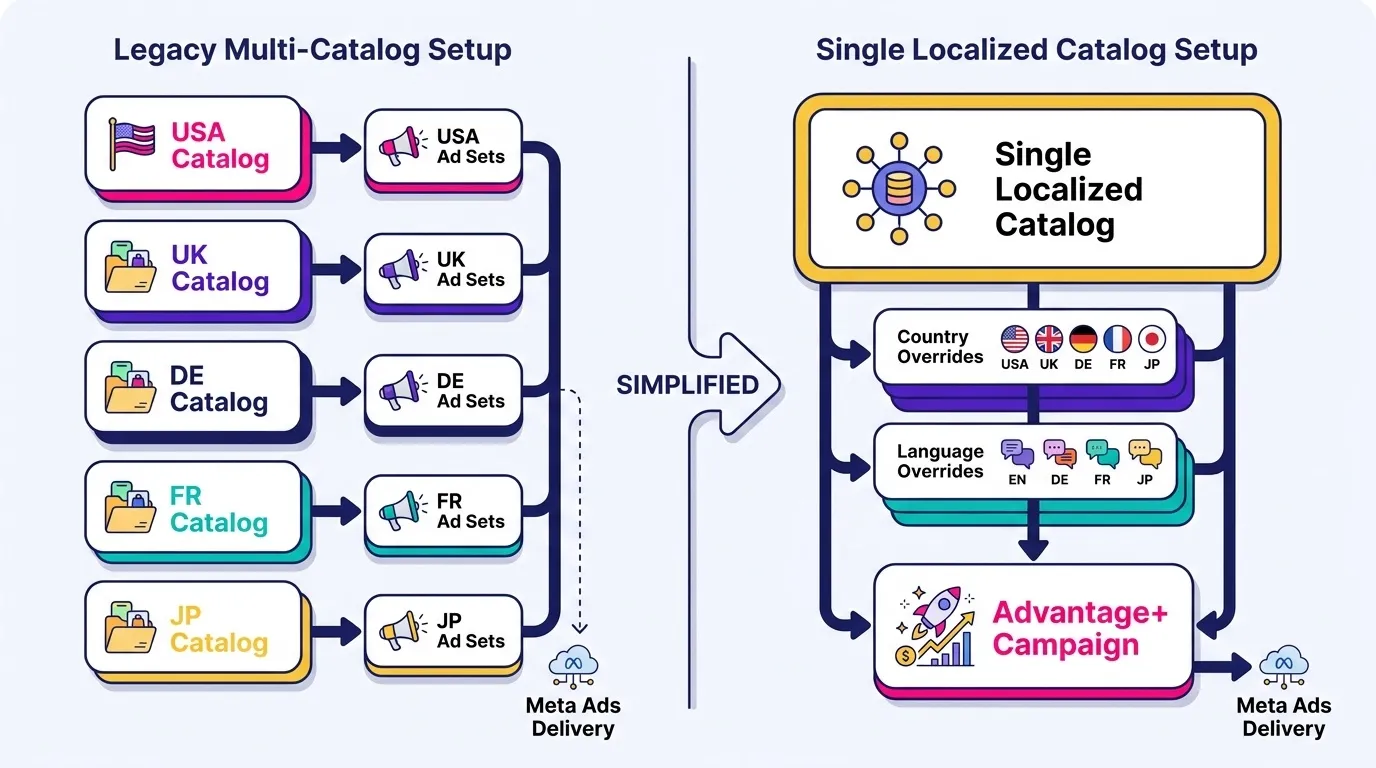
Advantage+ catalog ads do not learn about “your account” in the abstract. They learn at the item level: which product, shown to which person, in which context, produced a purchase. That signal is attached to the catalog item. So when the same sweater exists as five separate items in five separate catalogs, you have not built five optimized markets. You have built five underfed ones.
That’s the part that gets missed. Fragmenting a catalog doesn’t hurt proportionally, it hurts everywhere. Your biggest market loses the ability to inform your smallest, and your smallest never accumulates enough events to exit the learning phase on its own. Performance plateaus at a lower ceiling in all of them simultaneously, which is exactly the pattern that makes people blame creative fatigue when the problem is structural. If you want the full mechanics of how these campaigns consume feed data, we covered them in our guide to Meta catalog ads and Advantage+.
This is the same logic I apply to everything else in an account. Concentrated signal wins, fragmented signal loses, and almost every “the algorithm stopped working” conversation I have eventually traces back to data being split into pieces too small to be useful. It’s the identical argument behind building a first-party data strategy for ecommerce: fewer, richer signal sources beat many thin ones.
Should you use one catalog or separate catalogs for each country in Meta ads? One catalog, with country and language localization overrides. Separate catalogs per market now work against you, because they split the conversion signal the algorithm needs to optimize, and they multiply your maintenance surface for no performance benefit.
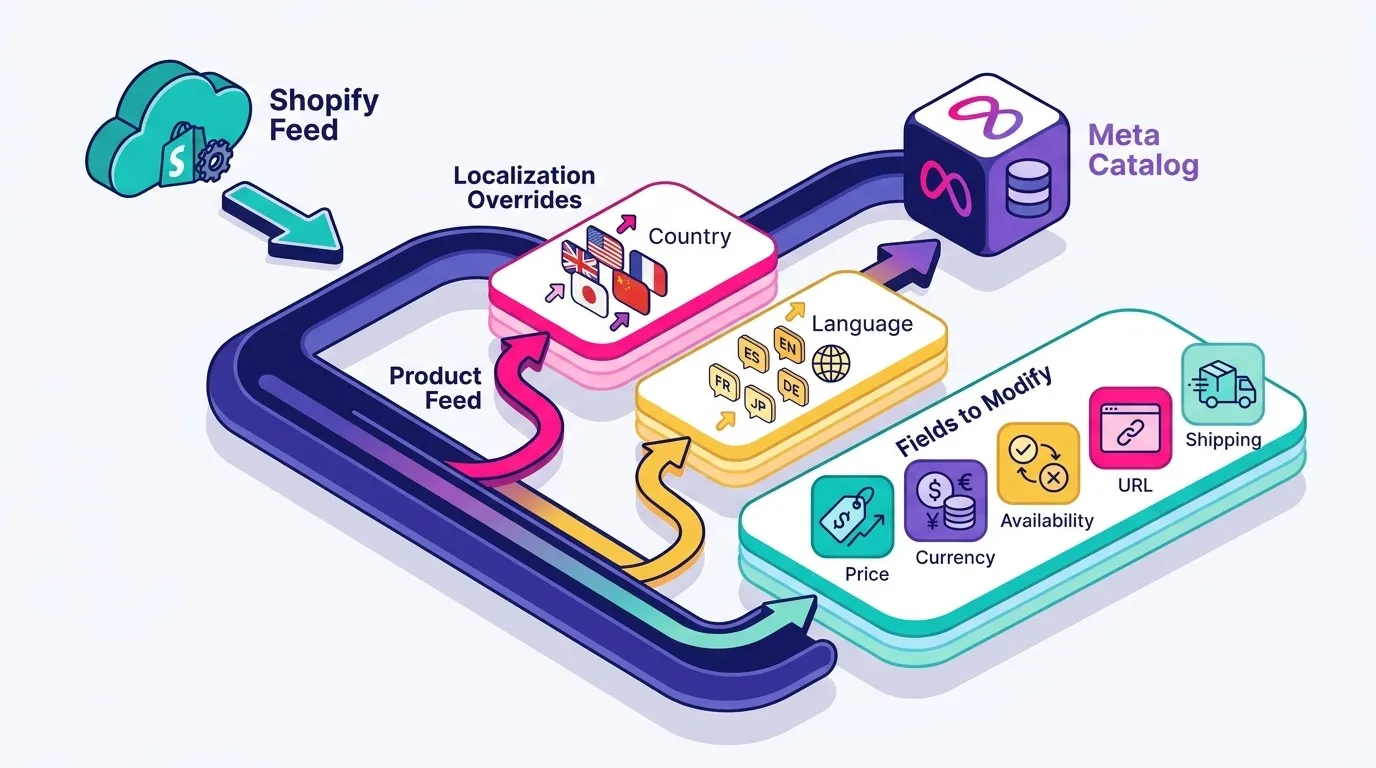
Localization means you keep one base product record and override only the fields that genuinely change by market. Price and currency, availability, title and description, product URL, shipping information. Everything else stays universal: the SKU, the identity of the item, its images, its category, its relationship to the rest of your product set.
What changes per market is usually narrower than people assume. Currency and price (including sale price), availability flags tied to regional stock, the landing page URL so a German shopper lands on the German storefront, the title and description in the right language, and shipping or delivery information. What should never change is the product’s core identity. Same item, same ID, different clothes on top. The practical test I use: if two markets would ever need different values for a field, it’s a localization field. If not, leave it in the base feed and stop touching it.
If you’re on Shopify or Shopify Plus, Shopify Markets already holds most of this information. You’ve configured regions, currencies, market-specific pricing, translated content and domain or subfolder structures. Meta’s localization layer works best when you treat Shopify as the single source of truth and let the market definitions mirror each other one to one: one Shopify market, one localization bundle, same language and country pairing on both sides.
The mismatches are where things break. A market defined in Shopify but missing from your localization bundles means those users see base-currency prices. A bundle configured in Commerce Manager for a market your store doesn’t actually support means ads driving traffic to a checkout that can’t serve them. The feed logic here is close to what happens on the Google side, where country and language targeting in Merchant Center follows the same discipline. We walked through that setup in how Google Merchant Center works with Shopify, and if you’re running both channels, aligning the two saves you from maintaining two different versions of the truth.
One catalog does not mean one less spreadsheet. I say this to clients before every migration, because consolidation solves a signal and structure problem, and it solves nothing about selling across borders.
Tax, customs and compliance stay exactly where they were. EU VAT handling and registration thresholds, duties on shipments leaving the UK or entering the US, delivery-time disclosures that are legally required to be accurate in some markets and merely advisable in others, return policies that differ per country. Availability flags are the one that bites hardest in practice: if your Italian warehouse is out of a shade and your Dutch one isn’t, the override has to reflect real regional stock, or you’re paying to advertise something a specific audience cannot buy.
For a Fashion or Beauty brand in the $1M to $20M range, this is usually the moment somebody discovers that the market-specific work was never really in the catalog. It was in operations, and the catalog was just where the mess surfaced.
Before merging anything, I treat the existing catalogs the way I’d treat evidence spread across several case files: lay it all out, identify what’s actually the same item wearing different IDs, and decide what gets kept, merged or thrown away. Map every SKU across every catalog, flag the duplicates, and find the items that only exist in one place (there are always a few, usually market exclusives nobody documented). Then pick your single feed source. For Shopify stores that’s normally the native integration or a feed tool like DataFeedWatch, not a manual CSV somebody uploads when they remember to.
The approach is the same one we use in a PPC audit: understand what’s there before you change it, because the thing that looks redundant is occasionally the thing holding a market together.
The ones I see most often, in rough order of how much they hurt:
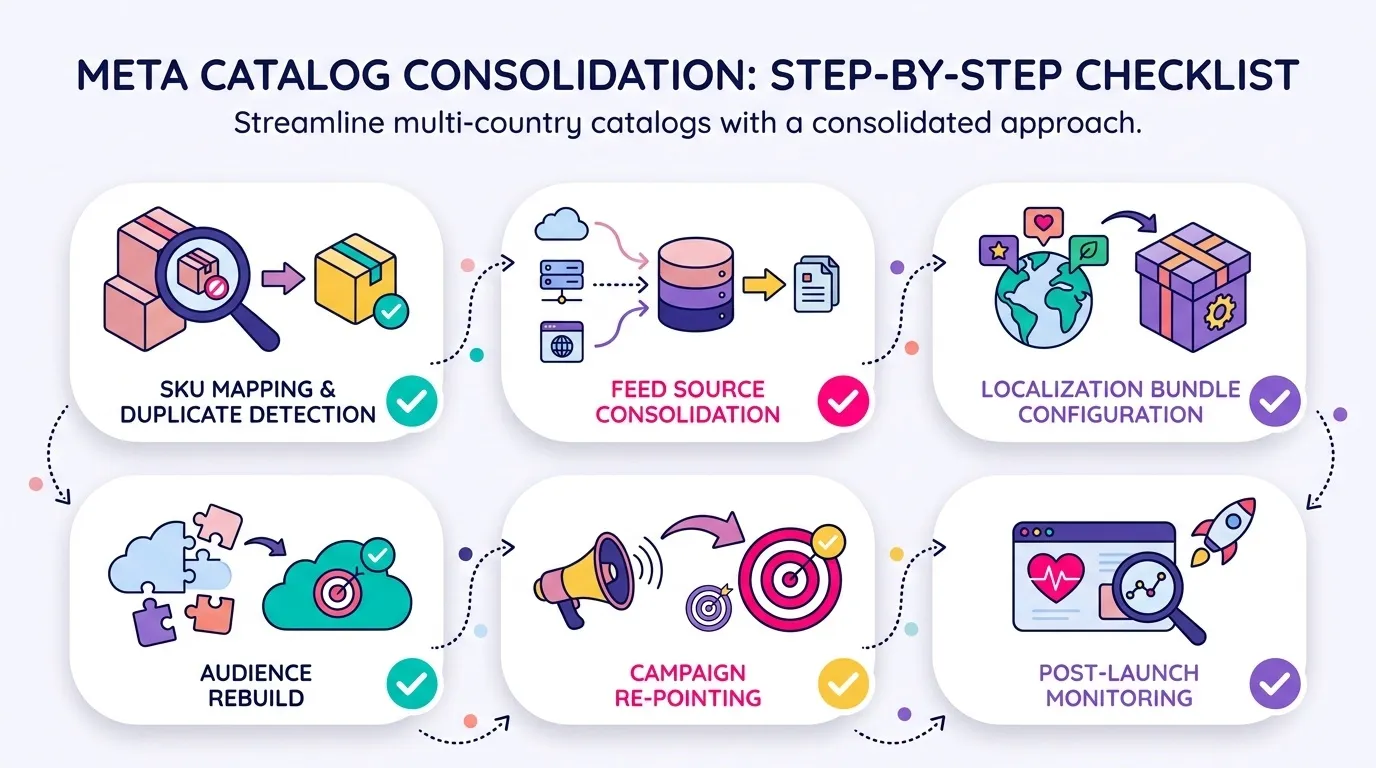
The catalog is the easy half. Once it merges, ad sets pointing at retired catalog IDs stop serving or quietly fall back to the wrong product set, so every Advantage+ shopping campaign touching those catalogs needs to be re-pointed or rebuilt. Audience exclusions need the same treatment: if you were keeping Market A purchasers out of Market B retargeting by using separate catalogs as a crude boundary, that boundary no longer exists and has to be reconstructed with proper audience logic.
Creative deserves a look at the same time, because localized catalog fields feed directly into dynamic templates. Localized titles and prices only help if the surrounding creative is built to carry them, which is worth checking against your existing Meta creative setup rather than assuming the feed will do the work alone. Formats that pull multiple catalog items into one unit, like collection ads, benefit most from clean localized data.
Expect a dip. Merging catalogs resets item history in practice, so you’ll usually pass through a short re-learning window before the pooled signal starts paying off. I plan for it openly rather than promising an immediate lift, because a migration that looks like a performance drop in week one gets reversed by week two if nobody warned the client.
When we take over a multi-country paid social account, the catalog audit happens before anyone touches campaign settings. We map SKUs across every existing catalog, line up the market definitions against the client’s Shopify Markets configuration, and document which audiences and ad sets depend on which catalog IDs. Only then do we plan the merge, usually market by market rather than all at once, so there’s a controlled window where we can see what moved and what broke.
We run the post-migration monitoring in GA4 and the platform side in parallel, because feed-level changes show up differently in each. And we tell clients the honest version up front: the structural win is real, the first two weeks are noisy.
One catalog, localized at item level, with the market-specific values layered on top instead of duplicated into separate feeds. The win is pooled conversion signal, which is what Advantage+ needs to optimize, and a maintenance surface that stops multiplying every time you open a country. Tax, duties, shipping disclosures and real regional stock stay outside the catalog, where they always were.
If you’re running multi-country Meta ads right now, the short version of the work:
Structural fixes like this are the kind of thing that quietly caps performance for months, which is also why they’re worth checking before you push more budget into a market. If you’re planning to scale after the merge, our notes on scaling ROAS-positive campaigns pair well with a freshly consolidated catalog.
Want a second pair of eyes on your multi-market setup before you start merging anything? Take a look at our Paid Social services or ask us for an account audit.
We’ll go through your catalogs, your localization bundles and your campaign structure, tell you exactly what’s splitting your signal, and map the migration order that puts your biggest market at the least risk.