

SEO
Structured Data in SEO: What It Is and Why It Matters
Learn what structured data is in SEO, how schema markup works, and whether it actually helps rankings, with copy-paste examples for Shopify stores.
Read MoreGenerative engine optimization works differently when you sell thousands of SKUs. Here’s why large catalogs need an entity and data-infrastructure fix, not a content rewrite, to…


For catalogs with thousands of SKUs, Generative Engine Optimization (GEO) isn’t a content rewrite, it’s an entity and data-infrastructure fix. AI engines like ChatGPT and Gemini cite a handful of named products per answer, not ranked lists, so getting cited depends on clean Product/Offer schema, consistent identifiers (GTIN, MPN, SKU), and accurate merchant feed data, all fixed once at the template level so every SKU inherits it automatically. Prioritize high-revenue categories for extra content and reviews, track AI referral traffic in GA4, and treat feed hygiene as an ongoing GEO task, not a one-off Shopping Ads chore.
If you manage a Shopify catalog with thousands of SKUs, you’ve probably already read a Generative Engine Optimization (GEO) checklist that told you to “write clearer answers” and “add FAQ sections.” Good advice, in theory. Completely unworkable when you’re staring at a spreadsheet with thousands of product rows and a content team of two.
Let’s define this properly first. GEO for ecommerce with a large catalog is the practice of structuring product data, entity signals, and page templates so AI systems like ChatGPT, Gemini, and Google AI Overviews can extract, verify, and cite specific products, not just crawl and rank category pages the way traditional search engines do. It’s less about prose and more about plumbing.
That distinction matters because at catalog scale, GEO stops being a content problem and becomes an entity and data-infrastructure problem. You can’t hand-write your way to AI citation across thousands of pages. You can, however, fix the systems that generate those pages, and that fix propagates everywhere at once.
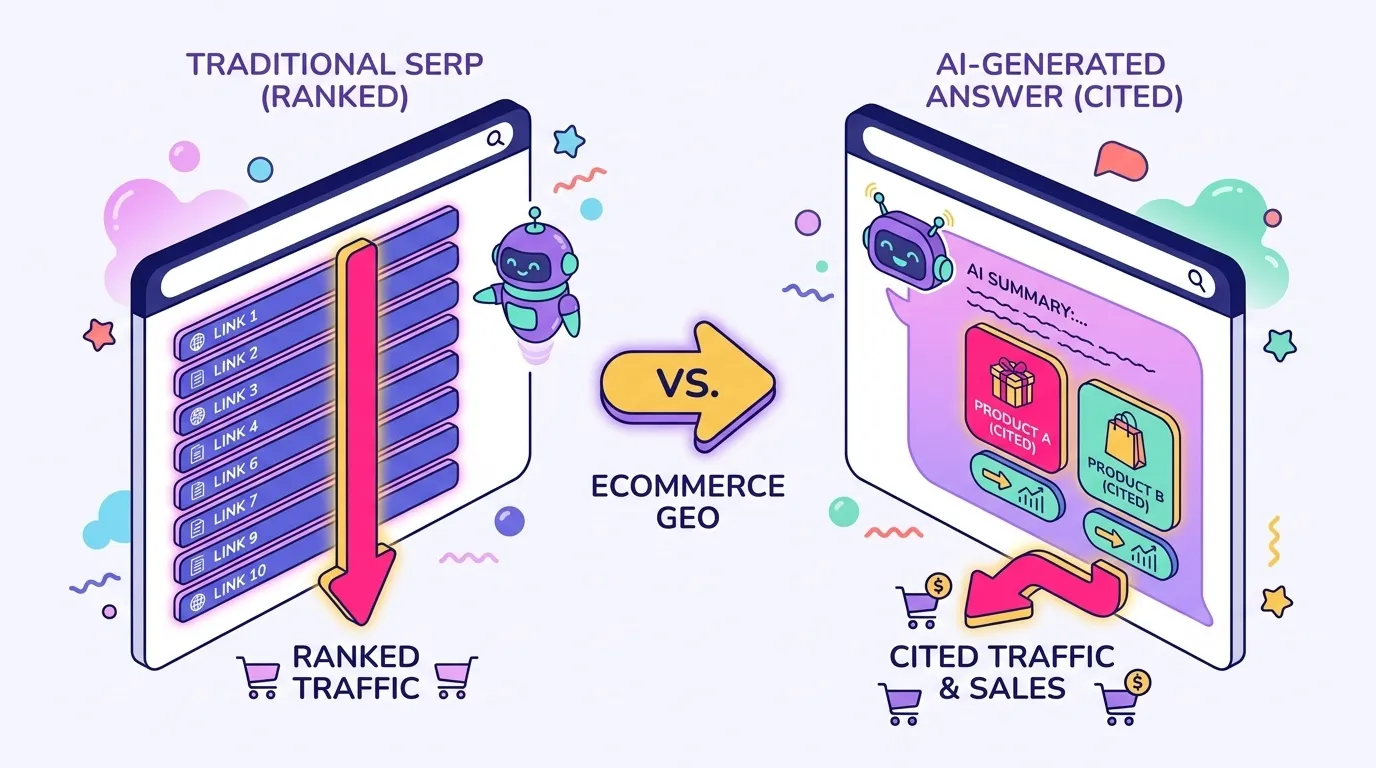
Here’s the short version, because it’s worth stating plainly before we go deep: ranking gets you a position in a list. Citation gets you named as the answer. For a catalog too large to optimize product by product, the only realistic path to citation runs through templates, schema, and feed data, not through rewriting descriptions one SKU at a time. Generative Engine Optimization is still an emerging discipline, and most of what’s written about it assumes a handful of hero pages. This article assumes you have thousands. If you want the foundational concept first, we covered the core SEO vs. GEO distinction in a separate piece, and it’s a useful primer before what follows.
Traditional SEO trained us to think in terms of position. Page one, top three, featured snippet. AI answers don’t work that way, and confusing the two mental models is the single most common mistake I see large catalogs make when they start “doing GEO.”
A citation is different from a rank. It’s when an AI engine names a specific product, spec, or brand as the answer to a question, rather than showing ten blue links for the user to sort through themselves. There’s no position ten. There’s just: named, or not named.
Take a query pattern relevant to a beauty DTC brand: “best clean skincare for sensitive skin under $40.” A user typing that into ChatGPT or Gemini isn’t shown a results page. The engine picks (usually) two to four specific products, names them, and states why. If your moisturizer isn’t among those two to four, it doesn’t exist for that query, no matter how well its PDP ranks in classic Google search.
This is why I call it winner-take-few rather than winner-take-all. A SERP has ten visible slots plus an ads block. An AI answer typically surfaces a handful of named entities. That’s a much smaller stage, and it means competition for citation is fiercer per query, even if the total number of queries where AI answers appear is still growing.
For a catalog with thousands of SKUs, the arithmetic is blunt: most of your products will never be individually cited, ever, no matter how much effort you put in. That’s not a failure of strategy. It’s the nature of the format. It’s also exactly why prioritization and template-level fixes, which I’ll get to shortly, matter more here than they ever did in classic SEO.
Backlinks, keyword density, domain authority: these signals still influence whether Google ranks your category page. However, they don’t carry the same weight when an AI model decides which specific product to name in an answer. What matters more there is whether the data behind that product is structured, verifiable, and extractable without ambiguity.
In other words, AI engines optimize for confidence before they optimize for authority. A model would rather cite a mid-tier brand with clean, unambiguous Product and Offer schema than a well-known brand whose price, availability, and specs are buried in unstructured paragraph copy. Confidence beats reputation when the model is trying to avoid a wrong answer.
I’ve seen this play out on PDPs that rank comfortably in the top five of Google’s organic results, yet get skipped entirely by AI Overviews, because the page’s schema markup is incomplete or the price shown in the visible copy doesn’t match what’s in the structured data. The page ranks. It doesn’t get cited. Two different games, two different scorecards, as we explored when AI Overviews started reshaping traditional SEO signals.
That gap between ranking and citation is precisely why large catalogs need a different playbook than the generic “write better answers” advice circulating right now. It’s not about better writing. It’s about better data.
Most GEO advice you’ll find online was written with a blog or a B2B site in mind, ten to twenty pages, maybe fifty at the outside. Apply that advice literally to a Shopify Plus store with thousands of active SKUs, and it collapses immediately.
The standard GEO recipe: rewrite the copy to answer specific questions directly, add an FAQ block, clarify claims with numbers instead of adjectives. This works fine, genuinely well even, when applied to ten or twenty hero SKUs. Your bestseller, your flagship, the products your paid media budget already leans on.
The math breaks down fast beyond that. A catalog running into the thousands cannot be manually rewritten SKU by SKU within any budget or timeline that makes commercial sense. Even at an optimistic thirty minutes per product (research, rewrite, schema check, QA), you’re looking at hundreds of work-hours just to touch the catalog once.
The opportunity cost is the real damage here. Teams that attempt manual optimization end up polishing a tiny, visible slice of the catalog, usually the same twenty products marketing already loves, while the long tail stays exactly as invisible to AI engines as it was before the project started. Effort spent, outcome flat.
The alternative isn’t “optimize faster.” It’s optimizing a different layer entirely: the system that generates the pages, not the pages themselves.
Structured data is the rhythm section of your catalog. Get the bass and drums locked in once, and every instrument on stage, every product, plays in time without needing individual coaching. Skip that layer, and no amount of clever guitar work up front fixes the fact that the band, as a whole, sounds off.
Here’s why that metaphor holds up technically: Shopify and Shopify Plus catalogs are template-driven. Your PDP template and your category (collection) template generate output for thousands of SKUs from shared underlying logic, usually Liquid code plus theme settings, sometimes layered with apps. Change something at the template level, and every page built from that template inherits the change instantly.
That’s the leverage point classic content optimization doesn’t have. A manual copy rewrite touches one page. A template-level structured data fix, done once, propagates across the entire catalog the moment it deploys. No queue, no backlog, no “we’ll get to the rest next quarter.”
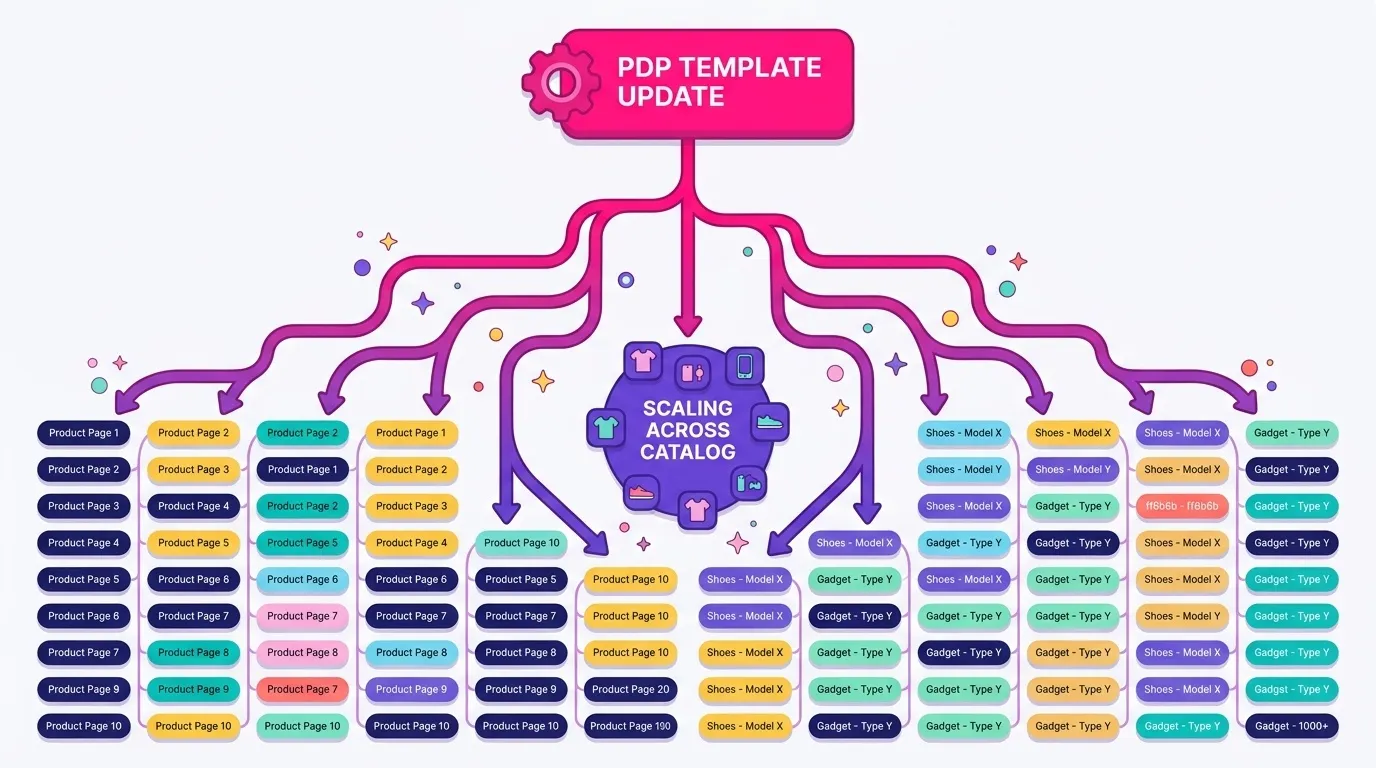
Everything from here builds toward exactly this: a template-level checklist you can action once and trust to hold for every SKU that comes after it.
Let’s get concrete about what AI crawlers are actually parsing when they decide whether a product is trustworthy enough to cite. This is the technical core of the whole article, so bear with the density.
Four schema.org types matter most for product entities: Product, Offer, AggregateRating, and Review. Together they tell a crawler what the item is, what it costs and whether it’s in stock, how it’s been rated, and what actual buyers have said about it.
Within Product and Offer, a handful of fields are non-negotiable: name, price, priceCurrency, and availability, per Google’s own structured data guidelines for products. Miss any of those and you’re asking the model to guess, which it generally won’t do when the stakes involve citing something as fact. AggregateRating and Review are enrichments, genuinely valuable ones, but the engine can still function without them; it just has less corroborating evidence to work with.
The real damage happens when schema is inconsistent across a catalog rather than simply absent. A model encountering incomplete or contradictory structured data on a given product doesn’t take a leap of faith. It skips the product and moves to the next candidate that gave it cleaner information. I call this an “entity gap,” and at scale it’s usually invisible until you audit for it systematically.
On Shopify specifically, the common failure mode is theme-generated schema that works fine for a handful of test products during setup, then quietly breaks or omits fields as apps get layered on top, variants get added, or the theme updates. Nobody notices because nothing “breaks” visually. The page still renders. The schema just stops being trustworthy at scale, which is exactly what we detailed in our piece on structured data foundations for ecommerce.
| Data Source | Field | Required? | Why AI Parsers Care |
|---|---|---|---|
| Product Schema | name, description, brand | Required | Establishes the base entity identity the model resolves against other sources |
| Offer Schema | price, priceCurrency, availability | Required | Confirms the product is purchasable now, at a verifiable price |
| AggregateRating | ratingValue, reviewCount | Recommended | Adds corroborating social proof the model can cite alongside the product |
| Merchant Feed | GTIN, MPN, product_category | Required | Acts as a second, cross-checkable entity source outside the page itself |
Here’s a shift that’s easy to miss: AI engines increasingly draw on the same feed data that powers Google Shopping and Google Merchant Center, not exclusively on-page schema. Your product feed is becoming a second, parallel entity source, and it’s one most GEO conversations ignore entirely.
Feed attributes like GTIN (Global Trade Item Number), product_category, custom_labels, and availability function as an independent verification layer. If your on-page schema says a product is in stock but your feed says otherwise, that inconsistency is exactly the kind of confidence-killer that gets a product quietly excluded from an AI answer.
This means feed hygiene, something we’ve historically framed purely as a Shopping Ads lever, is now also a GEO lever. The same discipline that keeps your Merchant Center account healthy for paid campaigns is doing double duty for AI citation eligibility.
We’ve built a fair amount of hands-on expertise here specifically because Shopify’s native feed export doesn’t always map cleanly to what Merchant Center (and by extension, AI systems drawing on similar data) expects. If you haven’t looked at your feed setup recently, our guides on Google Merchant Center and Shopify and a full Merchant Center setup walkthrough are the practical starting point.
AI engines need to confirm they’re talking about the exact same product when it appears across your site, your feed, marketplaces, and third-party review sites. Identifiers, GTIN, MPN (Manufacturer Part Number), and internal SKU, are how that confirmation happens.
When those identifiers are inconsistent, different SKU formats between your PIM (Product Information Management) system and your live feed, missing GTINs on a chunk of the catalog, the entity resolution AI relies on simply breaks. The model can’t confirm it’s the same product across sources, so instead of citing confidently, it either skips the product or, worse, conflates it with something similar.
The fix pattern here is refreshingly boring, which is good news: audit identifier fields once, at the PIM or feed level, rather than chasing individual product listings. Fix the source, and every downstream export inherits the correction.
It’s worth restating plainly: none of this section is copywriting work. It’s infrastructure work, the kind that happens in a spreadsheet and a feed export, not in a content brief.
Template-level fixes cover the whole catalog by default, which is great, but some categories still deserve deliberate extra attention on top of the baseline. The question is where to spend that limited bandwidth.
Most DTC catalogs follow a familiar 80/20 pattern: a small share of SKUs or categories drives the majority of revenue. Your seasonal drops in fashion, your replenishment-driving hero SKUs in beauty, whatever it looks like for your vertical.
Start deliberate GEO and entity work, extra content, review collection pushes, comparison content, on those high-revenue categories first. That’s where a citation win is both most likely to be noticed and easiest to tie back to actual revenue impact.
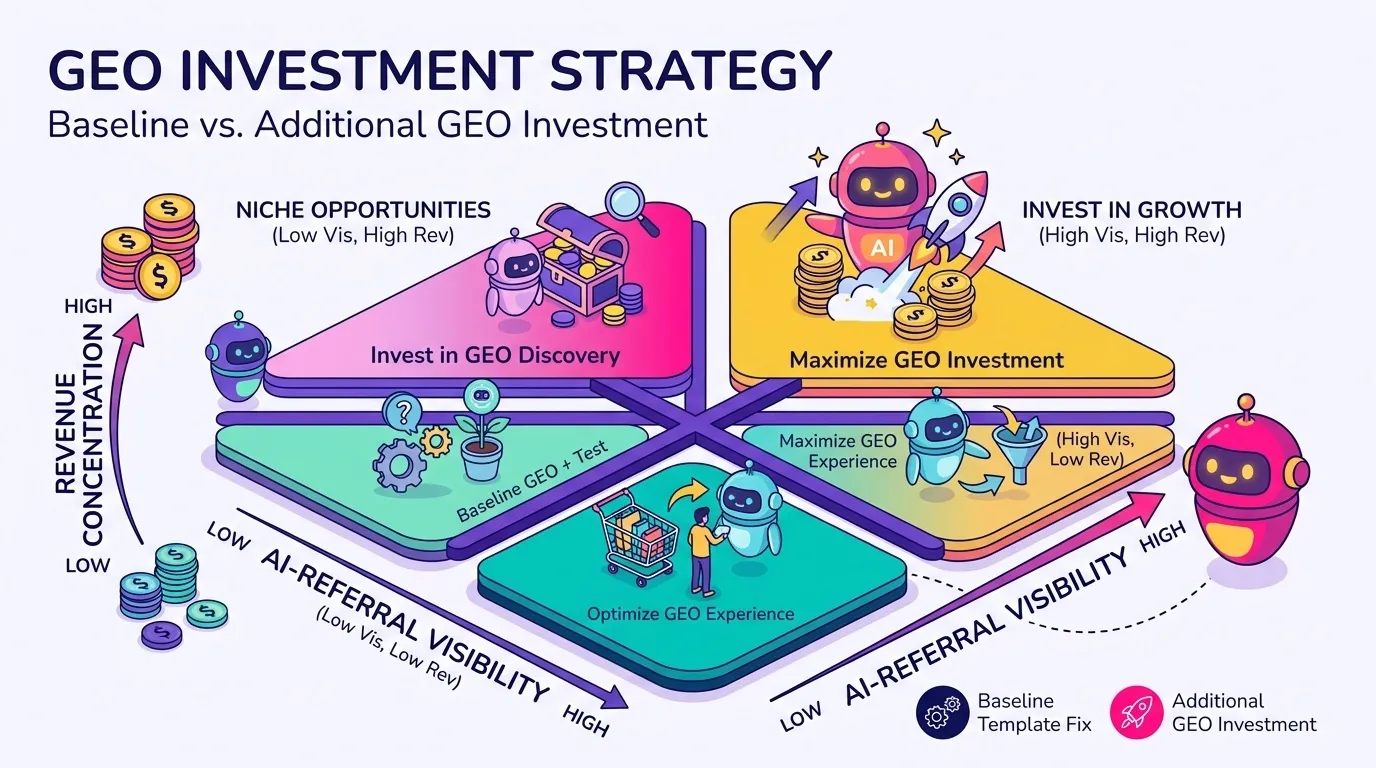
That said, don’t write off the long tail entirely. Because template-level fixes apply catalog-wide automatically, the long tail already gets baseline entity coverage for free. The real prioritization decision isn’t “who gets GEO and who doesn’t.” It’s “who gets the baseline template fix (everyone) versus who gets additional content and review investment on top (your revenue drivers).”
Think of it as a matrix, not a binary switch: revenue concentration on one axis, existing AI visibility on the other. Categories high on both get light-touch maintenance. Categories high on revenue but invisible to AI right now are your priority build queue.
Before assuming you’re starting from zero, check what’s already showing up. GA4 referral data can reveal traffic arriving from domains associated with AI assistants (chat.openai.com, gemini.google.com, and similar), and Google Search Console increasingly surfaces AI Overview appearance data as well.
Treat anything already surfacing as a validation signal, not a coincidence. If a specific category is already getting cited or referral traffic without deliberate effort, that tells you its existing schema and content happen to hit the confidence bar. Reinforce it rather than starting from a blank slate elsewhere.
It’s also worth cross-referencing with Microsoft Clarity session recordings for the sessions that do arrive via AI referral paths. Watching how those specific users behave on-site, do they bounce immediately, do they scroll to the reviews block, tells you something about whether the citation is actually matching intent, not just generating a click.
This data becomes the backbone of the measurement approach I’ll walk through later in the article, so it’s worth setting up the tracking now rather than retroactively.
This is the part you can actually action this week. Everything above builds the case for why template-level work matters. Here’s what that work looks like in practice.
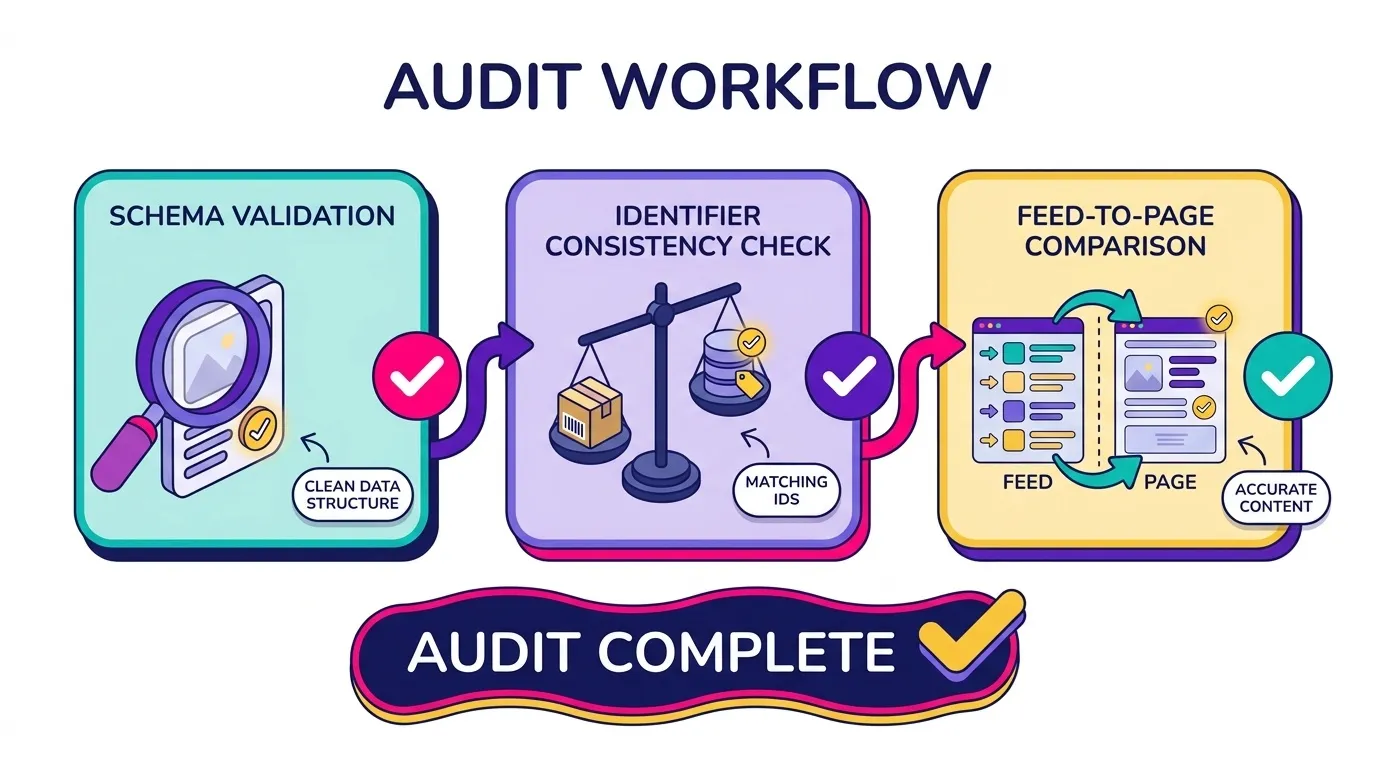
Start by pulling a representative sample, not every page, a sample, of your PDP and category templates. Check three things: schema completeness, identifier consistency against your feed, and whether answer-shaped content blocks (specs, comparisons, FAQs) are present at the template level rather than bolted on manually per product.
A working checklist looks roughly like this:
Test findings against that small sample before rolling anything catalog-wide. It’s far cheaper to catch a schema field mapping error on twenty products than to discover it after deploying across the full catalog.
Repeat this audit periodically, not once and done. Shopify themes update, apps get swapped, and template drift is genuinely common; a schema field that validated cleanly months ago can silently break after a theme update nobody flagged as risky. Our guides on category page best practices and product page optimization go deeper into the template-level mechanics if you want the full technical breakdown.
The goal is to build schema generation logic directly into the PDP and category templates, via theme code or a dedicated app, rather than relying on someone remembering to fill in a metafield correctly on every new product launch.
This is the amp-setting fix, not the retuning-every-guitar fix. Adjust the amp once, and every guitar plugged into it sounds right from that point forward. Build schema generation into the template once, and every new SKU launched afterward is GEO-ready by default, with zero additional manual work per product.
The same logic applies to category templates. Collection pages should carry their own entity signals automatically: category-level schema, consistent breadcrumb structure, and clear category descriptions that AI engines can use to understand what the collection represents as a whole, not just what individual products within it are.
This is, without exaggeration, the only approach that scales past a handful of hero products. Everything else is a stopgap.
Structured data gets you found and trusted. Content still matters for what gets quoted once a product clears that bar.
AI engines favor content phrased as direct, quotable claims over vague marketing language. “Formulated without fragrance, suitable for sensitive skin” is quotable. “Gentle, luxurious, and beautifully made” is not, because there’s nothing verifiable in it to cite.
Standardized spec tables, “best for” use-case lines, and direct comparison statements (“30% lighter than our previous model”) all give AI engines something concrete to lift and attribute. The specificity is the point.
Crucially, this content can be templated too. A standardized spec-table format or a “best suited for” line pattern, applied consistently across a category’s PDPs, achieves the same catalog-wide effect as the schema fix. It’s not bespoke writing per SKU; it’s a content template with variables that populate from your existing product attributes.
Even at the content layer, in other words, the fix stays structural rather than one-off. That consistency is what makes it survivable at catalog scale.
Reviews and user-generated content (UGC) feed directly into your AggregateRating schema, but their value goes beyond the markup itself. They give AI engines corroborating signals that exist independently of your own brand copy, which matters because models are explicitly designed to weigh third-party validation more heavily than self-reported claims.
Press mentions, marketplace listings, and comparison sites function the same way: external validation points an AI model can cross-reference against your on-site claims. A product mentioned favorably in an independent buying guide carries more weight, in AI terms, than the same claim made only on your own PDP.
Practically, this means prioritizing review collection efforts on the high-revenue categories you identified earlier in the prioritization framework, rather than spreading review-request campaigns evenly and thinly across the entire catalog.
It’s also a useful reminder that GEO isn’t a siloed SEO initiative. It intersects with PR, with paid social UGC campaigns, with post-purchase email flows asking for reviews. Treating it as cross-functional gets better results than treating it as one more item on the SEO team’s backlog.
Start by segmenting AI-driven referral traffic in GA4. Referral sources tied to domains like chat.openai.com and gemini.google.com are increasingly visible, and setting up a custom channel grouping to isolate this traffic from generic organic search gives you a clean baseline to monitor over time.
Be honest about the limits here: not every AI citation generates a trackable click. A model naming your product without a link still creates brand value and potential downstream demand, but GA4 won’t show you that directly. Treat this data as directional evidence, not a precise attribution model.
Success in GEO looks different from success in classic SEO. There’s no rank position to screenshot for a client report. Instead, the metrics that matter are citation frequency across a sampled set of relevant queries, AI referral session volume, and consistency of how your brand and products get represented when they do appear.
A practical approach: establish a baseline by running a fixed set of queries relevant to your top categories through the major AI engines periodically, then track whether and how your brand shows up over time. It’s manual, it’s a bit clunky, and it’s currently the most honest method available.
Where possible, tie this back to MER (Marketing Efficiency Ratio) or revenue impact rather than treating citation frequency as an end in itself. A brand cited often but generating no incremental revenue isn’t actually winning; the metric has to eventually connect to the P&L.
I’ll say this plainly because I think overpromising here does the industry no favors: measurement discipline for GEO is still maturing across the board. Nobody, including us, has a perfect attribution model for AI citation yet. Set expectations accordingly, and treat early metrics as directional signals you refine over time, not as a finished dashboard.
As AI engines mature, entity accuracy and data infrastructure are going to matter more, not less. This isn’t a trend to patch over with a content sprint and move on. It’s closer to technical SEO in that sense: unglamorous, ongoing, and easy to underestimate until the gap between you and a better-structured competitor becomes visible in the answers customers actually get.
Brands that treat this as ongoing infrastructure, the same discipline they apply to feed hygiene or Core Web Vitals, compound their advantage over brands running one-off “AI content” projects every few months. The compounding happens quietly, at the template layer, exactly where most competitors aren’t looking.
This kind of template-first, entity-driven work is the same territory we operate in daily on the technical SEO and structured data side. If your catalog is large enough that “just rewrite the descriptions” stopped being a real answer a while ago, it’s worth a proper audit of where your schema, feed, and templates currently stand, the same starting point I’d recommend to any DTC brand serious about this problem, and one we cover more broadly in our ecommerce SEO guide.
No cliché about the future being AI. Citation gets earned through data discipline, not clever copywriting, and that’s true whether it’s a good year for AI hype or a quiet one.
Ready to find out where your catalog’s entity data actually stands? Check out our SEO services or request a technical audit. We’ll pull apart your templates, your schema, and your feed, and tell you exactly where the gaps are before an AI engine finds them for you.