Local SEO for eCommerce: Boost Visibility & Sales in Your Area
If you run an online store and think local SEO is only for brick-and-mortar businesses, you are leaving serious revenue on the table. Searches with local…
If you run an online store and think local SEO is only for brick-and-mortar businesses, you are leaving serious revenue on the table. Searches with local intent convert at nearly three times the rate of generic queries, and eCommerce brands with a strong geographic presence consistently report lower customer acquisition costs and higher purchase intent traffic. In this guide, I will walk you through every strategy you need to make local SEO work for your store, from Google Business Profile setup to citation building to performance measurement. Whether you operate a showroom, a fulfilment warehouse, or a fully remote Shopify store, there is a local SEO play that applies to you.
What Is Local SEO for eCommerce?
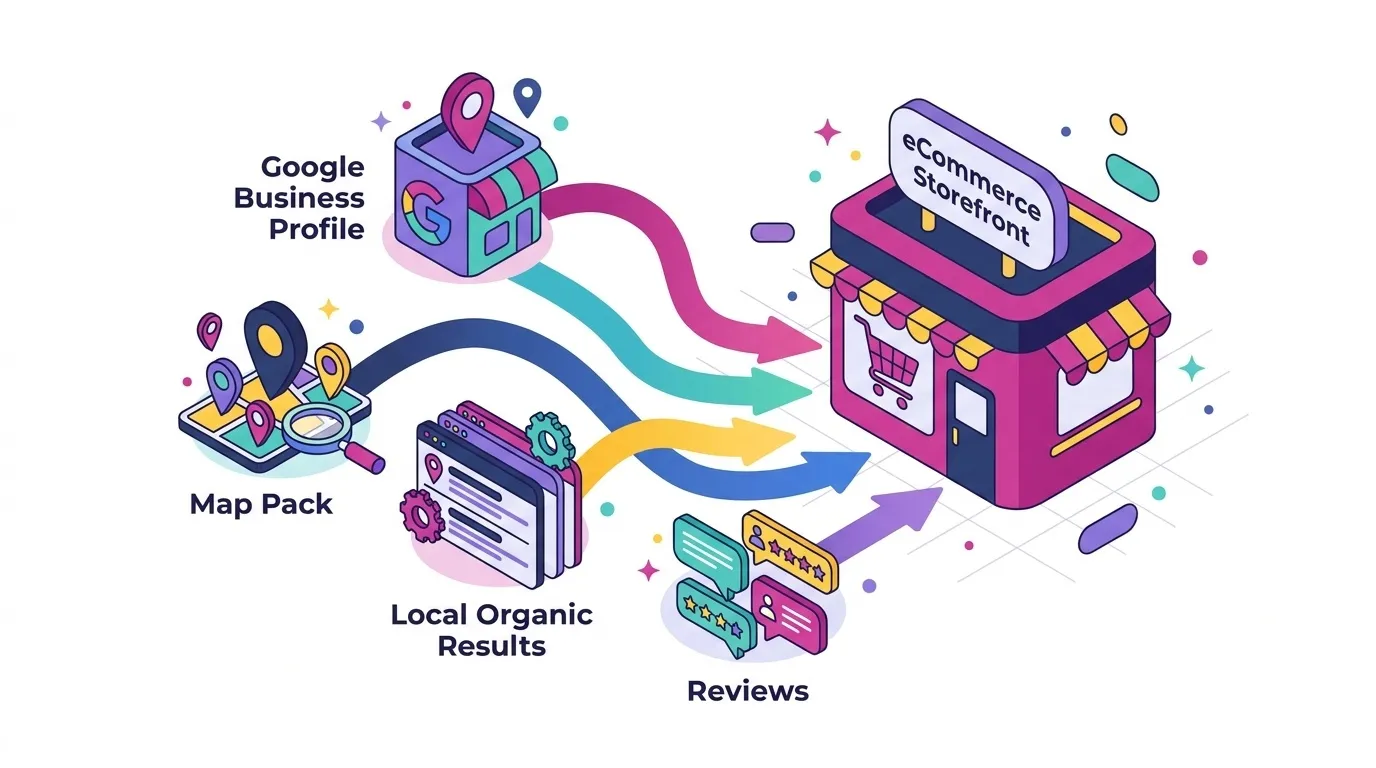
Local SEO for eCommerce is the practice of optimizing your online store to appear prominently in search results that are filtered by geography. This includes the Google Map Pack (the three business listings that appear at the top of local search results), local organic rankings below the map, and AI-powered search features that prioritize proximity and relevance to the searcher’s location.
Doing Local SEO for eCommerce means ensuring your store appears when users in your target area search for the products you sell. It covers your Google Business Profile, local citations, location-specific landing pages, geo-modified keyword optimization, and reputation management through customer reviews.
Unlike general SEO, which targets users anywhere in the world, local SEO targets users in specific cities, regions, or neighborhoods. For eCommerce brands, this becomes particularly powerful when you offer local pickup, same-day delivery, physical showrooms, or when your primary customer base is concentrated in specific geographic markets across Europe or North America.
Furthermore, local SEO is not a strategy reserved for small neighborhood shops. Multi-location eCommerce brands, direct-to-consumer Shopify stores with fulfilment centers, and online retailers serving defined geographic markets all benefit enormously from a well-executed local search strategy. The opportunity is systematically underpursued in eCommerce, which makes it one of the highest-ROI growth levers available to you right now.
The Benefits of Local SEO for eCommerce Brands
The most immediate and quantifiable benefit is higher purchase intent traffic. Someone searching “running shoes near me” or “buy leather handbags in Milan” is further down the funnel than someone searching “types of leather handbags.” They know what they want, they want it close by, and they are ready to act. This intent premium translates directly into better conversion rates and a lower cost per acquisition compared to cold traffic from broad campaigns.
In addition to purchase intent, local SEO builds brand trust and legitimacy in specific markets. When your store appears in the Map Pack and accumulates verified reviews from real customers in a city, you build a layer of social proof that paid advertising cannot replicate. For Fashion, Beauty, and Lifestyle brands where peer validation is a core purchase trigger, this credibility in local markets is invaluable and compounds over time.
Local SEO also creates a competitive moat that is slow to build and hard to displace. A competitor can outbid you on Google Shopping overnight, but displacing your local SEO position requires months of sustained effort on their part. A well-established local presence, with consistent citations, hundreds of reviews, and authoritative local content, becomes a durable brand asset rather than a rented traffic channel.
Not surprisingly, the cost dynamics are highly attractive. Traffic from local organic search is free, and it diversifies your traffic mix away from expensive paid channels. For Shopify brands feeling the squeeze on ROAS from Meta Ads or Google Shopping, local SEO reduces reliance on any single paid platform and builds equity in a channel you actually own.
Benefit
Impact for eCommerce
Higher purchase intent
Local searchers convert up to 3x more than users from generic organic traffic
Lower CAC
Organic local traffic has zero CPC and often drives high-LTV customers
Brand trust and social proof
Map Pack visibility and reviews build credibility that paid ads cannot replicate
Traffic diversification
Reduces dependence on paid channels and improves your overall Marketing Efficiency Ratio (MER)
Durable competitive moat
Local authority is slow to build and expensive for competitors to displace
Setting Up and Optimizing Your Google Business Profile
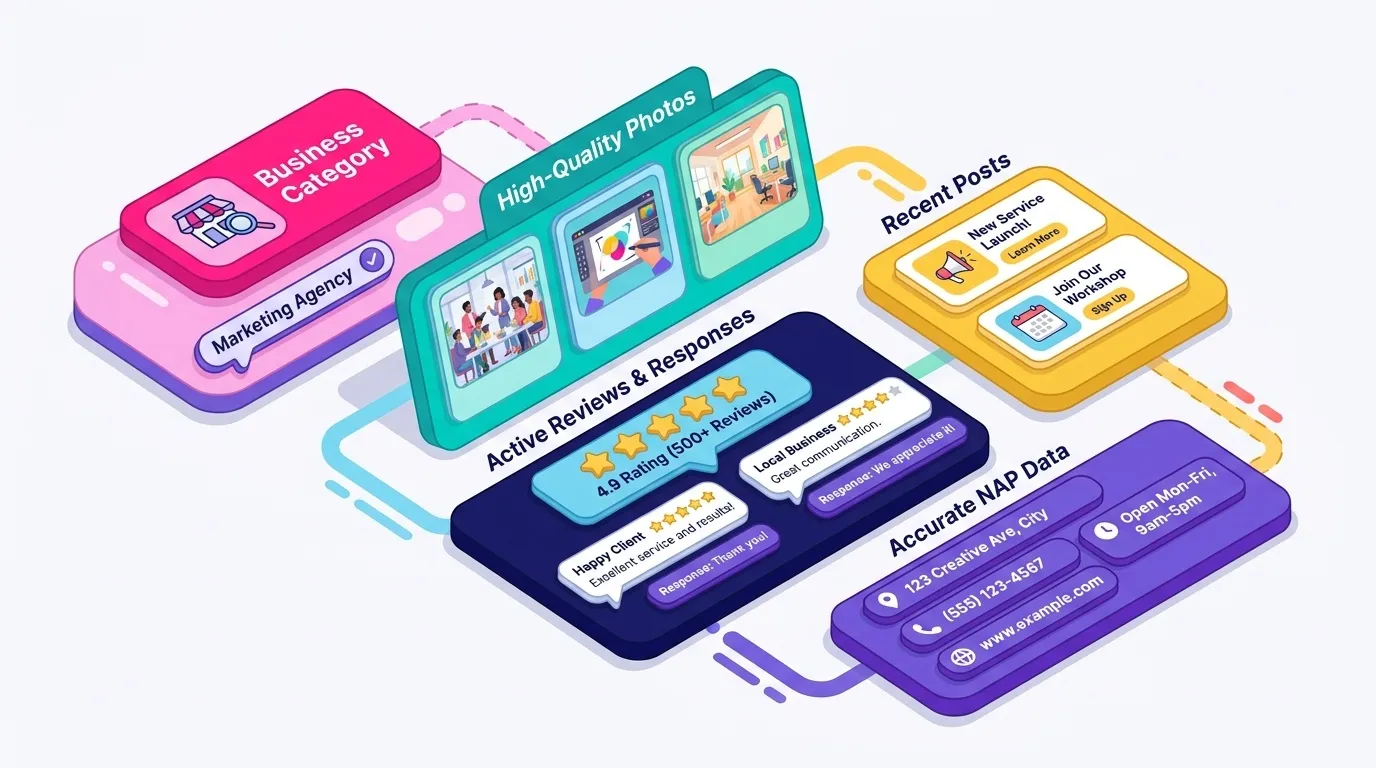
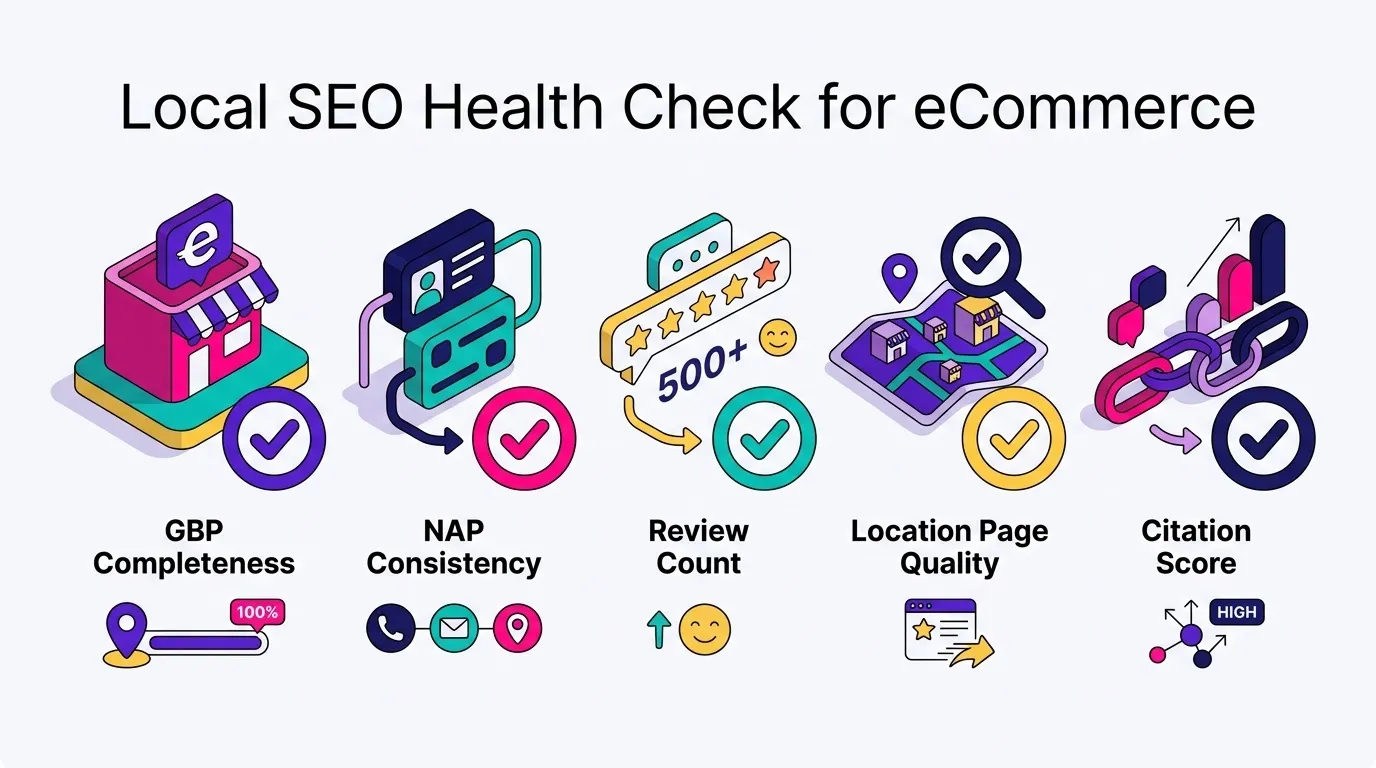
Your Google Business Profile (GBP) is the single most important asset in your local SEO toolkit. Without a verified, complete, and actively managed GBP, you are invisible in the Map Pack and significantly disadvantaged in local organic rankings. This is the foundation everything else builds on.
Start by claiming your profile at business.google.com and completing every available field with precision. Your business name, address, phone number, and website URL must match exactly what appears on your website and across all online directories. This is the core of your NAP consistency (Name, Address, Phone), and even small discrepancies (for example, “St.” versus “Street”) can dilute your local authority in Google’s local index.
Choose your primary and secondary categories with care. The primary category is the strongest relevance signal you send to Google about your business type. If you sell premium skincare, “Skin Care Products” is your primary category, not the generic “Health and Beauty Store.” You can add up to 10 secondary categories, which help you appear for adjacent searches. For Shopify brands with multiple product lines, use secondary categories to cover related verticals without diluting your primary focus.
Once your profile is live, treat it as an active channel, not a static listing. Post regular GBP updates to showcase new collections, seasonal promotions, or local events. Upload high-quality photos of your products, packaging, team, and physical space if you have one. Respond to every review. Google’s algorithm rewards profiles with consistent engagement, and prospective customers trust brands that visibly care about their reputation enough to show up.
Local Keyword Research for Your Online Store
Effective local SEO starts with understanding what your target customers are actually searching for in their specific geography. Keyword research tools such as Ahrefs, Semrush, and Google Keyword Planner all offer location filters, and you should use them to identify geo-modified keywords relevant to your product catalog.
Geo-modified keywords are search queries that include a geographic signal. They take several forms worth tracking separately:
Explicit location queries: “buy designer bags in Rome,” “sustainable clothing store Barcelona”
Near me intent: “vintage furniture near me,” “handmade jewellery near me”
Neighborhood-level queries: “SoHo boutique,” “Notting Hill fashion shop”
Your keyword strategy should tier these by specificity. Go after the highest-volume city-level terms first, then build out to neighborhood and region-level content over time. Each tier may represent a distinct piece of content or a dedicated location landing page on your site. Do not try to capture everything at once. Focus on your top three to five geographic markets and go deep before going wide.
For Shopify stores already generating organic traffic, pay close attention to your Google Search Console data. Filter performance by country or region to identify which cities and geographic queries are already driving clicks and impressions. This reveals where you have latent organic traction, and a focused local SEO push can unlock meaningful fast wins without starting from scratch. In many cases, brands are already ranking on pages two or three for valuable local queries without any deliberate optimization effort.
On-Page Local SEO for eCommerce
With your target keywords identified, the next step is optimizing the right pages on your site to capture local traffic. For most eCommerce stores, this means working across three layers: your homepage, your category pages, and dedicated location-specific landing pages.
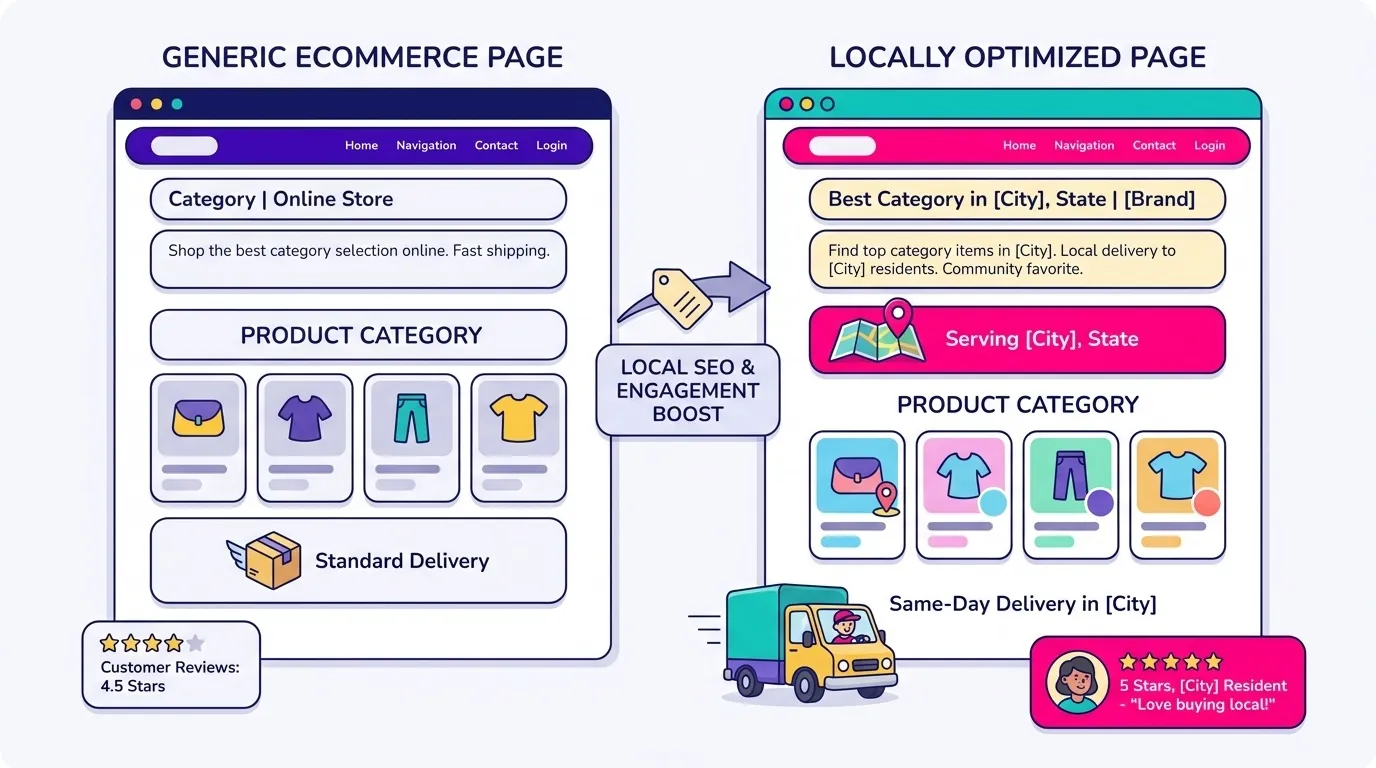
Homepage optimization is the starting point for brands that primarily serve one city or region. Include your target location in the page title tag, meta description, and ideally in the H1. “Premium Cycling Gear for London Cyclists” communicates both product and geography immediately to users and search engines alike. Add a locally-contextualized paragraph to your homepage content that explains why your store is relevant to customers in that specific area.
Category page optimization becomes the priority for stores serving multiple cities. Consider creating location-specific category pages for your top markets. Each page should include unique content about the brand’s relevance to that market, local delivery timeframes, and location-specific customer testimonials.
Location landing pages are the most powerful tactic in the local eCommerce SEO toolkit and also the most underused. These are dedicated pages for each city or region you serve, rich with unique content, local social proof, and location-specific offers. For example, an online bike retailer serving the Netherlands could create a page targeting a keyword like “bike store Amsterdam.” Instead of using a generic category page, the landing page could highlight bike delivery in Amsterdam, popular models for city commuting, customer reviews from Amsterdam-based buyers, local pickup options, and seasonal offers relevant to cyclists in the city. This makes the page much more relevant for both users and search engines.
Furthermore, do not overlook your individual product pages. If specific products resonate strongly with customers in a particular market, add a short paragraph about local relevance. Mention which local events or seasons make the product especially relevant, or include a testimonial from a customer in that city. These localization signals on product pages carry more weight than most eCommerce brands realize, especially as AI-powered search features increasingly evaluate contextual relevance at a granular level.
Building Local Citations and NAP Consistency
A local citation is any online mention of your business name, address, and phone number. Collectively, citations across directories, review platforms, and industry listings tell search engines that your business is real, established, and located exactly where you claim. They are the backbone of your local authority.
The most important citation sources for eCommerce brands to prioritize are:
Google Business Profile (your primary and most powerful anchor)
Bing Places for Business (frequently overlooked but valuable for Bing and Cortana)
Apple Maps (growing in importance with Siri searches and iPhone Maps)
Industry-specific directories (Trustpilot for retail, Houzz for interiors, Clutch for B2B services)
Local business directories (Yelp, Yell, regional chamber directories depending on your market)
The NAP Consistency Rule is absolute: your business name, address, and phone number must be identical across every citation, not approximately similar, but character-for-character identical. If your registered name is “Midsummer Agency”, it should not appear as “Midsummer Agency” on one directory and “Midsummer Srl.” on another. Use a citation management tool (BrightLocal, Moz Local, or Semrush Listing Management) to audit inconsistencies at scale and correct them systematically.
Building citations is not glamorous work, but the compound effect is substantial. Each consistent citation functions as a vote of confidence for your business in Google’s local index. For Shopify brands entering new geographic markets, a structured citation-building campaign in the first few months can significantly reduce the time it takes to surface in local results for those cities. Think of citations as laying the infrastructure before building the house.
Similarly, monitor actively for duplicate listings. If your business has rebranded, moved, or had team members independently create GBP profiles, you may have duplicate or conflicting entries in Google’s system. Duplicates confuse the algorithm and split your local authority across multiple profiles. Identify and merge or remove duplicates through the GBP dashboard or by contacting Google support directly.
Earning and Managing Local Reviews
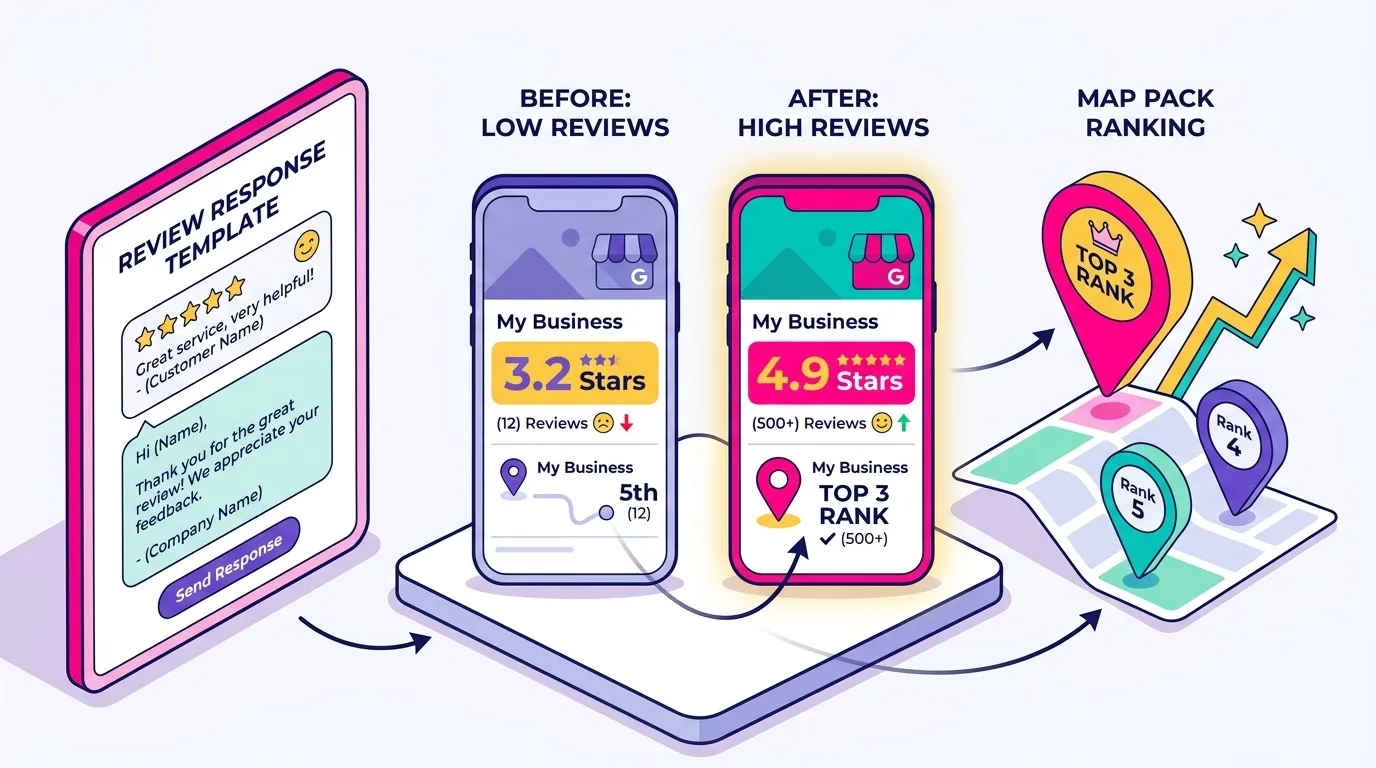
Reviews are one of the most powerful local ranking factors available, and they are systematically underutilized by eCommerce brands. Google’s local algorithm evaluates the quantity, recency, and quality of your reviews when determining Map Pack rankings. Beyond rankings, users read reviews before purchasing, making your review profile a direct conversion rate lever as well.
Your first priority is to build a systematic review acquisition workflow. After every purchase or delivery, send a follow-up email asking satisfied customers to leave a review on your Google Business Profile. Minimize friction: include a direct link to your review submission form, not just a link to your GBP page.
For brands with physical touchpoints (showrooms, pop-up events, local collection points), place a QR code at checkout or inside packaging that links directly to your review page. This captures the moment when customer satisfaction is highest and makes contributing a review effortless. The conversion rate on in-person review requests is significantly higher than email alone.
Responding to every review is not optional. Google explicitly factors business responsiveness into local ranking calculations, and users scrutinize how brands respond to criticism far more closely than they read positive reviews. Always respond publicly, calmly, and with a genuine acknowledgement or resolution. A thoughtful response to a two-star review often converts skeptical readers more effectively than five five-star reviews with no engagement.
In this context, it is also worth understanding that review velocity matters alongside total volume. Fifty reviews accumulated gradually over six months signal sustainable, organic customer satisfaction. Fifty reviews arriving in a single week can trigger Google’s spam detection filters and result in reviews being removed or the profile being penalized. Build a steady, consistent review acquisition rhythm that mirrors natural business activity.
Local Link Building for eCommerce
Link building remains one of the highest-impact activities in SEO, and local link building is a particularly efficient form of it. Links from websites based in or focused on your target geographic markets carry a relevance signal that reinforces your local authority in ways that generic backlinks cannot replicate.
The most effective local link building tactics for eCommerce brands are:
1. Local press and media placements: Pitch your brand story to regional lifestyle publications, local newspapers, and city-specific digital magazines. “Sardinian ceramics brand shipping globally from Cagliari” is a compelling local narrative that earns links from regional media with genuine geographic authority.
2. Local partnerships and event sponsorships: Sponsor a local running club, a neighborhood fashion market, or a community cultural initiative. Sponsorship pages almost universally include a link back to the sponsor’s website, and these links carry strong local relevance signals.
3. Local influencer and creator collaborations: Partner with micro-influencers based in your target cities. Blog posts, YouTube descriptions, and creator bios frequently include website links, and these references build geographic relevance signals that support local rankings.
4. Chamber of Commerce and business association directories: Many local chambers of commerce and professional associations maintain member directories with website links. Membership costs are typically modest, but the links carry credible, locally relevant authority.
5. Educational and cultural institution partnerships: If your products are relevant to schools, universities, or cultural organizations in a specific city, explore partnership opportunities. Links from institutional domains carry particular authority in Google’s local relevance evaluation.
Each local link you earn adds a layer of geographic trust to your domain. Over time, this compounding trust is what separates brands that dominate local search from those that appear inconsistently or not at all.
Measuring Local SEO Performance
You cannot improve what you do not measure, and local SEO requires tracking a different set of signals compared to standard digital marketing KPIs. Getting the measurement right ensures you can identify what is working, where to double down, and which markets are underperforming.
Map Pack ranking position is your primary local SERP metric. Use a rank tracking tool (Semrush, BrightLocal, or Local Falcon) to monitor where you appear in the Map Pack for your target keywords across your target cities. Because local rankings can vary significantly by neighborhood and device, track at postcode-level granularity when your business model requires it.
Google Business Profile Insights provides performance data directly from GBP: how many users searched for your profile directly versus discovered it through a category search, and how many clicked “Get directions,” “Call,” or “Visit website.” These are high-intent micro-conversions that are invisible in standard website analytics but reveal a great deal about the commercial impact of your local presence on offline and hybrid purchase journeys.
In Google Analytics 4, apply a geographic filter to your organic traffic segment to track local organic visits by city or region over time. For accurate attribution, add UTM parameters to your GBP website link (for example, `?utm_source=google&utm_medium=organic&utm_campaign=gbp-london`) so GA4 correctly identifies GBP-driven sessions rather than bucketing them into generic organic or direct traffic. According to Google’s own guidance on Business Profile performance, tracking these actions is essential for understanding real local impact.
For businesses with physical locations or local pickup options, track offline conversion signals such as in-store visits and phone calls. In Google Ads, store visit conversions are reported automatically once the account meets Google’s eligibility requirements, including active location assets or affiliate location assets, verified store locations where applicable, supported countries, and sufficient ad interaction and foot-traffic data to meet privacy thresholds. For local SEO activity outside Google Ads, use call tracking software to measure how many leads come through the phone number listed on your Google Business Profile, and report these phone calls as a separate offline conversion stream.
KPI
Tool
What It Measures
Map Pack ranking position
BrightLocal, Local Falcon
Local SERP visibility by keyword and target city
GBP actions (calls, directions, clicks)
Google Business Profile Insights
High-intent interactions driven by your local profile
Local organic traffic
Google Analytics 4
Volume and trend of geographically-filtered organic visits
Review count and average rating
GBP dashboard
Reputation strength and local ranking factor health
Citation consistency score
Moz Local, BrightLocal
NAP accuracy across all major directories
Common Local SEO Mistakes eCommerce Brands Make
Even brands with strong general SEO performance frequently stumble on local-specific issues. Recognizing these mistakes early saves months of wasted effort and prevents you from unknowingly working against your own rankings.
The most common mistake is inconsistent NAP data across channels. Brands update their website address or phone number after moving or rebranding without updating their GBP, directories, and citations. The resulting inconsistency fragments local authority and sends conflicting signals to Google’s local algorithm. Conduct a NAP audit every six months at minimum, especially after any business changes.
A close second is pointing GBP links to the homepage instead of a location page. When a user finds your business in the Map Pack and clicks “Website,” they should land on a page specifically relevant to that location, not your generic homepage. Linking to the homepage forces them to navigate from scratch, increases bounce rate, and wastes the high-intent traffic your local presence generated. Always link GBP profiles to the most relevant location or category page on your site.
Another frequent error is treating reviews as a passive activity. Brands assume satisfied customers will naturally leave reviews without any prompting. In practice, the vast majority of satisfied customers never leave a review unless specifically invited to do so. Without a systematic acquisition workflow, your review count stagnates while competitors who ask consistently accumulate social proof and ranking advantage.
Finally, many eCommerce brands create location pages that are thin or duplicate. A page that reads “We deliver sustainable sportswear to customers in [City]” with minimal additional content does not provide the uniqueness or depth that Google’s local algorithm rewards. Every location page needs genuine, specific content about why your brand is relevant to that particular market, including local testimonials, specific delivery or pickup information, and locally-relevant product context.
How We Run Local SEO for eCommerce at Midsummer Agency
At Midsummer Agency, we approach local SEO for eCommerce with the same data-driven rigor we apply to paid channels like Google Ads or Meta Ads. The reason is simple: a well-executed local search strategy reduces your dependence on expensive paid traffic, and that directly improves your overall MER. For the eCommerce brands we work with, local SEO is not a secondary tactic. It is a revenue channel.
When we onboard an eCommerce client for local SEO, our first step is always a Local Presence Audit. We assess the current state of the GBP, check NAP consistency across the citation sources, analyze local keyword rankings by city, and benchmark performance against the top three local competitors. This gives us a precise baseline and highlights the highest-leverage gaps to address first, so we are never working blindly.
From there, we build a Location Content Strategy tailored to each brand’s ICP and target markets. For a Fashion brand, this might mean location-specific category content around seasonal collections popular in target cities. For a Beauty brand, it might mean content addressing specific skin concerns tied to the climate of each target region. For a Lifestyle brand shipping across Europe, it might mean city-specific editorial content that builds cultural relevance before purchase intent.
We manage local SEO as an ongoing channel, not a one-time setup task. Every month includes a structured workflow: review acquisition, citation monitoring, GBP post management, local content updates, and performance reporting tied to the KPIs that actually matter for eCommerce growth. The brands that dominate local search are the ones that treat it as a living strategy, not a checked box. That is exactly how we run it.
Your Local Market Is Searching Right Now
Local SEO for eCommerce is not a project to defer. Every day your Google Business Profile sits incomplete, your NAP data is inconsistent across directories, and your review count stagnates, a competitor is quietly building the local authority that will take months to displace.
The good news is that the fundamentals are achievable: verify and optimize your GBP, fix your citations, implement a review acquisition workflow, build location-specific landing pages with genuine content, and optimize your category pages for your top geographic markets. Each of these actions compounds over time, creating an increasingly powerful and defensible signal of local relevance.
Furthermore, the eCommerce brands that combine strong local SEO with a well-structured paid strategy (Google Shopping, Meta Ads) create a flywheel effect that is hard to compete with. Local organic traffic validates product-market fit in specific geographies, lowers blended CAC, and builds the kind of trust that extends customer LTV well beyond what paid channels alone can achieve.
Your local audience is searching for your products right now. The only question is whether they find you or your competitor. Start with a complete, active Google Business Profile, build from there systematically, and measure every step. If you would like expert support running this playbook for your store, our team at Midsummer is ready.
Ready to make local SEO a genuine revenue channel for your eCommerce store? Explore our SEO services or request a personalized Local SEO Audit tailored to your markets.
We will map out exactly where your store stands in local search, identify what is holding your visibility back, and build a clear roadmap to make sure you show up when and where it counts most.