In 2026, businesses spent over $207 billion on social media advertising, yet most campaigns fail to deliver meaningful ROI. The difference between success and failure often comes down to one thing: understanding how to build a paid social ad strategy that works before you spend a single dollar.
Learning how to build a paid social ad strategy that works isn’t just about creating ads and hoping for the best. It’s about understanding your audience, choosing the right platforms, crafting compelling creative, and continuously optimizing based on data. Whether you’re new to paid social marketing or looking to improve existing campaigns, this guide will walk you through every step of building a paid social ad strategy that works for your ecommerce store.
In this comprehensive guide, we’ll explore the essential components of successful paid social media campaigns, from platform selection to scaling profitable ads. You’ll discover exactly how to build a paid social ad strategy that works, with proven frameworks, real-world examples, and actionable tactics you can implement immediately to drive measurable business results.
Understanding How to Build a Paid Social Ad Strategy That Works
A successful paid social strategy starts with clear business objectives and a deep understanding of your customer journey. If you want to learn how to build a paid social ad strategy that works, you must begin with solid foundations. Before launching any campaigns, you need to define what success looks like for your ecommerce business.
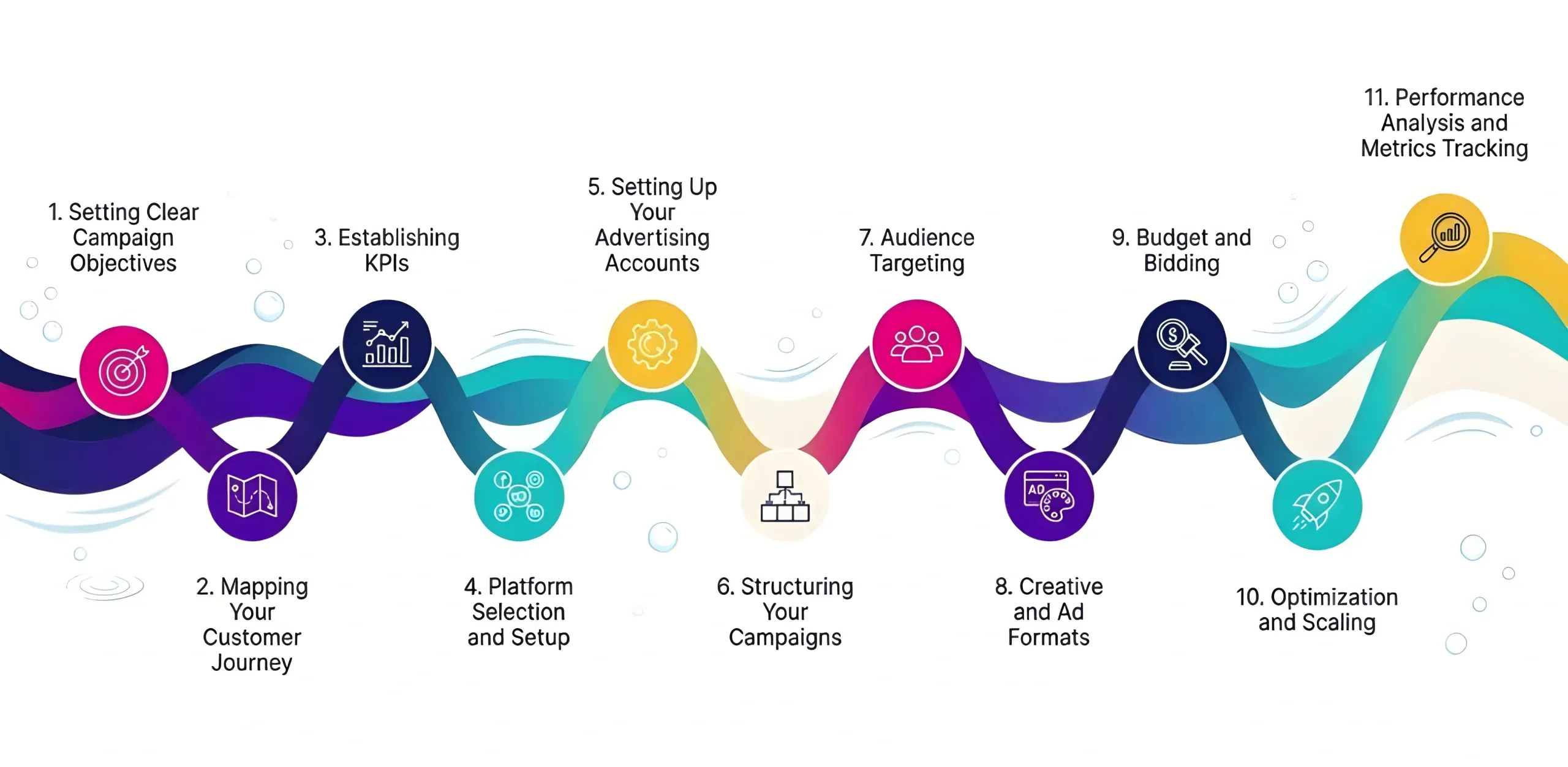
Setting Clear Campaign Objectives
Your paid social ads best practices begin with choosing the right campaign objective. Most platforms offer three core objective types:
Awareness: Build brand recognition and reach new audiences
Consideration: Drive traffic, engagement, and lead generation
Conversion: Generate sales, sign-ups, or other valuable actions
For ecommerce businesses, we typically recommend a full-funnel approach. This means running awareness campaigns to introduce your brand to cold audiences, retargeting campaigns to nurture consideration, and conversion campaigns to drive purchases.
According to Meta’s 2026 advertising research, brands that implement full-funnel strategies see 34% higher ROAS compared to those focused solely on bottom-funnel conversions.
Mapping Your Customer Journey
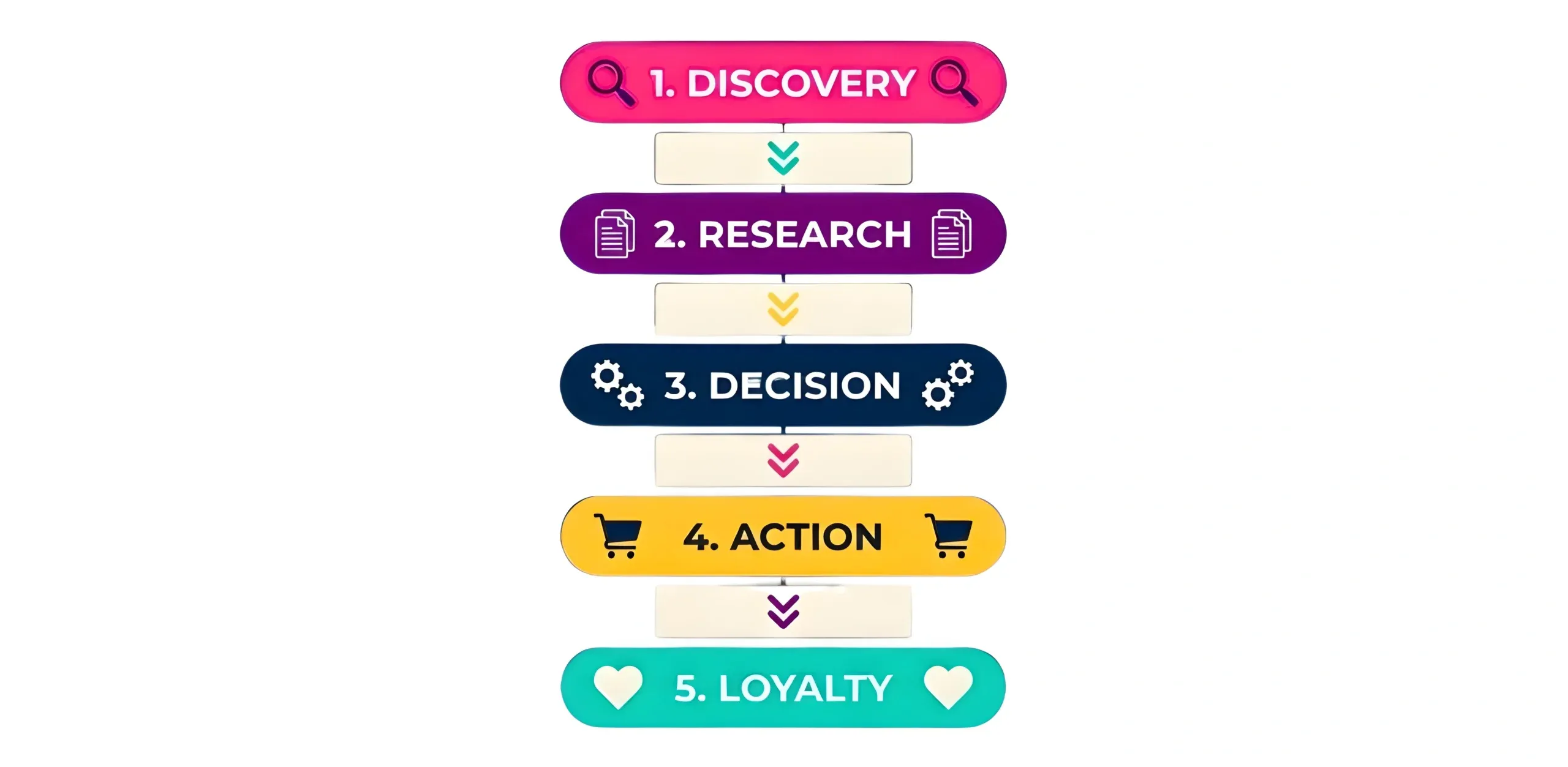
Understanding where your customers discover, evaluate, and purchase is critical for effective paid social marketing. The typical ecommerce customer journey includes:
Discovery: Customer becomes aware of your brand or product
Research: Customer compares options and reads reviews
Decision: Customer adds to cart and considers purchase
Action: Customer completes the transaction
Loyalty: Customer returns for repeat purchases
Each stage requires different messaging, creative, and ad formats. For example, carousel ads showcasing product benefits work well in the discovery phase, while dynamic product ads excel at converting customers who’ve already shown interest.
Establishing Key Performance Indicators (KPIs)
Tracking the right metrics ensures you’re measuring what matters. When figuring out how to build a paid social ad strategy that works, defining success metrics upfront is critical. Essential KPIs for paid social campaigns include:
Return on Ad Spend (ROAS): Revenue generated per dollar spent
Cost Per Acquisition (CPA): Average cost to acquire a customer
Click-Through Rate (CTR): Percentage of people who click your ads
Conversion Rate: Percentage of clicks that result in purchases
Customer Lifetime Value (CLV): Total revenue expected from a customer
We recommend setting target benchmarks before launching campaigns. For ecommerce, a ROAS of 3:1 to 4:1 is typically the break-even point when factoring in product costs and overhead. However, this varies by industry and profit margins.
Platform Selection and Setup: Paid Social Strategy
Choosing the right social platforms is crucial for maximizing your advertising budget. A key part of how to build a paid social ad strategy that works is selecting platforms where your target customers actively engage. Not all platforms deliver equal results for every business, so strategic selection based on your audience and products is essential.
Comparing Major Paid Social Platforms
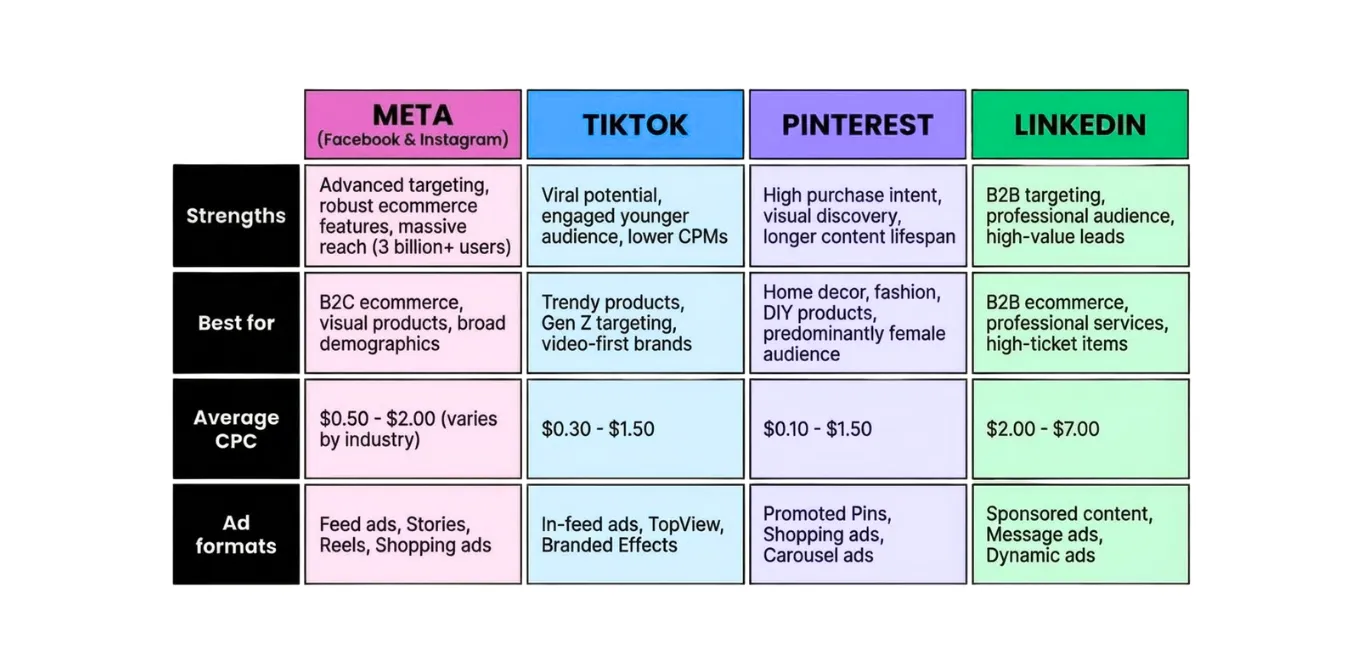
Each platform offers unique strengths for ecommerce advertisers. When learning how to build a paid social ad strategy that works, platform selection can make or break your results:
Best for: Trendy products, Gen Z targeting, video-first brands
Average CPC: $0.30 – $1.50
Ad formats: In-feed ads, TopView, Branded Effects
Pinterest
Strengths: High purchase intent, visual discovery, longer content lifespan
Best for: Home decor, fashion, DIY products, predominantly female audience
Average CPC: $0.10 – $1.50
Ad formats: Promoted Pins, Shopping ads, Carousel ads
LinkedIn
Strengths: B2B targeting, professional audience, high-value leads
Best for: B2B ecommerce, professional services, high-ticket items
Average CPC: $2.00 – $7.00
Ad formats: Sponsored content, Message ads, Dynamic ads
For most ecommerce businesses, we recommend starting with Meta platforms due to their sophisticated targeting capabilities and proven ecommerce tools like Meta Advantage+ Catalog Ads.
Setting Up Your Advertising Accounts
Proper account structure sets the foundation for scalable campaigns. Follow these setup steps:
Create a Business Manager: Centralize all your assets (ad accounts, Pages, pixels)
Install tracking pixels: Essential for conversion tracking and retargeting
Set up the Conversions API: Improves tracking accuracy in the post-iOS 14 era
Create custom audiences: Build saved audiences for testing
Link your product catalog: Enable dynamic ads and shopping features
According to Shopify’s commerce trends report, ecommerce businesses that properly implement server-side tracking see 22% more attributed conversions compared to pixel-only tracking.
Structuring Your Campaigns
A well-organized account structure makes optimization easier. We recommend this hierarchy:
Campaign Level (Objective)
Campaign 1: Prospecting – Conversions
Campaign 2: Retargeting – Conversions
Campaign 3: Awareness – Reach
Ad Set Level (Audience & Budget)
Ad Set 1: Interest-based targeting, $50/day
Ad Set 2: Lookalike audience (1%), $75/day
Ad Set 3: Website visitors (30 days), $100/day
Ad Level (Creative & Copy)
Ad 1: Carousel showcasing product line
Ad 2: Video testimonial
Ad 3: Single image with promotional offer
This structure allows you to test different audiences while maintaining budget control and clear performance attribution.
Audience Targeting Strategies: Paid Social Marketing
Effective audience targeting is what separates profitable campaigns from wasted spend. Modern paid social platforms offer sophisticated targeting options, but success requires strategic implementation.
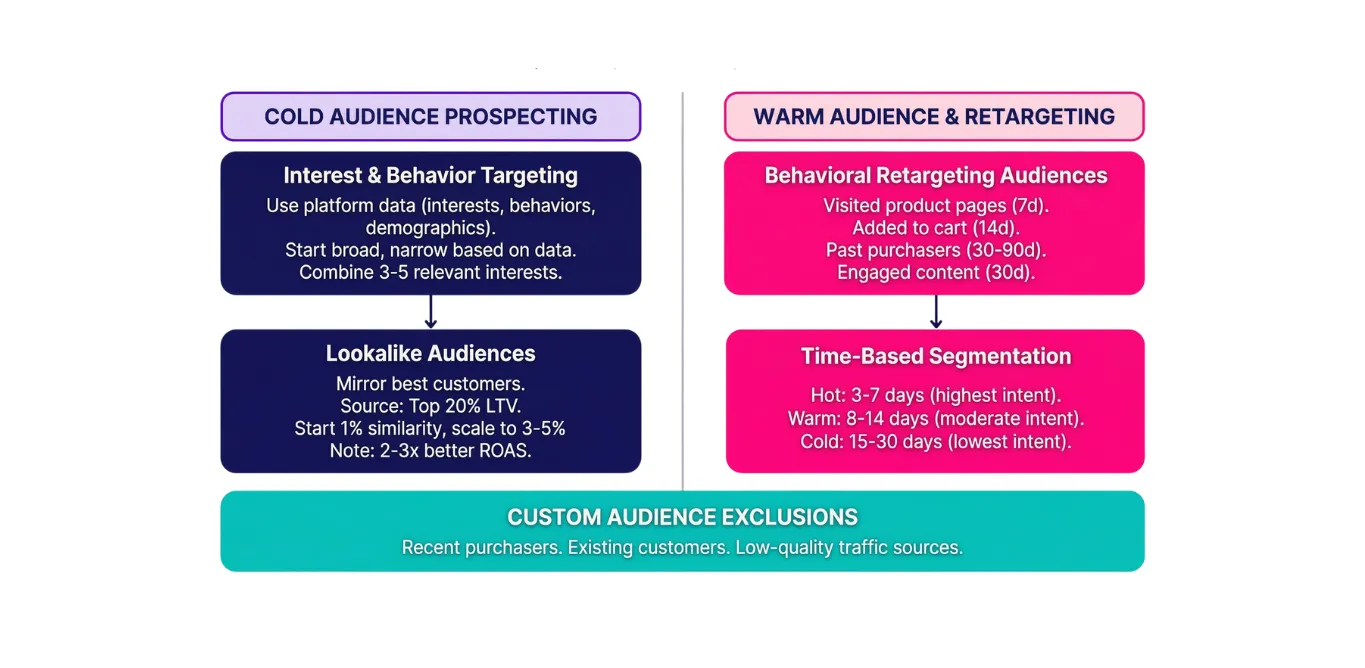
Cold Audience Targeting Methods
Reaching new customers who’ve never heard of your brand requires a different approach than retargeting. A critical element of how to build a paid social ad strategy that works is mastering cold audience prospecting. Here are the most effective cold prospecting strategies:
Interest and Behavior Targeting
Use platform data to target users based on their interests, behaviors, and demographics. For example, an outdoor gear retailer might target users interested in hiking, camping, and outdoor recreation.
Key considerations:
Start broad and narrow based on performance data
Combine 3-5 relevant interests to find your ideal audience
Avoid over-targeting (audiences smaller than 100,000 may limit delivery)
Lookalike Audiences
Upload your customer list or pixel data to create audiences that mirror your best customers. Meta’s algorithm identifies users with similar characteristics, behaviors, and purchasing patterns.
Best practices for lookalikes:
Use your top 20% customers by lifetime value as the source
Start with 1% similarity for highest quality
Scale to 3-5% once 1% audiences mature
Create separate lookalikes for different customer segments
According to our internal campaign data, lookalike audiences typically deliver 2-3x better ROAS than interest-based targeting during the prospecting phase.
Warm Audience and Retargeting
Website visitors and engaged users convert at significantly higher rates than cold audiences. Build these retargeting audiences:
Behavioral Retargeting Audiences
Visited specific product pages (last 7 days)
Added to cart but didn’t purchase (last 14 days)
Purchased in the past (30-90 days) – for cross-sells
Engaged with Instagram/Facebook content (last 30 days)
Time-Based Segmentation
Not all website visitors have equal intent. Segment by recency:
Hot: Last 3-7 days (highest intent, most aggressive bidding)
Warm: Last 8-14 days (moderate intent)
Cold: Last 15-30 days (lowest intent, awareness-focused)
Custom Audience Exclusions
Equally important is who you exclude. Key exclusions:
Recent purchasers (prevent ad fatigue)
Existing customers (for acquisition campaigns)
Low-quality traffic sources
Dynamic Audience Optimization
Modern platforms increasingly rely on machine learning for targeting. Meta’s Advantage+ Audiences and TikTok’s automatic targeting can outperform manual audience selection.
However, we recommend a hybrid approach:
Test broad targeting with minimal audience inputs (let the algorithm learn)
Run controlled tests against your manual audiences
Provide audience suggestions rather than restrictions
Allow the platform to expand beyond your defined audience
Research from Meta Business shows that Advantage+ campaigns with minimal audience restrictions see 12% lower cost per conversion compared to tightly targeted campaigns.
The key is balancing algorithmic learning with strategic human oversight based on your unique business knowledge and customer insights.
Creative and Ad Formats: Paid Social Media Campaigns Examples
Creative is the most important element of your paid social ads. Even perfect targeting can’t overcome poor creative. Your ads need to stop the scroll, communicate value, and drive action within seconds.
High-Performing Ad Formats for Ecommerce
Different formats serve different purposes in your social media paid advertising strategy. Knowing how to build a paid social ad strategy that works means choosing the right format for each campaign objective:
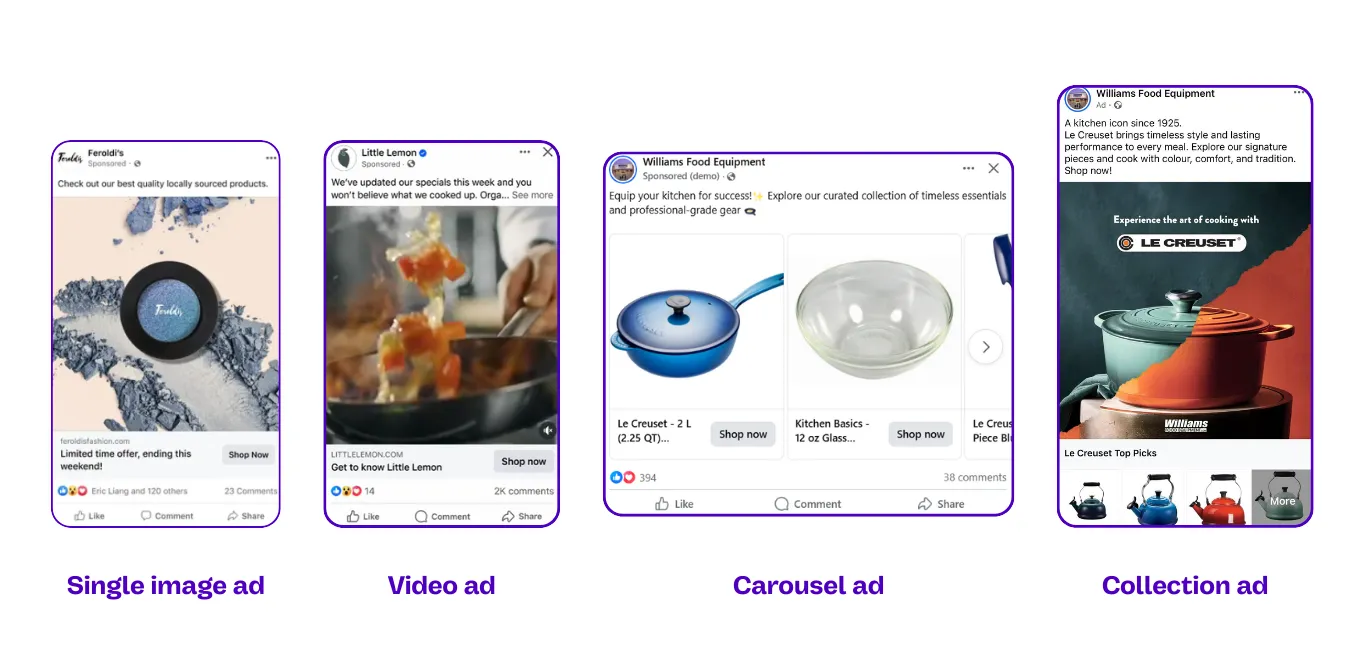
Single Image Ads
Best for: Simple product showcases, promotional offers, testing concepts
Specifications: 1080 x 1080px (square) or 1080 x 1350px (vertical)
Use cases: Flash sales, hero product launches, lifestyle imagery
Video Ads
Best for: Storytelling, product demonstrations, user-generated content
Specifications: 9:16 (vertical) or 1:1 (square), 15-30 seconds optimal
Use cases: How-to content, testimonials, behind-the-scenes
Carousel Ads
Best for: Showcasing product variety, step-by-step guides, multiple benefits
Specifications: 2-10 cards, 1080 x 1080px per card
Use cases: Product collections, feature highlights, comparison guides
Use cases: New arrivals, curated collections, mobile-first campaigns
According to Meta’s creative best practices, video ads generate 38% more conversions than static images for ecommerce brands, with the highest performance coming from videos under 15 seconds.
Creative Best Practices
Winning creative follows proven principles:
Visual Elements
Show the product in use, not just isolated on white backgrounds
Use high-quality images optimized for mobile viewing
Include text overlays sparingly (under 20% of image area)
Test lifestyle images vs. product-only shots
Incorporate user-generated content for authenticity
Copy Framework
Structure your ad copy using this proven formula:
Hook (first 5 words): Grab attention with a question, stat, or bold claim
Problem: Identify the pain point your product solves
Solution: Explain how your product addresses the problem
Proof: Include social proof, testimonials, or data
Call-to-Action: Clear next step (Shop Now, Learn More, etc.)
Example:
“Tired of uncomfortable running shoes? [Hook]
Most athletic shoes sacrifice comfort for performance. [Problem]
Our CloudStep technology provides both – tested by 10,000+ marathon runners. [Solution + Proof]
Try them risk-free for 60 days. [CTA]”
Testing Variables
Continuously test these creative elements:
Primary visual (product vs. lifestyle vs. UGC)
Headlines and hooks
Ad copy length (short vs. long)
CTA button text
Video vs. static imagery
Format variations (carousel vs. single image)
We’ve seen that systematic creative testing improves campaign performance by an average of 25-40% over 90 days.
Platform-Specific Creative Considerations
Each platform has unique creative requirements:
Instagram & Facebook
Optimize for mobile-first viewing (9:16 vertical)
Keep text concise – users skim quickly
Use Stories for urgency and time-sensitive offers
Leverage Reels for entertainment-focused content
TikTok
Embrace native, unpolished content
Start with a hook in the first 2 seconds
Add captions (many watch without sound)
Participate in trending sounds and challenges
Pinterest
Create vertical images (2:3 ratio ideal)
Include descriptive text overlays
Focus on aspirational lifestyle imagery
Link to blog content, not just product pages
Remember that creative fatigue occurs rapidly on social platforms. Refresh your creative every 7-14 days to maintain performance and prevent declining engagement.
Budget and Bidding
Strategic budget allocation and bidding strategies directly impact your campaign profitability. Understanding how to distribute spend and optimize bids separates successful campaigns from those that burn through cash.
Determining Your Initial Budget
Your starting budget should align with platform learning requirements and your business goals. An essential part of how to build a paid social ad strategy that works is setting budgets that allow platforms to optimize effectively. Here’s how to calculate your minimum viable budget:
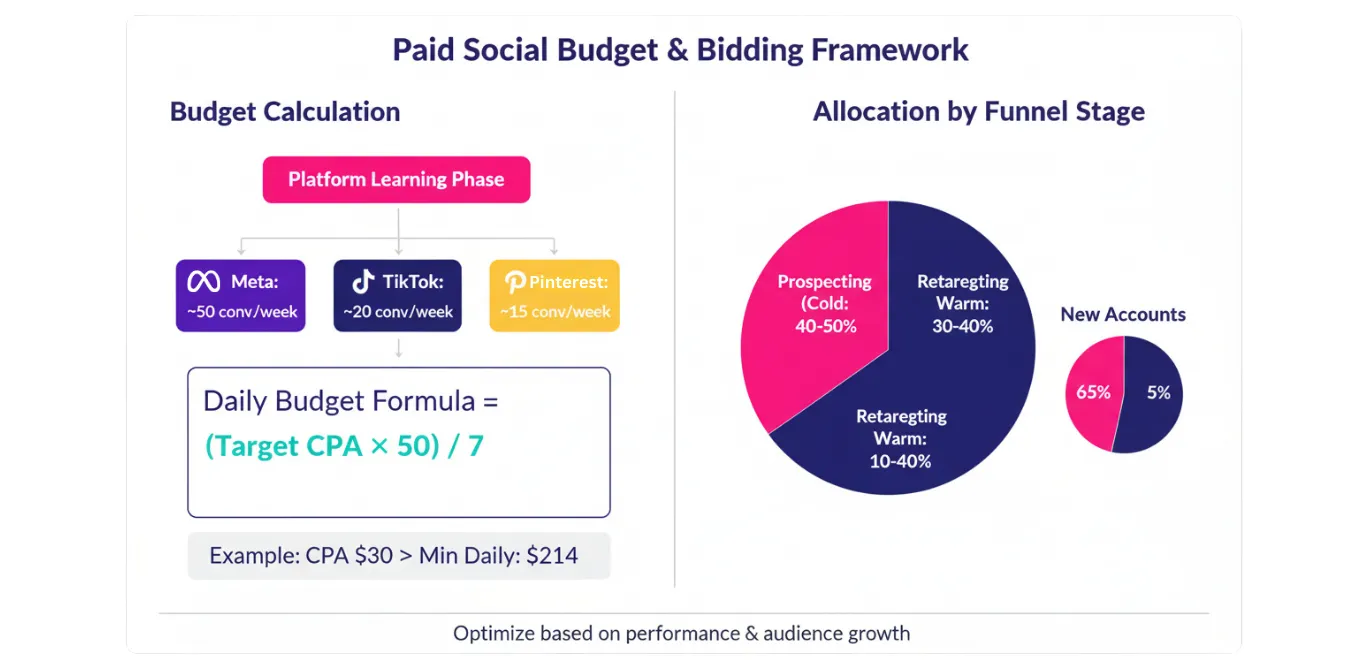
Platform Learning Phase Requirements
Meta: Needs ~50 conversions per ad set per week for optimization
TikTok: Requires ~20 conversions per week for algorithmic learning
Starting below platform thresholds leads to inconsistent delivery and poor performance. If you can’t meet minimum budgets, focus on one platform rather than spreading thin across multiple channels.
Budget Allocation Across Funnel Stages
Distribute your budget based on the customer journey. We recommend this allocation for mature accounts:
Prospecting (Cold): 40-50% of total budget
Retargeting (Warm): 30-40% of total budget
Retention/Loyalty: 10-20% of total budget
New accounts should weight more heavily toward prospecting (60-70%) to build audience pools for retargeting.
As your account matures and retargeting audiences grow, gradually shift budget toward high-intent audiences that deliver better immediate ROAS while maintaining prospecting to fuel ongoing growth.
Bidding Strategies for Different Objectives
Choosing the right bidding strategy impacts both performance and cost efficiency:
Cost Cap
Best for: Maintaining consistent CPA while maximizing volume
How it works: Algorithm aims to keep average cost per result at or below your target
Use case: Established campaigns with clear CPA targets
Bid Cap
Best for: Controlling maximum bid in competitive auctions
How it works: Sets ceiling on what you’ll bid for any single impression
Use case: Preventing overpaying during peak seasons or competitive periods
Lowest Cost (Automated Bidding)
Best for: New campaigns in learning phase
How it works: Platform optimizes to get most results at lowest average cost
Use case: Testing new audiences, initial campaign launches
How it works: Algorithm optimizes toward achieving target return on ad spend
Use case: Mature campaigns with consistent conversion data
For most ecommerce businesses, we recommend starting with lowest cost bidding during the learning phase (first 7-14 days), then transitioning to cost cap once you have performance data to set realistic targets.
Scaling Budget Without Killing Performance
Rapid budget increases often tank campaign performance. Follow these scaling guidelines:
Safe Scaling Practices
Increase budgets by 20-30% maximum every 3-4 days
Avoid changes exceeding 50% in a single day
Scale winning ad sets rather than poor performers
Duplicate high-performing campaigns for faster scaling
Horizontal vs. Vertical Scaling
Vertical: Increase budget on existing campaigns (safer but limited)
Horizontal: Launch new campaigns targeting different audiences (riskier but higher ceiling)
Use vertical scaling to 2-3x your budget, then add horizontal scaling to expand reach without re-entering learning phases that damage performance.
Optimization and Scaling
Consistent optimization separates good campaigns from great ones. Mastering how to build a paid social ad strategy that works means committing to ongoing testing and refinement. Systematic testing and data-driven decisions compound over time to dramatically improve performance.
Testing Framework and Methodology
Structured testing prevents random changes and builds reliable performance data:
What to Test (Priority Order)
Audiences: Different targeting options (highest impact)
Creative: Images, videos, copy (high impact)
Placements: Feed vs. Stories vs. Reels (medium impact)
Ad formats: Carousel vs. single image vs. video (low-medium impact)
How to Test Properly
Change one variable at a time for clear attribution
Run tests for minimum 7 days to account for weekly patterns
Require statistical significance (not just directional trends)
Document all tests and results in a testing log
Sample Size Requirements
A common mistake is calling test winners too early. Ensure adequate data:
Minimum 100 conversions per variant
At least 1,000 clicks per variant
95% confidence level before declaring a winner
Performance Analysis and Metrics Tracking
Monitor these metrics at different frequencies. Successful implementation of how to build a paid social ad strategy that works requires disciplined performance tracking:
Daily Checks
Spend vs. budget (ensure campaigns are delivering)
Use platform analytics combined with Google Analytics 4 to get a complete picture. Server-side tracking via Conversions API is essential for accurate attribution, especially for iOS users.
Advanced Optimization Tactics
Once foundational optimization is solid, implement these advanced strategies:
Dynamic Creative Optimization
Let platforms automatically test combinations of creative elements:
Upload 5-10 images/videos
Provide 3-5 headline variations
Include 3-5 description variations
Allow algorithm to find best-performing combinations
This approach typically improves performance by 10-15% compared to static ads.
Automated Rules
Set up rules to prevent waste and capitalize on winners:
Pause ad sets with CPA >150% of target after 50 conversions
Increase budget by 20% on ad sets achieving <80% target CPA
Pause ads with CTR <1% after 2,000 impressions
Send alerts for daily spend exceeding $X
Funnel Optimization
Look beyond platform metrics to your full conversion funnel:
Analyze post-click behavior in Google Analytics
Identify drop-off points in checkout process
Test landing page variations via A/B testing tools
Remember that paid social ads don’t exist in isolation. Your landing pages, checkout experience, email follow-up, and product itself all impact the ultimate success of your campaigns.
When and How to Scale Winning Campaigns
You’ve found winning campaigns—now scale them strategically:
Indicators You’re Ready to Scale
Consistent ROAS above target for 14+ days
Ad sets have exited learning phase
Creative shows no signs of fatigue (CTR stable)
Conversion rate remains consistent as spend increases
Scaling Strategies
Vertical Scaling (Increase budget on winning ad sets)
Week 1: Increase budget by 20%
Week 2: If performance holds, increase another 20-30%
Week 3+: Continue 20-30% increases until performance degrades
Horizontal Scaling (Expand to new audiences/placements)
Launch campaigns targeting new lookalike percentages (3%, 5%)
Test new interest combinations
Expand to previously excluded placements
Launch on additional platforms
Campaign Budget Optimization (CBO)
Let Meta allocate budget across ad sets automatically
Set minimum spend per ad set to ensure testing
Works best with 3-5 ad sets per campaign
The key is patience. Rapid scaling often crashes performance by forcing campaigns back into learning phases. Steady, systematic scaling produces sustainable growth.
Frequently Asked Questions
What is a paid social ad strategy?
A paid social ad strategy is a comprehensive plan for using paid advertising on social media platforms to achieve specific business objectives. Understanding how to build a paid social ad strategy that works involves selecting the right platforms, defining target audiences, creating compelling ad creative, setting budgets and bids, and continuously optimizing for better performance. An effective strategy aligns your ad spend with customer acquisition goals and overall business growth.
How does a successful paid social strategy work?
A successful paid social strategy works by matching your products with the right audiences on the most relevant platforms. It uses data-driven targeting to reach potential customers, compelling creative to capture attention, and strategic bidding to win ad placements cost-effectively. The strategy includes both prospecting to find new customers and retargeting to convert interested users, with continuous testing and optimization to improve results over time.
What are the benefits of paid social advertising for ecommerce?
Paid social advertising offers ecommerce businesses several key benefits: highly targeted reach to specific customer demographics and interests, measurable ROI through detailed tracking and attribution, scalable growth as you increase budgets on winning campaigns, and faster results compared to organic marketing. Additionally, paid social provides valuable customer insights, enables retargeting to recover abandoned carts, and allows testing of new products before large inventory investments.
How do I implement a paid social strategy for my business?
Start by setting clear objectives and KPIs aligned with your business goals. Choose 1-2 platforms where your target customers spend time. Set up proper tracking with pixels and conversion APIs. Begin with small test budgets ($20-50/day) to validate audiences and creative. Analyze performance data weekly, scaling what works and cutting what doesn’t. Expand gradually to new audiences and platforms as you prove profitability. Consider partnering with a specialized agency if managing campaigns in-house becomes overwhelming.
What budget do I need for paid social marketing?
Minimum effective budgets vary by platform and business goals, but expect to invest $500-1,500/month minimum for meaningful testing and results. This allows platforms to gather enough conversion data for optimization. Larger budgets ($3,000-10,000+/month) enable faster testing, reach broader audiences, and deliver more predictable results. Your budget should also align with customer acquisition costs—if your average order value is $50 with 20% margin, you can afford approximately $10 per customer acquisition to maintain profitability.
Conclusion
Now you understand exactly how to build a paid social ad strategy that works. Building a paid social ad strategy that works requires more than just boosting posts or running occasional promotions. It demands a systematic approach to platform selection, audience targeting, creative development, budget management, and continuous optimization.
Start with clear objectives and proper tracking infrastructure. Test methodically, analyzing data to understand what resonates with your target customers. Scale winning campaigns gradually while maintaining discipline around your target metrics.
The most successful paid social advertisers view their campaigns as ongoing experiments, constantly testing new approaches while doubling down on proven winners. They balance algorithmic automation with human strategic oversight, allowing platforms to optimize while providing clear direction based on business knowledge.
Whether you’re launching your first campaign or optimizing existing efforts, the frameworks and tactics covered in this guide provide a complete roadmap for how to build a paid social ad strategy that works in today’s competitive landscape.
Begin by implementing the foundational elements—proper tracking, account structure, and testing frameworks—then progressively add advanced tactics as your campaigns mature and your expertise grows. Remember, knowing how to build a paid social ad strategy that works is an ongoing journey of learning, testing, and optimization.