Best AI Tools to Increase Average Order Value (AOV)
Discover which AI tools actually move the needle on AOV, organized by funnel stage and store maturity, with a practical framework to test before you scale.
AI tools increase AOV by personalizing recommendations, upsells, and bundles based on real-time shopper behavior instead of static, one-size-fits-all rules. The five core categories are AI product recommendation engines (Nosto, LimeSpot, Rebuy), AI upsell/cross-sell apps, AI chatbots for guided selling, AI-driven dynamic bundling, and predictive email/SMS personalization (Klaviyo AI is the most common example). The right stack depends on your revenue stage and order volume, not just your budget. Test one tool at a time, track it in GA4 and Microsoft Clarity, and give it a full order cycle before deciding whether it earned its place in your app stack.
If you run a Shopify store between $1M and $20M, you already know the uncomfortable truth: acquisition costs keep climbing, and the platforms keep getting less predictable. Meta changes its algorithm, iOS keeps tightening tracking, and your CAC creeps up whether you like it or not. Knowing your break-even ROAS makes it obvious how much runway AOV actually gives you before acquisition costs eat your margin. AOV is one of the few levers you fully control, and it doesn’t depend on anyone’s ad account.
This article answers a specific question I get asked constantly by eCommerce managers: which AI tools can I actually use to increase customer AOV? Not a flat listicle of ten apps you’ll forget by Friday, but a breakdown organized by funnel stage (pre-purchase, cart, checkout, retention) and by where your store sits on the revenue ladder.
By the end, you’ll have tool categories, real examples, a decision framework matched to your store’s maturity, and (this part matters) the pitfalls that most “10 AI tools for eCommerce” articles conveniently skip.
What Is AOV and Why It Matters More Than Ever for Shopify Brands
Let’s start with the basics, because getting this wrong upstream ruins every decision downstream. Average Order Value (AOV) is simply the average amount a customer spends per transaction. The formula is refreshingly simple:
AOV = Total Revenue ÷ Number of Orders
If your store generates $50,000 in revenue from 800 orders in a month, your AOV sits at $62.50. Nothing fancy, just division. But the implications of moving that number are anything but trivial.
Here’s why a small lift compounds fast. If you push that same $62.50 AOV up by just 10%, to roughly $68.75, and your order volume stays flat at 800 orders, you’ve added $5,000 in monthly revenue without spending an extra dollar on ads. No new customers acquired, no CAC increase, just more value extracted from the traffic you already have.
Why rising CAC makes AOV a survival metric, not a vanity one
This is where AOV stops being a “nice to have” and becomes a survival metric. Brands scaling past the $1M mark can’t out-spend rising CAC forever, the math simply doesn’t hold up. What they can do is out-earn per order. If you want to see how this ties directly into your blended efficiency, plug your numbers into our MER calculator and watch what a 10-15% AOV lift does to your overall marketing efficiency ratio without touching ad spend at all.
AI enters the picture because it lets you move this metric at scale, without hiring a full merchandising team to manually curate bundles or recommendations for every single SKU. That’s the real promise here, not magic, just automated leverage.
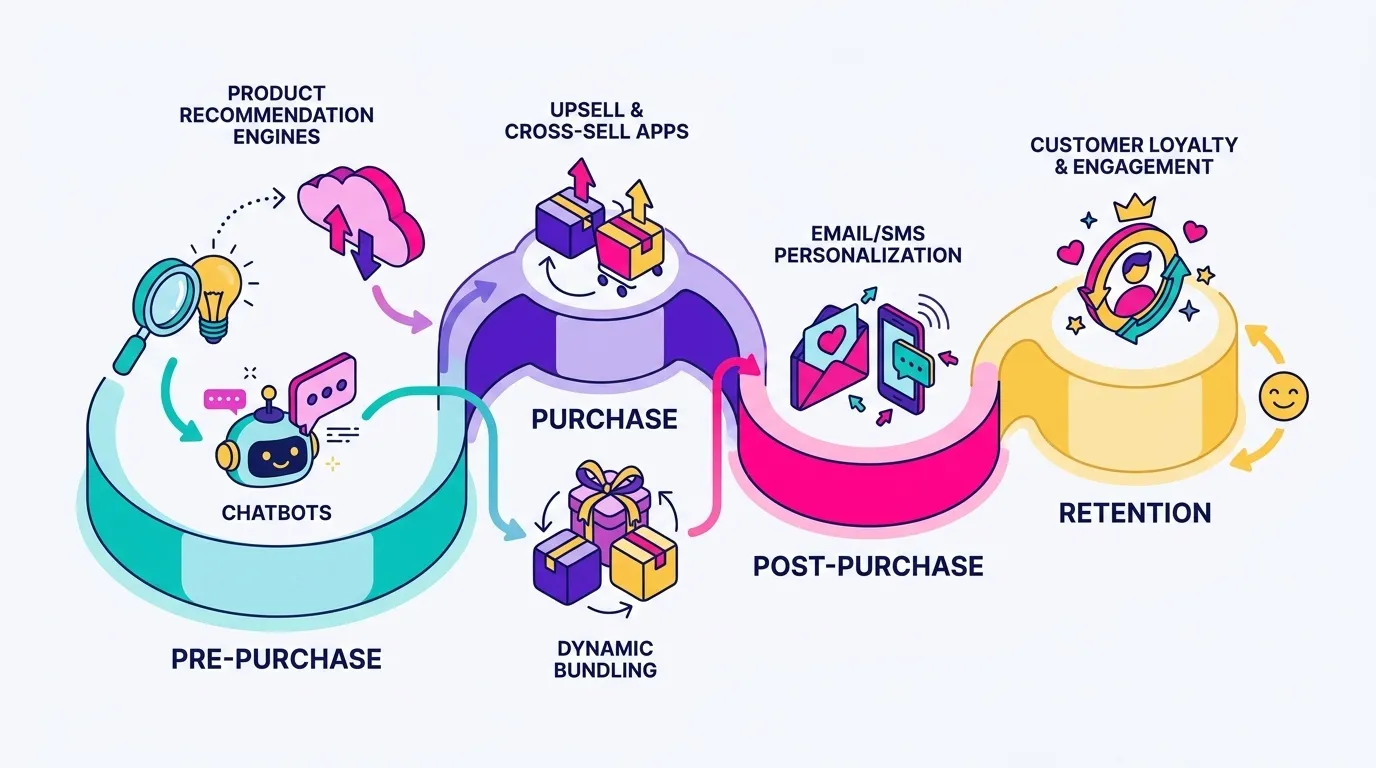
Direct answer: Which AI tools can I use to increase customer AOV? There are five main categories worth knowing: AI-powered product recommendation engines (pre-purchase, PDP-level), AI upsell and cross-sell apps (cart and checkout), AI chatbots and guided selling assistants (conversational, especially for high-consideration categories), AI-driven dynamic bundling (automated basket-building), and predictive personalization in email, SMS, and popups (retention and repeat-purchase layer). We’ll walk through each one, in the order a shopper actually encounters them.
How AI Actually Increases AOV (The Mechanics, Not the Hype)
Before naming specific tools, it’s worth understanding what’s actually happening under the hood. Otherwise you’re just trusting a vendor’s sales deck, and I’d rather you understand the mechanism.
Behavioral prediction vs. static “customers also bought”
Traditional eCommerce recommendation logic is rule-based: if a customer views Product X, always show Product Y. It’s static, it doesn’t learn, and it treats every shopper identically regardless of what they’re actually doing on your site. AI-driven recommendation models work differently. They ingest real behavioral signals and constantly update their predictions based on what’s happening in that specific session, not a fixed rule written six months ago.
The inputs matter here. A trained model looks at browsing history, current cart contents, past purchase behavior, time spent on specific product pages, and even scroll depth to build a probability score for “what is this shopper likely to add next.” It’s the difference between a boxer who throws the same combination every round and one who reads his opponent’s guard and adjusts in real time. One gets predictable, the other keeps winning rounds.
Real-time personalization at the product page and cart level
This plays out live on your storefront. A well-implemented AI widget doesn’t show the same “you may also like” block to every visitor. It changes what it displays based on what’s already sitting in the cart, adjusting the offer the moment a shopper adds a second item versus a first.
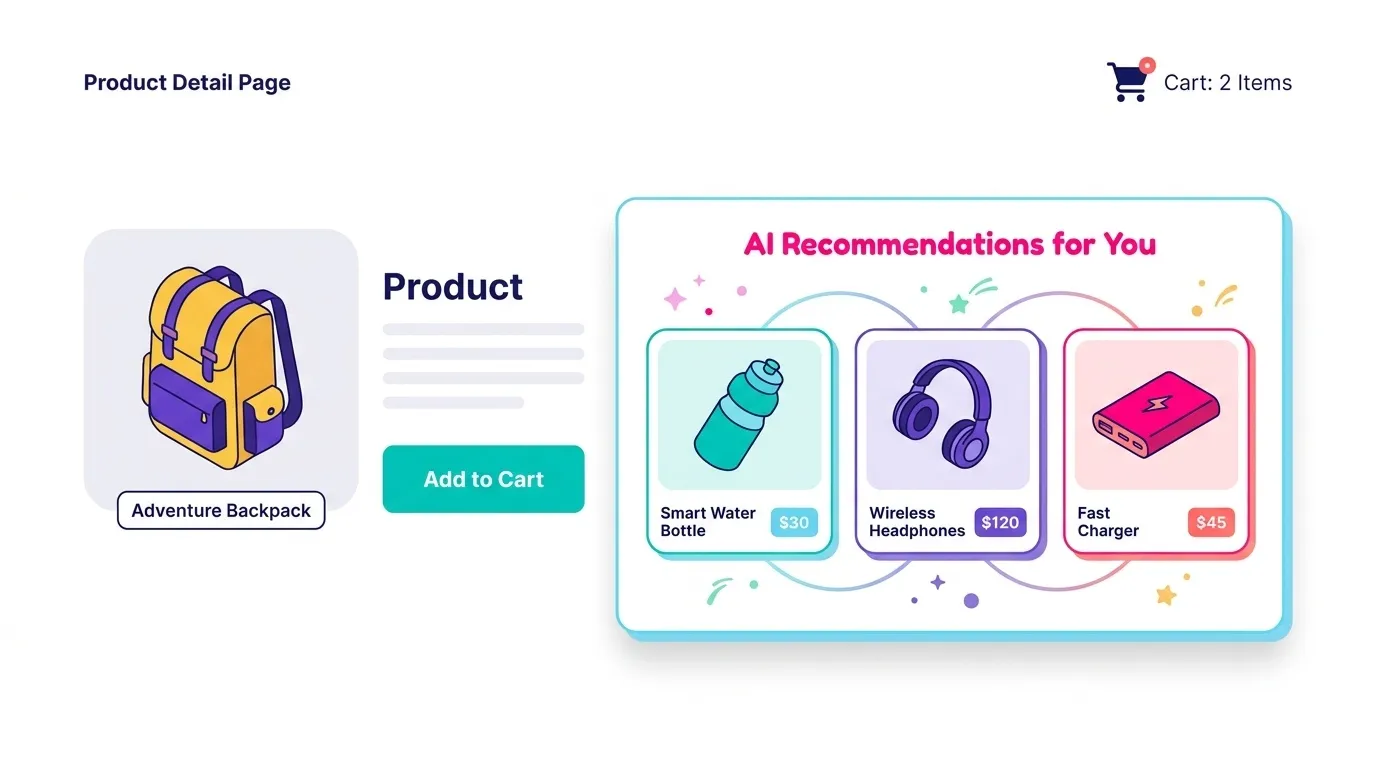
Picture a generic PDP recommendation slot showing the same three “related products” to everyone, versus an AI-personalized slot that recognizes a shopper just added a dress and now surfaces a matching belt or shoe style that’s frequently co-purchased with that exact SKU. The lift potential is real, though I’d treat any specific percentage you see quoted by a vendor as illustrative rather than guaranteed, results vary heavily by traffic volume and catalog depth.
Now that the mechanics are clear, let’s break down the five categories in the order a shopper actually moves through your funnel, starting with the page they land on first.
AI-Powered Product Recommendation Engines
This is the pre-purchase layer, and it’s usually the first AI tool category a growing Shopify brand installs.
How they work: collaborative filtering + on-site behavior signals
These engines cross-reference an individual shopper’s behavior against patterns observed across your entire customer base. If enough customers who bought Product A also bought Product B, the model learns that association and surfaces it to new shoppers exhibiting similar early behavior. This is collaborative filtering, layered on top of live on-site signals like current session activity.
Placement strategy matters just as much as the algorithm itself. A recommendation engine can be technically excellent and still underperform if it’s buried below the fold on a PDP, or competing with five other widgets for attention on the homepage. Where you place it changes whether shoppers ever see it, which is a CRO problem as much as a tech problem.
Examples: Nosto, LimeSpot, Rebuy in Shopify context
Three names come up constantly in this space, each with a slightly different positioning. Nosto leans enterprise, offering a broader personalization suite beyond just recommendations. LimeSpot is more mid-market and Shopify-native, making it a common first pick for brands in the $1M-$5M range. Rebuy has built a strong reputation specifically around subscription flows and upsell mechanics, which makes it a natural fit if replenishment is core to your beauty or wellness catalog.
For Shopify Plus merchants, native theme integration tends to move faster because checkout and theme extensibility are more flexible. Standard Shopify plans can still run these tools well, just expect slightly more app-block configuration to get placement right.
Before you scale spend or reliance on any recommendation widget, validate it visually. Heatmaps tell you whether shoppers are actually engaging with the widget or scrolling past it entirely, which ties directly into how you approach product page optimization as a whole.
AI Upsell & Cross-Sell Apps for the Cart and Checkout
Once a shopper has committed to buying something, the second funnel layer kicks in: cart and checkout.
These tools specialize in one-click post-purchase offers, presented immediately after a customer completes payment but before they hit the order confirmation page. The AI-enhanced versions of this mechanic don’t show a static “add this too” offer to everyone, they adjust the specific offer based on what the customer just purchased, increasing relevance and, ideally, acceptance rate.
There’s an important distinction between in-cart upsells (shown before checkout, while the shopper can still edit their cart) and post-purchase upsells (shown after payment is captured, with a single click to add). The psychology differs. In-cart upsells compete with checkout friction and cart abandonment risk. Post-purchase upsells convert on pure impulse, since the payment decision is already made and the shopper just needs to click “yes.”
Where AI beats rule-based upsell logic
A static rule shows the same upsell to every customer who buys Product X. An AI-driven version adjusts sequencing and even pricing dynamically per shopper, factoring in what’s actually in their basket rather than a single hardcoded trigger. Consider a skincare brand: instead of a generic “frequently bought together” block, the AI layer recognizes the exact serum just added and surfaces a complementary SPF specifically formulated to pair with it, not a random moisturizer pulled from the catalog.
That said, more prompts aren’t automatically better. Stacking multiple upsell moments at checkout increases friction fast, and we’ll come back to that trap later in the mistakes section, because it’s one of the most common ways brands sabotage their own AOV gains.
For Shopify Plus merchants, checkout extensibility opens up more customization here than standard Shopify plans allow, which is worth factoring into your tool selection if checkout-stage upsells are a priority.
AI Chatbots and Guided Selling Assistants
Not every AOV win comes from an algorithm quietly running in the background. Sometimes it comes from a conversation.
Conversational commerce for high-AOV categories (beauty sets, home bundles)
A guided-selling chatbot asks qualifying questions, skin type, budget range, intended use, and then recommends a bundle rather than a single item. This matters enormously in categories where product-fit uncertainty is what’s suppressing AOV in the first place. A shopper unsure whether a serum will suit their skin type will often default to buying just one item to “test it,” when a guided quiz could have confidently recommended a three-piece routine from the start.
Building these qualifying questions around a clear buyer persona for each shopper segment, rather than a generic one-size-fits-all quiz, is what separates a chatbot that actually lifts AOV from one that just adds friction.
This is precisely why beauty, wellness, and home categories benefit disproportionately from this tool type. The uncertainty tax on multi-item purchases is real, and a well-designed guided flow removes it by doing the thinking for the shopper.
From FAQ bot to guided-selling assistant
There’s a meaningful difference between a basic FAQ chatbot that answers shipping questions and an AI-driven guided-selling assistant that actively recommends higher-value baskets based on stated preferences. Most brands already have the former installed and assume it’s doing AOV work. It isn’t, unless it’s specifically configured to recommend and bundle.
If you want the full mechanics of building a chatbot that actually sells rather than just answers tickets, I break that down in more depth in our chatbot marketing strategy post. Here, I’ll just say this: a quiz-to-chatbot flow that ends in a recommended bundle tends to lift basket size compared to a static “shop now” CTA, though the exact magnitude depends heavily on your category and how well the questions are designed.
AI-Driven Bundling and Dynamic Pricing
Recommendations suggest one item at a time. Bundling builds the whole basket automatically, and that’s a distinct mechanism worth separating out.
How AI decides which SKUs to bundle and when
Bundling algorithms analyze co-purchase frequency, current inventory levels, and margin data to auto-generate bundle offers, rather than relying on a merchandiser manually curating them once a quarter. This means bundles can update dynamically as stock levels shift, something a static “shop the set” page simply can’t do on its own.
Dynamic pricing logic takes this further. An AI-driven system can adjust bundle discount thresholds in real time based on demand signals, discounting more aggressively on overstocked SKUs while holding firmer margins on fast-movers. It’s automated inventory-aware merchandising, running continuously in the background.
Picture a fashion brand running a “build your own bundle” feature where AI suggests complementary sizes and colors based on real-time stock and popularity data, steering shoppers toward what’s actually available and selling well, rather than pushing dead stock that happens to be sitting in a warehouse.
Founders often worry about margin erosion here, and it’s a fair concern. Bundling tools should tie back to defined margin rules, not just volume targets. If the AI is optimizing purely for units moved without a margin floor, you can end up “winning” on AOV while quietly losing on profit, which is the exact tension we cover in our piece on how to maximize profit rather than just chasing top-line revenue.
One practical note before you buy anything: bundling tools frequently overlap with recommendation engines, some platforms genuinely do both. Check for redundancy before adding another line item to your app stack.
AI Personalization in Email, SMS & On-Site Popups
AOV strategy shouldn’t stop at the storefront. Retention channels carry serious, often underused, AOV potential.
Predictive send-time and product-block personalization
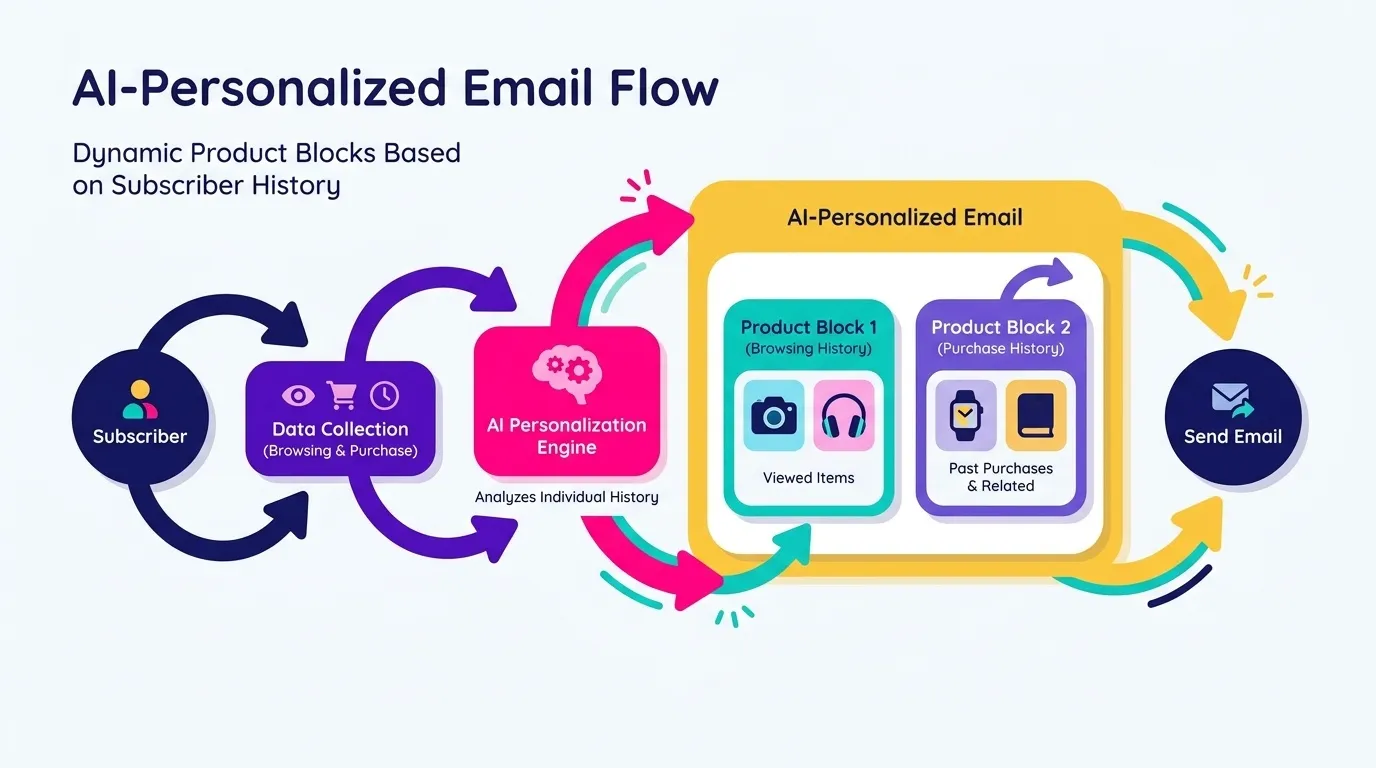
Klaviyo AI is the tool that comes up most often here, and for good reason. It predicts optimal send times per individual subscriber and personalizes the product blocks inside flows and campaigns based on each person’s browsing and purchase history. This isn’t the same product block for your entire list, it’s dynamically assembled per recipient.
This affects AOV specifically, not just repeat purchase rate. A personalized post-purchase flow that recommends genuinely complementary products drives higher basket value on the next order, rather than simply nudging the customer to buy the same item again.
The same logic extends to on-site popups. Instead of a static “get 10% off” exit-intent popup shown to everyone, an AI-personalized version adjusts the offer or product shown based on actual cart contents, which tends to feel far less generic to the shopper on the receiving end.
This is squarely automation territory, and if you want a broader view of lifecycle flows beyond just AOV, our marketing automation ideas post covers the wider picture. One caution worth flagging early: over-triggering these popups and emails causes frequency fatigue fast, and we’ll unpack that properly in the mistakes section next.
How to Choose the Right AI Tool for Your Store’s Stage
Here’s where most listicles stop being useful, because they hand you a list without telling you which tool fits your actual situation.
A $1M-$5M brand and a $5M-$20M brand should not be buying the same AI stack. Implementation bandwidth differs, and more importantly, the data volume an AI model needs to learn effectively differs too. A recommendation engine trained on 200 orders a month will produce far weaker predictions than one trained on 5,000.
If you’re in the $1M-$5M range, start lighter. Shopify-native recommendation apps and the AI features already bundled into a Klaviyo plan you’re likely already paying for will get you real gains before you invest in a dedicated bundling platform or a custom-trained chatbot. Prove the concept cheaply first.
If you’re in the $5M-$20M range, you generally have enough traffic and order volume for AI models to train effectively, and enough margin cushion to test more aggressively. This is the stage where layering in dedicated upsell/cross-sell platforms and guided-selling chatbots starts to make financial sense, because the data backing those decisions is actually reliable.
Tool Category
Best-Fit Revenue Stage
Implementation Effort
Directional AOV Lift Range
AI Recommendation Engines
$1M-$5M and up
Low to Medium
3-8%
AI Upsell/Cross-Sell Apps
$1M-$5M and up
Low
2-6%
AI Chatbots / Guided Selling
$5M-$20M
Medium to High
5-12%
AI Dynamic Bundling
$5M-$20M
Medium
4-10%
AI Email/SMS Personalization
$1M-$5M and up
Low
2-7%
Treat these ranges as directional, not guarantees. Actual outcomes depend on catalog size, traffic quality, and how well the tool is configured, which brings up an important caveat.
Revenue stage matters less than data volume. A $2M brand with high traffic and healthy order counts may be more “ready” for AI personalization than a $6M brand with low order volume and a niche, low-frequency catalog. Check your actual data depth against the CRO framework you’re already running before assuming revenue alone qualifies you for the more advanced tools.
Common Mistakes When Deploying AI Tools to Increase AOV
This is the section most “top 10 AI tools” articles skip entirely, and it’s arguably the most important one here.
Over-personalization and checkout friction
Stacking multiple AI-driven prompts at once, a recommendation widget on the PDP, a chatbot popup, an exit-intent offer, and a post-purchase upsell, creates decision fatigue fast. You end up targeting AOV so aggressively that you hurt overall conversion rate, which defeats the purpose entirely. Every additional prompt has to earn its place.
There’s also the false urgency trap. Some AI tools auto-generate scarcity messaging (“only 2 left!”) without checking whether that’s actually true against live inventory. Shoppers notice inconsistency fast, and once trust erodes on one message, it erodes across your whole storefront.
Deploying without a testing framework
Installing an AI upsell app and flipping it on for 100% of traffic on day one is a gamble, not a strategy. We recommend heuristic analysis first: does the widget placement make sense, is the offer logically relevant, does it respect the shopper’s current context? Only once that passes a basic sanity check should you move to structured A/B testing with VWO, assuming you have enough traffic to reach statistical confidence.
Microsoft Clarity plays a specific role here that’s easy to underrate. Watching session recordings and heatmaps around a newly deployed AI widget tells you whether people are actually engaging with it, ignoring it entirely, or rage-clicking it out of confusion, well before you’d see any of that reflected in a revenue report.
A practical checklist to close this section: test one AI tool at a time, isolate its impact on AOV via GA4 segmentation, and set a defined evaluation window before judging ROI. Running three new tools simultaneously guarantees you’ll never know which one actually moved the number.
How to Measure Whether Your AI Tool Is Actually Moving AOV
“AOV went up since we installed the tool” is not proof the tool worked. Seasonality, a promo you ran that same week, or a shift in traffic mix toward higher-intent channels can all move AOV independently of anything the AI widget did.
Event tracking for upsell/cross-sell attribution
Before you can trust any of this, your web analytics foundation needs to be solid, inconsistent or missing event tracking will make any AOV comparison meaningless before you even start. Set up a custom GA4 event, something like ai_upsell_add_to_cart, fired specifically when a shopper adds an item through the AI widget rather than through normal browsing. This isolates revenue directly attributable to the tool, instead of lumping it in with organic basket building that would have happened anyway.
Once that event is live, build a simple GA4 exploration comparing AOV for sessions that engaged with the AI tool versus sessions that didn’t. It’s not a perfect randomized experiment, but it’s a solid heuristic proxy for lift, and it’s far more rigorous than eyeballing a monthly dashboard.
Pair this with Clarity session recordings on a sample of AI-influenced sessions. Numbers tell you what happened, recordings tell you why, and the “why” is often where the real optimization opportunity is hiding.
Give it time before making a keep/kill call. A minimum of one full order cycle, longer if your catalog has a slower repeat-purchase rhythm like home goods, gives you enough data to judge the tool fairly rather than reacting to a noisy first week.
Building an AOV Strategy That Actually Compounds
Let’s bring this together. AI tools aren’t a plug-and-play AOV button you install and forget. They’re most effective when mapped to a specific funnel stage and matched honestly to your store’s maturity, exactly as we’ve broken down above.
Measurement discipline is what separates the brands who see real AOV lift from the ones who just add another app to an already bloated Shopify stack. GA4 event tracking, Clarity heatmaps, and VWO testing aren’t optional extras here, they’re the difference between knowing something worked and hoping it did.
I get it, though. Most $1M-$20M teams don’t have the internal bandwidth to run this level of testing rigor on top of daily operations, and that’s genuinely fine. That’s exactly where a CRO and AI partner adds practical value, not by promising magic, but by bringing a tested rollout process to something you’d otherwise be guessing at.
If you’re weighing which AI tools deserve a spot in your stack, we’d rather help you test small, validate with real data, and scale only what earns its place, than watch you bet the store on an unproven widget. Explore our CRO services or our AI automation work to see how we approach this end to end.
We’ll analyze your current funnel, flag where AOV is genuinely being left on the table, and build a testing roadmap that tells you what’s working before you scale spend on it.
Let’s turn your average order into your best-performing metric, side by side.