A new frontier model launches roughly every few weeks, and every launch arrives with a press cycle claiming it changes everything. For marketers, most of them change nothing about Tuesday morning. The releases worth your attention are the ones that shift what you can produce, what you can query, or what you can automate, and this piece gives you a four-point filter to spot them without reading another benchmark thread.
If you run marketing at a DTC brand doing a few million a year, you have probably spent an evening reading launch threads on LinkedIn and ended it with no idea what to actually do differently. That is the problem I want to solve here. I will show you the filter I run before I touch a client workflow, then apply it to SEO and GEO, paid creative, and automation, so you know exactly where the real shifts have landed.
Why most AI model news is noise for marketers
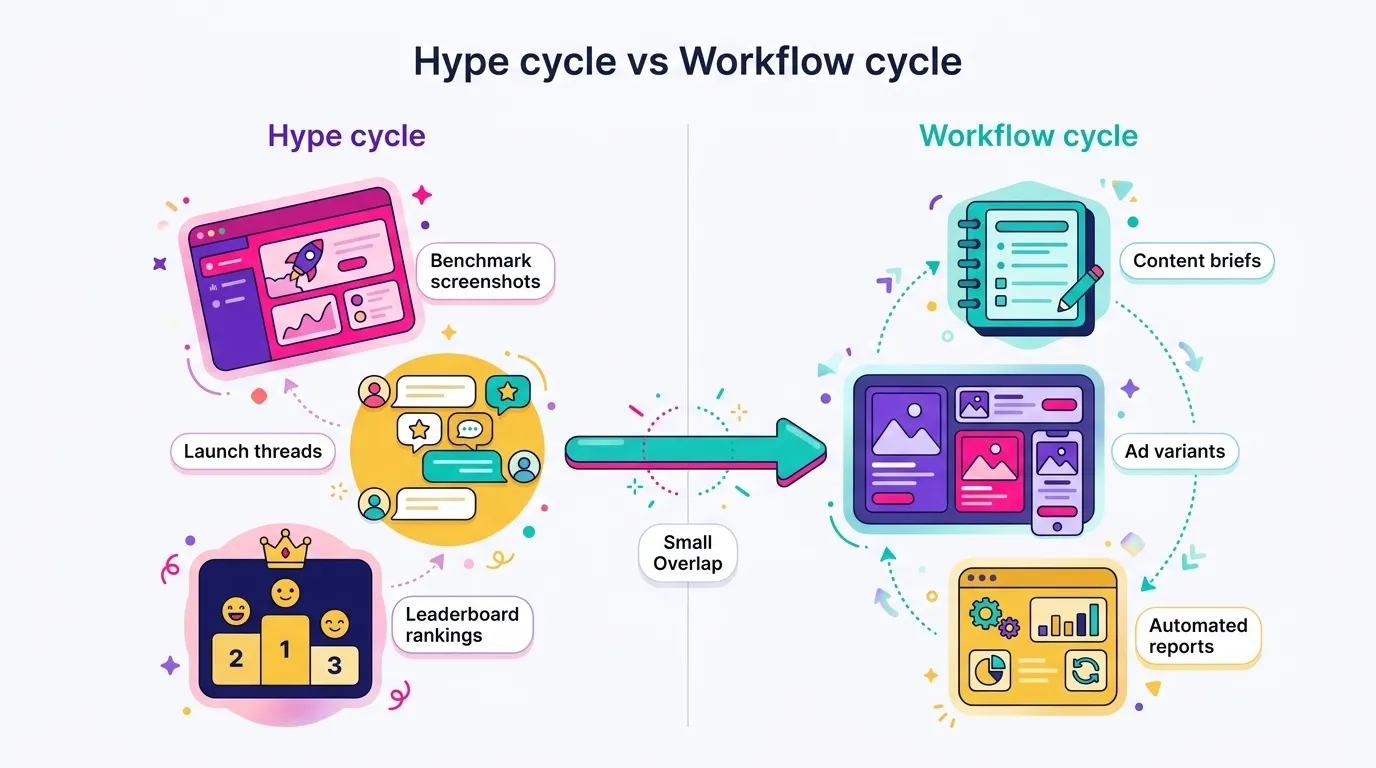
Every launch follows the same script. A benchmark screenshot, a “beats the previous flagship on X” claim, a demo video with ambient synth music, and 400 reposts within the hour. None of that tells you whether your content team can ship faster next week or whether your product feed can finally be processed in one pass.
Part of my job at Midsummer is to absorb this flood so the rest of the team does not have to. I read the model cards, I test the API, and most weeks my conclusion is a shrug: interesting, changes nothing for us yet. That shrug is the most common honest answer, and almost nobody publishes it.
The hype cycle vs. the workflow cycle
The hype cycle rewards speed of commentary. Post first, get the impressions, move on. The workflow cycle has one rule: did an output you actually ship get better, cheaper, or faster to produce?
Those two cycles overlap maybe once or twice a year. The rest of the time a release moves the first needle and leaves the second one completely still. Once you internalise that, you can skip most of the content written about model launches without losing anything.
Who should track releases closely, and who should not
If you build on raw APIs for a living, track everything. Model behaviour changes break prompts, function calls and output schemas, and you want to know before a client notices.
If you are a founder, a head of ecommerce or an SEO lead at a brand between $1M and $20M in revenue, a filtered monthly summary is plenty. You need to know when something changes what your team can do, not when a lab updates a leaderboard. Everything else is somebody else’s homework.
The four-point filter: how to tell if a release actually matters
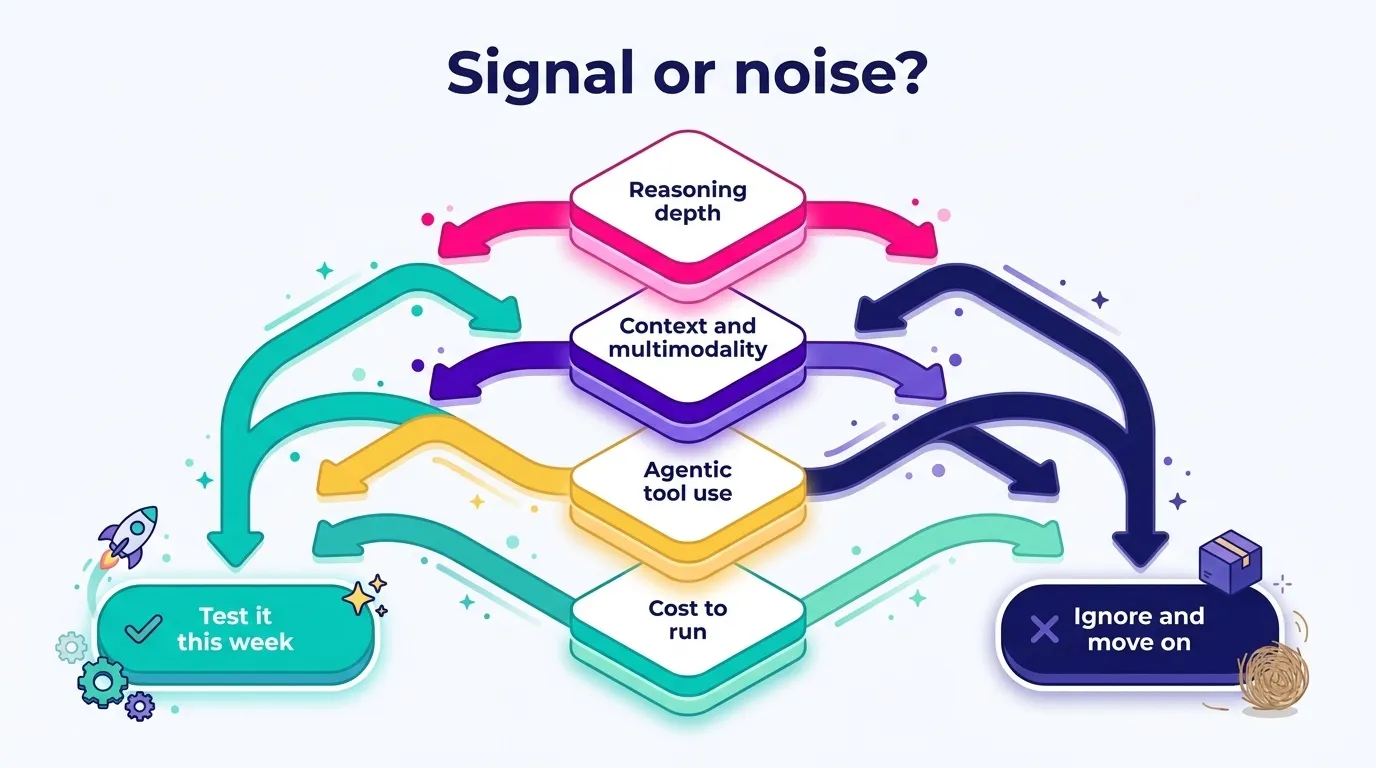
Replace the question “is this model smarter” with “does this change what I can do”. Then ask four things. Each one is a yes or no, and a single clear yes is enough to justify a closer look.
Reasoning depth
Does the model produce better strategic output, not better test scores? The practical test is boring and reliable: give it the same content brief, the same keyword cluster, the same competitive analysis you gave the previous model, and see how much restructuring the output needs before a human would publish it.
When reasoning genuinely improves, you feel it in editing time. Fewer rewrites of the argument, fewer sections that technically answer the prompt but miss the point. When it does not improve, the prose just gets glossier.
Context window and multimodality
Theoretical token counts are a marketing number. What matters is whether the model can hold your actual working material in one pass: a 4,000 SKU catalogue export, a 30 page brand guideline, a quarter of ad creative with the performance data attached.
Long-context models like the Gemini family changed real work here, because feeding an entire style guide plus a full product set in one request removes the chunking logic that used to eat half the build time. Multimodality matters for the same practical reason: if the model can read your creative assets and your dashboards as images, you stop writing descriptions of things it could just look at.
Agentic and tool-use capability
This is the dividing line between a model that answers and a model that works. Can it call tools reliably, browse, chain five steps together and recover when step three fails?
For anyone running n8n, Make or a LangGraph-style stack, function-calling reliability is the single most consequential property in a release. A model that follows a tool schema reliably, instead of drifting off it under a longer chain of steps, is the difference between an agent you can leave running and one that needs a human babysitter.
Cost to run
The least glamorous criterion and often the most decisive. Price per million tokens and latency decide what is economically viable, not what is technically possible.
Writing unique descriptions for 10,000 SKUs is the same prompt whether the run costs you a few dollars or several hundred, and that gap is what decides whether the job gets automated. When a capable model drops in price, automations that were sitting in my “nice idea, bad math” list suddenly move into production. Those price moves are published, checkable, and far more useful to you than any benchmark chart.
Which AI model release should marketers actually care about? The ones that measurably shift at least one of those four criteria for a task you already do: content production, ad creative, SEO and GEO work, or internal automation. Topping a leaderboard does not qualify.
What recent releases changed for SEO and GEO work
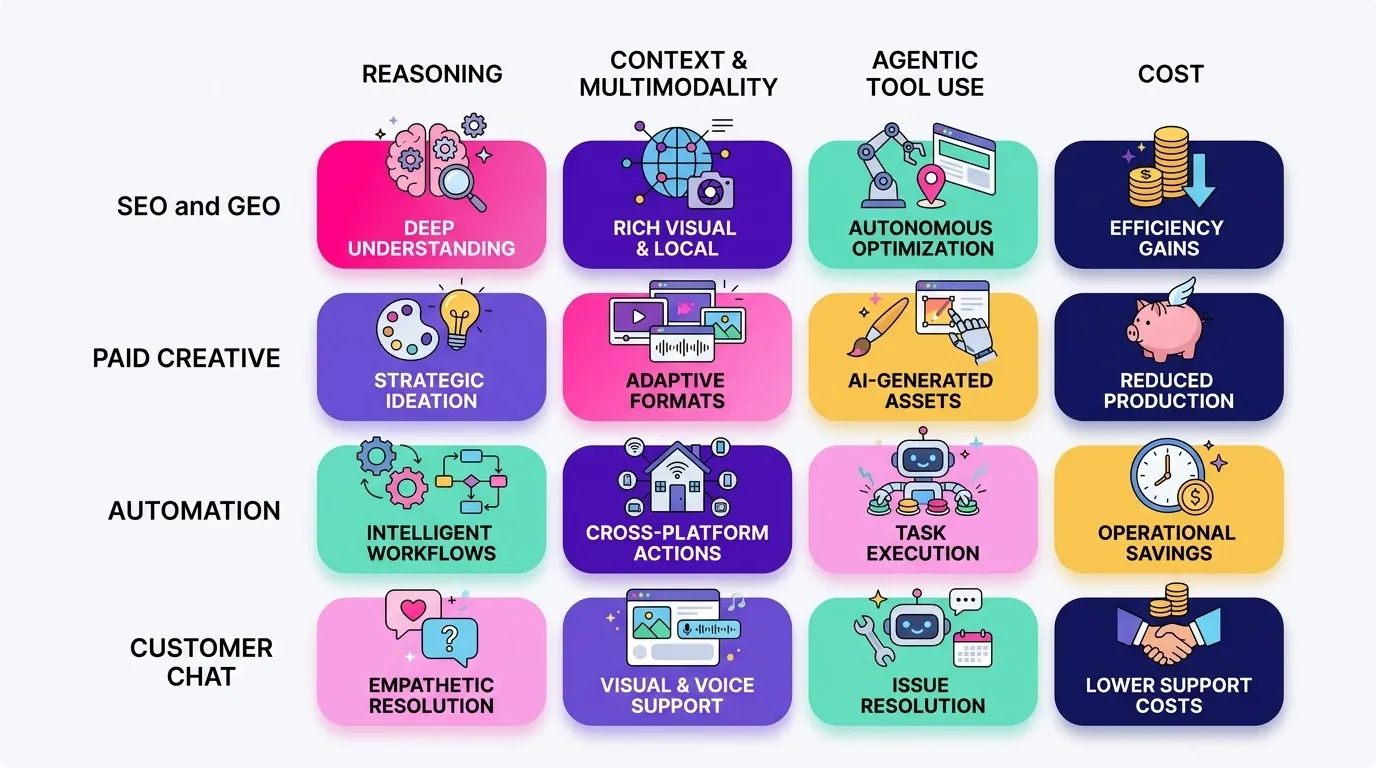
Two of the four criteria have genuinely moved for SEO work: reasoning depth and context. Drafts come back more coherent across 2,000 words, and the structure of an argument survives to the end of the piece instead of degrading into a bullet soup by section four. That cuts editing time, which is the only SEO metric a model release can directly affect.
The more interesting shift is on the generative search side. Models with better retrieval and more consistent citation behavior change how your brand gets referenced inside AI answers, which is a different game from ranking blue links. If you sell a large catalogue, the practical question is whether your product pages are structured clearly enough to be quoted, and we covered that in depth in our piece on getting your products cited, not just ranked. The strategic difference between the two disciplines is laid out in SEO vs GEO.
One caveat I would push hard: almost every “better for search” claim in a launch post is unverifiable. Nobody publishes how a model picks its citations. So test it yourself. Ask the model the ten questions your customers ask, see who gets named, and track it over time rather than trusting the announcement. GEO is where I test new models first, simply because the feedback loop is fast and brutally honest.
Capability shift in the release notes
What it actually changes
Impact on SEO and GEO work
Deeper reasoning / longer coherent output
Drafts hold a single argument across a full article
Less human restructuring per piece, higher output per editor
Million-token context windows
Full catalogue exports and brand guidelines fit in one request
Consistent tone across thousands of product pages without chunking logic
Native multimodal input
Model reads screenshots, SERP captures and creative directly
Faster competitive and on-page audits with less manual data entry
Improved retrieval and citation behaviour
Answers lean more on live sources than on training memory
Your content structure decides whether you get quoted in AI answers
Reliable function calling
Model can query your tools and act on the result
Content QA, internal linking checks and reporting run unattended
What recent releases changed for paid media and ad creative
On ad copy, the honest summary is that quality improved where you feed real context and stayed mediocre where you do not. A current model given your landing page, your top performing headlines and your actual objection handling produces variants a media buyer will run. The same model given “write 10 Google Ads headlines for a skincare brand” still produces the beige filler it always did.
Image and video models are where the workflow math changed most. When a creative team can generate twenty usable concept variations in an afternoon instead of briefing an external designer for a week, the testing bottleneck moves from production to analysis. That is a real shift for fashion brands running seasonal drops, where the window to test creative is measured in days. The limit is no longer how many variants you can make, it is how much traffic you have to judge them with.
The third shift is catalogue understanding, and it is early but worth watching if you run Shopify Plus with thousands of SKUs. Models that parse a product feed properly can reason about substitutions, bundles and attribute gaps, which matters both for recommendation logic and for how agents eventually shop your store. We mapped the merchandising side of that in our overview of AI tools that lift average order value.
What recent releases changed for marketing automation and agentic workflows
This is my own backyard, and it is the area where the last wave of releases changed the most. Tool use went from “works in a demo” to “works often enough to deploy”. Models now follow structured output formats consistently, call several tools in sequence, and handle a failed step without derailing the whole run.
In practice that means fewer human checkpoints inside a workflow. A reporting agent that used to need someone to confirm the data pull can now query the source, validate the numbers against last month, flag the anomalies and draft the commentary. A content QA agent can crawl a batch of new pages, check them against the brief and only escalate the ones that fail.
Customer-facing conversation quality improved as a side effect. Holding context across a twenty message exchange while checking order status through an API is a tool-use problem more than a language problem, and that is exactly what got better. The same capability underpins the shopping agents starting to transact on behalf of customers, which we unpacked in our piece on agentic commerce. When I decide whether to rebuild a client automation around a new model, this criterion is usually the deciding one. Better prose is nice. Reliable tool calls pay rent.
The red flags of noise: what to actively ignore
Benchmark wins come first. A model topping a synthetic reasoning test tells you almost nothing about whether it writes a usable product description for a candle brand. I have watched leaderboard leaders lose head to head on real client prompts more than once, because the thing being measured is not the thing you need.
Second, ignore anything that is announced but not available. Launch videos routinely show capabilities that reach general API access months later, or in a limited region, or at a price that kills the use case. Until you can hit it with an API key, it does not exist for planning purposes. I have lost afternoons to features that looked remarkable in a keynote and then fell apart the moment they met a real workflow with real error handling, so now I wait for access before I get interested.
Third, consumer app gimmicks. A new chat interface trick with no reproducible business use case is entertainment. Enjoy it, do not build a quarter around it. And if you are in Europe, remember that compliance has a say in what you deploy regardless of how good the demo was, which is worth factoring in early rather than late. Our breakdown of what the EU AI Act means for advertisers covers that side.
How to stay current without chasing every launch
Monthly is the right cadence for most marketing teams. Block an hour, read the official model cards and changelogs from the labs you actually use (OpenAI, Anthropic and Google publish them), check the pricing pages, and ignore the commentary layer entirely. Primary sources take less time to read than the threads summarizing them.
The nautical instinct applies well here: you do not chase every wave that looks big from shore, you watch for the set that is actually heading your way. The four-point filter is the compass. The feed is just weather.
Internally we run this as a standing triage. New release goes through the filter, anything that scores a yes gets tested against a fixed set of client prompts and workflows, and only then does it reach the team as a recommendation with a reason attached. Most releases never make it past the first step, which is exactly the point.
Final thoughts: a filter, not a feed
Keep four questions and you can throw away the rest of the coverage. Does it reason better on work you already do? Does it hold your real material in one pass? Can it reliably use tools? Does it change the economics of automating something at scale?
That reframe is the whole article. The question is never whether a model is impressive, it is whether it changes what you produce, query or automate this month. Nine times out of ten the answer is no, and knowing that quickly is worth more than knowing it first.
If you would rather have someone else run this triage and build the automations that come out of it, that is a good chunk of what I do. Take a look at our AI automation services, or send us your current stack and we will tell you where the real gaps actually are.