Agentic Commerce: What Happens When An AI Agent Checks Out For Your Customer
AI agents are starting to browse, compare and buy on behalf of shoppers. We explain what agentic commerce changes and how to make your store selectable.
Agentic commerce is when AI agents, like ChatGPT’s Instant Checkout or Perplexity’s shopping assistant, browse, compare, and complete purchases on a shopper’s behalf without a human clicking through each step. OpenAI, Perplexity, Google (via AP2), and card networks like Visa and Mastercard are already building the infrastructure for this. For DTC brands, the takeaway is simple: product feeds, schema markup, and plain-text policies need to be agent-readable, not just human-readable. Agents don’t rank you poorly for messy data, they just quietly leave you off the shortlist.
Picture this: a shopper types “find me a waterproof running jacket under $150” into ChatGPT or Perplexity. No tabs open. No scrolling. An AI agent does the browsing, the comparing, and eventually the buying, on the human’s behalf.
This isn’t a thought experiment for a keynote slide. It’s happening right now, in pilots and live integrations, and it quietly changes who (or what) your store actually needs to convince.
I’m not going to bury you in developer jargon or protocol diagrams. This piece is written for a Shopify manager who wants to know exactly what to check this quarter, not a whitepaper for engineers.
What Is Agentic Commerce?
The Short Definition
Here’s the direct answer, no runaround: agentic commerce is when an AI agent, acting on a shopper’s behalf, searches, compares, and completes a purchase without the human clicking through each step themselves. The agent doesn’t just recommend. It executes.
How It’s Different From a Chatbot Recommending a Product
That distinction matters more than it sounds. A chatbot that suggests three jackets and says “here are some options” is still handing the wheel back to the human. The human clicks, compares prices manually, and pays. That’s recommendation.
An agent that checks stock, compares five stores, picks the best match against a stated budget, and completes the payment is execution. Gartner has been using the term “machine customers” to describe this shift: entities, not people, initiating and completing purchases based on parameters we set once and then largely forget about.
There’s a spectrum here, and it’s worth understanding before we go further. Some flows still pause for a human nod before the card gets charged (“agent shops, human approves”). Others run fully autonomous within guardrails you define upfront, like a subscription refill or a budget cap for office supplies.
Why does this matter practically? Because the level of autonomy determines when your brand has to do its persuading. If a human still approves the final pick, your product page copy still has a job to do. If the agent decides alone, your persuasion has to be baked into the data itself, before any human eyes ever see it.
From Search to Chat to Agents: A Quick Timeline
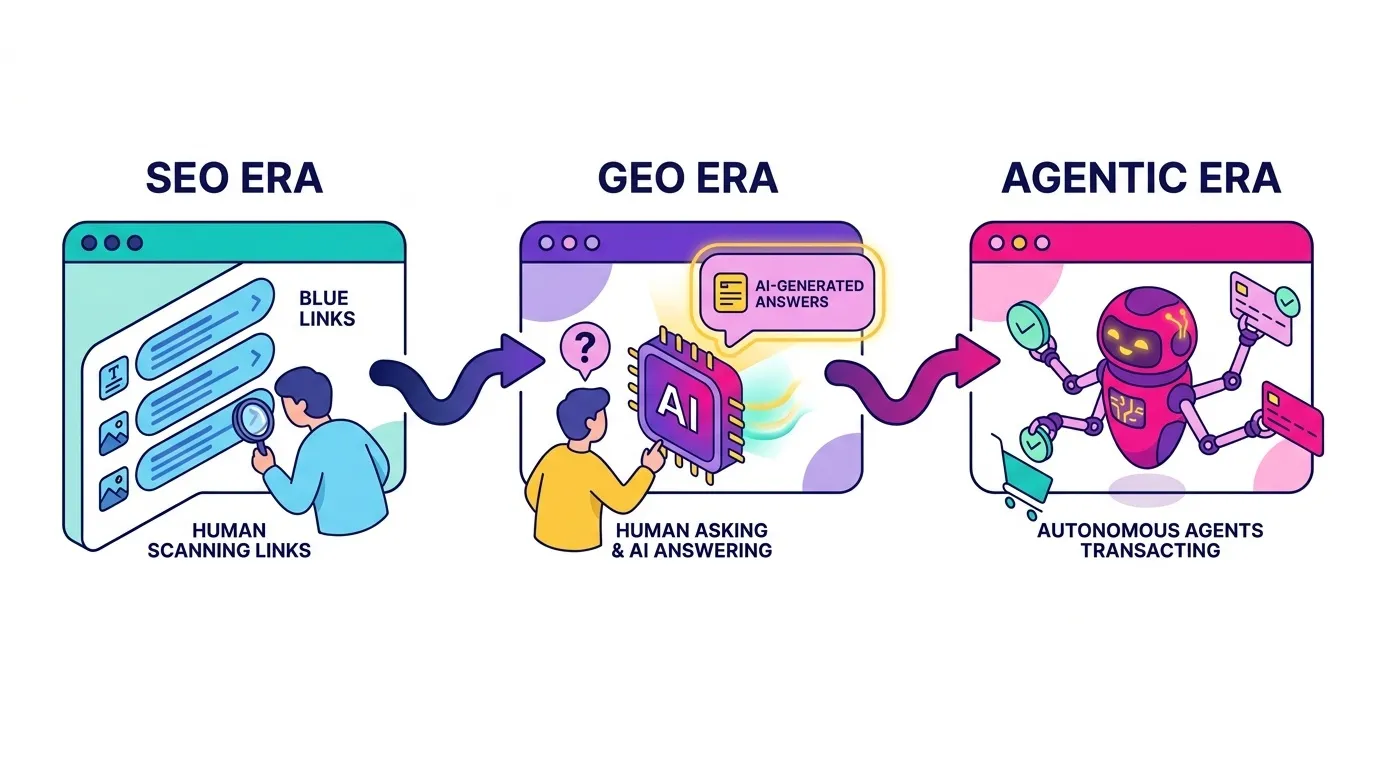
SEO Era → GEO Era → Agentic Era
Let’s zoom out, because this helps the whole thing click into place. In the SEO era, you optimized to rank in a list of blue links that a human would scan with their own eyes and click at their own pace.
Then came the GEO era. Suddenly the goal wasn’t just ranking, it was being cited and summarized inside an AI-generated answer, as we’ve covered in detail in our SEO vs GEO breakdown. The human still asks the question, but an AI does the reading for them.
Now we’re stepping into the agentic era. Nobody scans anything. An autonomous process selects, compares, and transacts, and the human only sees the final result: a confirmed order.
Why This Shift Is Happening Now
This isn’t arriving out of nowhere. Three things had to mature at roughly the same time, and they finally have.
First, large language models got genuinely good at function-calling and tool-use, meaning an agent can reliably parse structured data and carry out multi-step tasks without falling apart halfway through. Second, agent frameworks (think browser-navigating agents and standardized integration protocols like the Model Context Protocol) became consistent enough for real commerce use cases, not just demos.
Third, and this is the part people underestimate, payment infrastructure caught up. Tokenization and agent-specific authentication now make it possible for a transaction to happen safely without a human physically present to type in a card number. That’s the piece that turns “cool demo” into “actual checkout.”
Who’s Already Building This
Let’s ground this in names, because vague talk about “the future of commerce” doesn’t help you plan your quarter. Here’s who’s actually shipping something.
OpenAI has rolled out Instant Checkout, letting a shopper complete a purchase directly inside a ChatGPT conversation, powered by merchant integrations with platforms including Shopify and Etsy. The agent doesn’t redirect you to a website. It finishes the transaction where the conversation already is.
Perplexity Shopping / “Buy For Me”
Perplexity has been pushing a similar idea with shopping features that let its assistant browse for products and complete a purchase based on a stated preference or budget, sometimes referred to as “buy for me” functionality. Same logic: state the intent once, let the assistant handle the legwork.
Google’s Agent Payments Protocol (AP2) and Project Mariner
Google has introduced the Agent Payments Protocol (AP2), an open protocol designed to let agents initiate payments in a way that merchants and issuers can trust. Alongside it sits Project Mariner, an agent built to navigate and take actions on websites the way a human would, clicking, filling forms, and completing tasks autonomously.
Visa Trusted Agent Protocol & Mastercard Agent Pay
The card networks aren’t sitting this one out either. Visa has been developing its Trusted Agent Protocol and Mastercard its own Agent Pay initiative, both aimed at giving merchants and issuers a way to recognize an agent-initiated transaction as legitimate, distinct from a fraud pattern. This is a genuinely important piece of the puzzle: without it, agent checkouts would keep tripping fraud filters.
Here’s the common thread across all four. Every single one of these systems requires your product, pricing, and policy data to be structured and accurate enough for an agent to act on with confidence. No structured data, no confident agent decision. It’s that simple.
Player
What It’s Doing
Layer of the Stack
OpenAI
Instant Checkout inside ChatGPT via Shopify and Etsy integrations
Conversational commerce interface
Perplexity
Shopping and “buy for me” assistant features
Discovery and execution assistant
Google
Agent Payments Protocol (AP2) and Project Mariner
Payment protocol and web-navigating agent
Visa / Mastercard
Trusted Agent Protocol and Agent Pay
Payment rail trust layer
How an AI Agent Actually Shops
Understanding the mechanics behind this matters, because it directly sets up what you’ll need to fix later in this article.
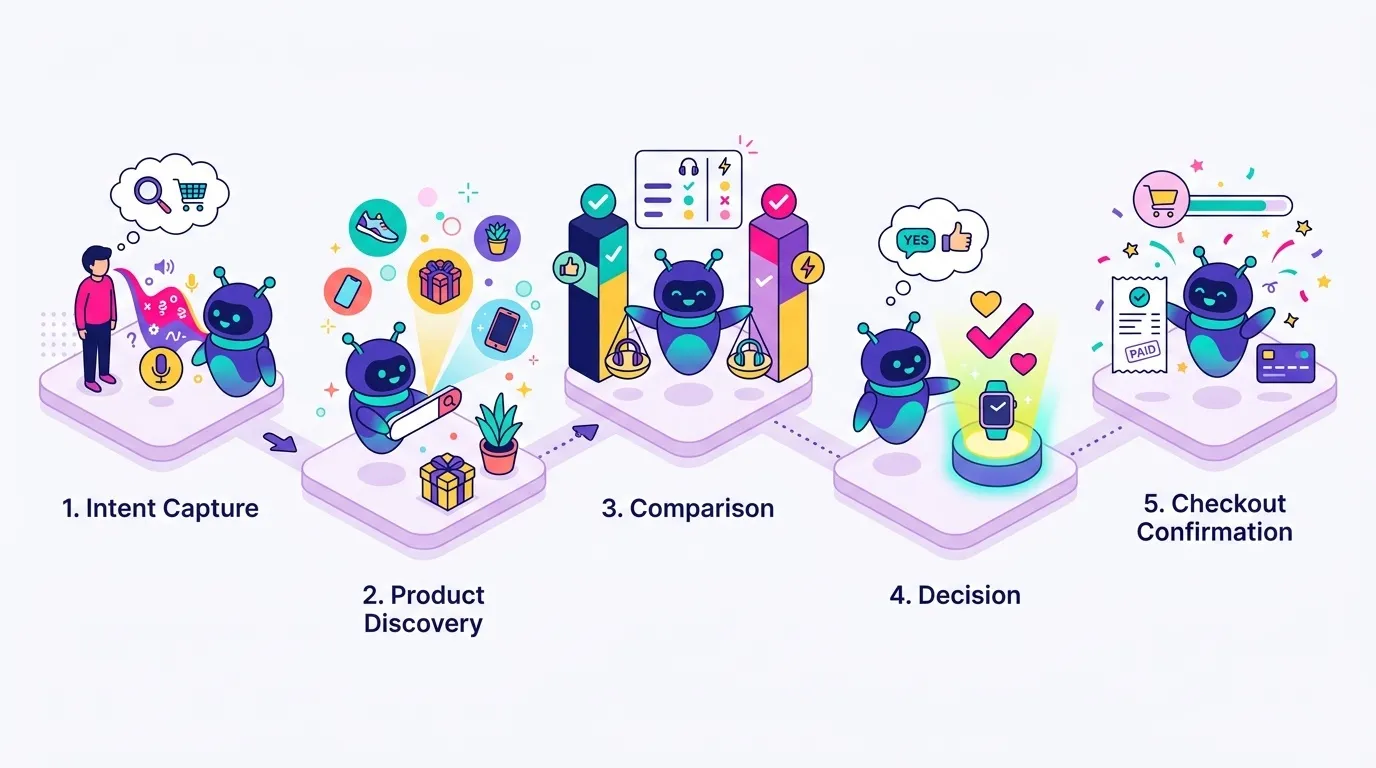
It starts with intent capture. The agent parses a natural-language request, pulling out budget, size, use case, and stated preferences from a sentence a human would consider perfectly casual.
From there it moves into discovery. The agent queries product feeds, structured data, and indexed pages to build a shortlist of candidates that seem to match the request. This is the exact moment your store either shows up or silently doesn’t.
Next comes comparison. The agent weighs price, availability, review signals, and policy terms across every candidate on that shortlist, much like a very fast, very literal shopper who never gets tired of opening tabs.
Finally, decision and checkout. The agent picks a winner and either completes payment autonomously or pauses to ask the human for a quick confirmation before finalizing, depending on how much autonomy it’s been granted.
What Data the Agent Reads at Each Step
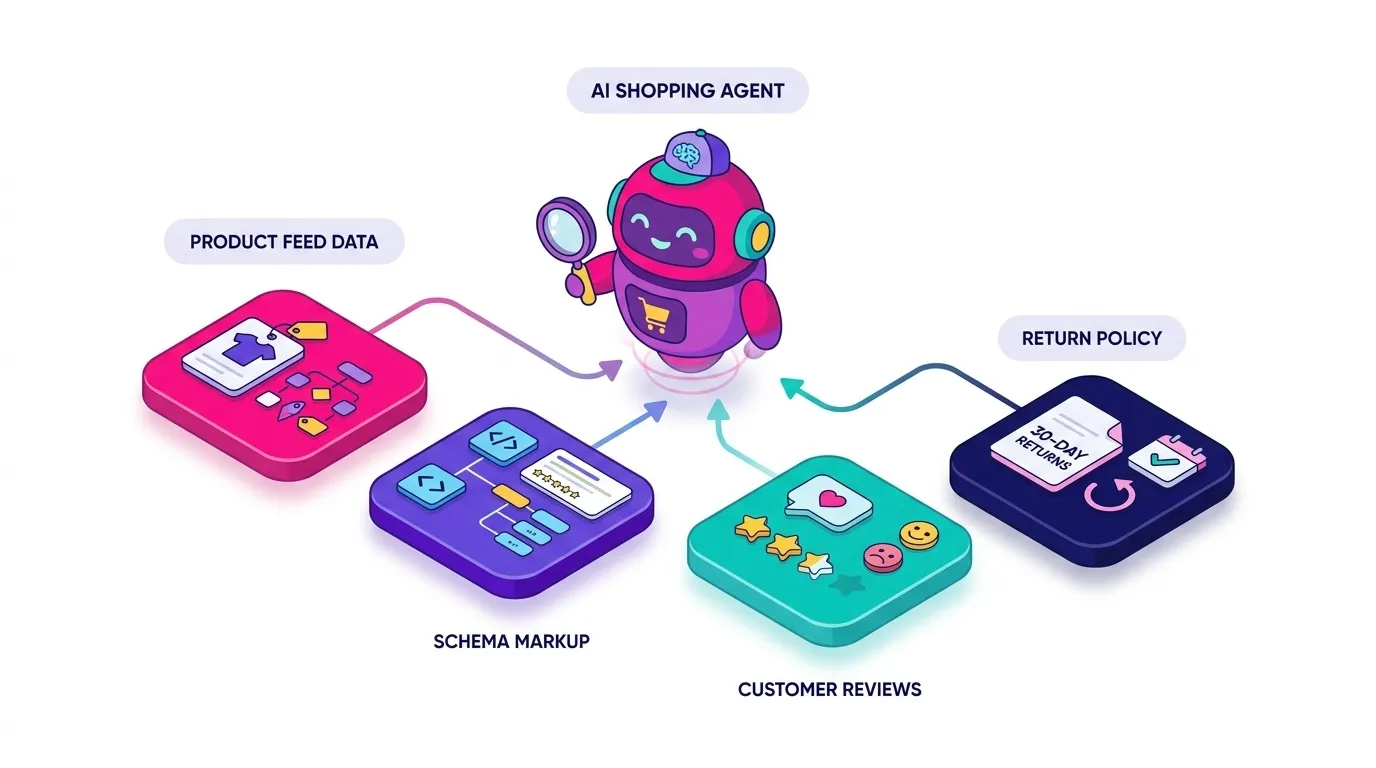
At every one of those stages, the agent is reading specific data, and it’s worth knowing exactly what.
Your product feed data comes first: title, price, availability, GTIN. This is the same backbone that powers Google Shopping, so if you’ve already invested in feed quality through Google Merchant Center, you’re further ahead than most.
Schema markup is next on the list: Product, Offer, and AggregateRating structured data. We’ve written a full breakdown of how structured data works in SEO, and the same principles apply here, just to a different reader.
Reviews and ratings also factor in as a comparison signal, weighed in a way surprisingly similar to how a human would skim star ratings before clicking “add to cart.”
Finally, the agent reads your return and shipping policy text. This is where a lot of stores quietly fail: policies locked inside a PDF or a screenshot are effectively invisible to an agent’s parsing layer. If it can’t read it, it can’t quote it, and it won’t trust the purchase.
Why This Matters for DTC Brands Right Now
Let’s connect this to the number you actually lose sleep over: CAC. Rising customer acquisition costs mean every discovery channel counts, and “agent visibility” is a new channel most brands haven’t audited yet, largely because they don’t know it exists.
Here’s the uncomfortable part. If an agent can’t parse your product data, it doesn’t rank you poorly. There’s no “position 8” for agents. It simply excludes you from the shortlist, silently, with no error message and no way to know it happened.
That said, there’s a genuine upside worth getting excited about. Agents can reduce cart abandonment friction almost by design: no forgotten carts, no distracted checkout, no getting a phone call mid-purchase. For brands with clean data, this could meaningfully improve conversion efficiency.
And because adoption is still early, this is a timing advantage more than a technical burden. Brands that fix feed and schema hygiene now are essentially getting free positioning before competitors start treating this as a priority. That’s not a vanity metric either. It’s the kind of profitability lever that shows up in a healthier MER, not just a prettier dashboard.
Human-Optimized Store vs. Agent-Optimized Store
Most stores today are built for one reader: a human with eyes, patience, and the ability to squint at a slightly blurry size chart. Agents don’t have that patience, and they definitely can’t squint.
What Agents Can’t Parse
Bad or missing alt text is the first casualty. A human skips right past it. An agent relies on it to even understand what the product is.
PDF-only size charts or policy documents are next. They might look perfectly normal to a shopper on a laptop, but they’re functionally invisible to a scraping or parsing layer.
JS-rendered prices and availability cause a subtler problem. If the number a human sees only appears after JavaScript runs, and an agent’s crawl doesn’t render it the same way, the agent may act on stale or missing data entirely.
And then there’s vague, scattered policy language, spread across three different pages with three slightly different wordings. Humans forgive inconsistency. Agents don’t reconcile it, they just distrust it.
What Agents Reward
On the flip side, here’s what actually earns you a spot on the shortlist. Clean, complete schema markup across Product, Offer, and AggregateRating fields, not just on your bestsellers but across the catalog.
Real-time accurate stock and pricing that matches your feed exactly, with no lag between what’s on the shelf and what’s in the data.
Structured, plain-text shipping and return policies an agent can quote confidently without guessing at what you actually meant.
And consistent product identifiers (GTIN, MPN) used the same way across your site and your feed, which removes ambiguity when an agent is trying to figure out if two listings are actually the same item.
See the comparison below for the full picture, side by side.
Element
Human-Optimized Store
Agent-Optimized Store
Product Descriptions
Persuasive copy, brand voice, storytelling
Structured attributes, schema markup, clear specs
Size / Fit Info
Visual size chart, sometimes as image or PDF
Plain HTML text, machine-readable measurements
Pricing & Stock
Displayed on page, may load via JavaScript
Present in raw HTML and feed, real-time accurate
Return Policy
Linked footer page, sometimes inconsistent wording
Single source of truth, plain scrapeable text
Reviews
Visual star ratings, widget-based
AggregateRating schema with numeric values
Is Your Store “Agent-Selectable”? A Practical Checklist
Enough theory. Let’s run a quick self-audit you can actually complete this week.
Structured Data Audit
Start with your Product, Offer, and AggregateRating schema. Run a handful of product pages through Google’s Rich Results Test and check whether the key fields (price, availability, rating) come back clean. A “pass” means the tool reads exactly what a human sees on the page, no gaps, no missing fields.
Feed Hygiene
Next, check your feed. Here’s the thing most managers miss: Merchant Center feed accuracy doubles as agent accuracy. It’s the same data pipeline serving two very different audiences. If you’ve already been through our Google Merchant Center and Shopify guide, you’re most of the way there.
Machine-Readable Policy Pages
Then look at your return and shipping policies. If they live inside an image or a PDF, that’s a fix worth prioritizing. Convert them to plain, scrapeable HTML text, written in clear language a machine can quote without ambiguity.
Monitoring for Agent Traffic in GA4
Finally, start watching for early signals in GA4. Keep an eye on unusual referral patterns, new user-agent strings you don’t recognize, or session behavior that doesn’t look particularly human (unnaturally fast navigation, for instance). Build a lightweight segment now, even before the volume matters, so you have a baseline once it does.
No lag between Merchant Center feed and storefront price
Policies in plain text
Pass / Fail
Return/shipping terms not locked in PDF or image
GA4 agent monitoring
Pass / Fail
Segment or annotation set up to flag anomalous sessions
What This Means for Paid Media and Attribution
Now let’s address the question that’s probably already forming in the back of your mind. If an agent completes the purchase inside a chat interface, what happens to last-click attribution in GA4 or your ad platform dashboards?
Honestly, the near-term reality is that attribution gets murkier before it gets clearer. We’ve already seen a version of this problem play out with dark social and AI Overview citations, both of which complicate a clean last-click story, as we discussed in our piece on how AI Overview is affecting SEO.
For this reason, I’d recommend leaning harder on MER and blended efficiency metrics rather than chasing channel-level last-click precision. An agent-driven purchase simply won’t map cleanly to a single UTM parameter, no matter how carefully you build your tracking.
That doesn’t mean giving up on measurement. It means tagging and annotating any identifiable agent-referred sessions now, even imperfectly, so you’re not flying completely blind once volume actually grows. A rough signal today beats a perfect signal that arrives two years too late.
What Brands Should Do Today
Here’s where I want to bring this back down to earth, because none of this requires betting the farm.
No-regret move #1: clean, accurate, real-time product feeds. This benefits Google Shopping performance, GEO visibility, and agentic commerce readiness, all at once. One investment, three payoffs.
No-regret move #2: audit and implement schema markup across your full catalog, not just the handful of bestsellers everyone remembers to optimize. Agents don’t care about your top ten SKUs any more than they care about the rest.
No-regret move #3: GA4 and GTM tracking hygiene, specifically aimed at capturing early agent-referral signals before they become a measurable channel. You want the historical baseline sitting in your data before anyone asks for it.
What I wouldn’t do is panic about full autonomous “agents buy everything at scale” behavior just yet. That’s still early, genuinely early, and rebuilding your entire funnel around a trend that hasn’t matured yet is a good way to waste a quarter chasing something that will look different in six months anyway.
Why Midsummer Agency Sees This as the Next Frontier
Here’s the thesis I keep coming back to: your store is now being read by two audiences, humans and agents, and most brands have only ever optimized for one of them. The teams that treat this as a data-quality problem, not a hype problem, are going to have a real head start.
I say this from the trenches, not from a press release. Building agentic workflows and automation is what I do day in, day out, and the pattern is always the same: the systems that work reliably are the ones fed clean, structured, unambiguous data. Agents are not magic. They’re disciplined readers with zero patience for a messy sparring partner. Feed them a confused, inconsistent product page and they’ll simply step out of the ring rather than throw a punch on your behalf.
I’ll also be honest about the uncertainty here. The named products and protocols in this article will keep changing, probably faster than we’d like. What won’t change is the underlying skill: data hygiene and structured thinking. That’s the durable asset, not chasing every new integration announcement as it lands.
If you want a second set of eyes on your feed, schema, or GA4 setup before agent traffic becomes something you have to explain to a board, that’s exactly the kind of groundwork our AI automation services are built for. We’ll help you get the fundamentals right, so whichever version of agentic commerce wins out, your store is already speaking its language.