

Web Analytics
Building A First-party Data Strategy For Ecommerce After The Cookie
Third-party cookies are gone and platform signals keep shrinking. We show you what data to collect first, how to activate it, and where it outperforms.
Read MoreFor $1M to $20M DTC founders dealing with rising acquisition costs, the reality of e-commerce today is clear: revenue is vanity, and profit is sanity. In…


For $1M to $20M DTC founders dealing with rising acquisition costs, the reality of e-commerce today is clear: revenue is vanity, and profit is sanity. In this guide, I will walk you through the mechanics of Contribution Margin, pricing psychology, Lifetime Value mechanics, and operational efficiency. You need this approach because generating high seven-figure revenue with a fraction of a percent in net margin is an unsustainable failure. Scaling a brand on Shopify without a firm grasp of your profit optimization strategies will lead to burning cash and eventual burnout.
To learn how to maximize profit, you first need to redefine how your organization measures success. Too many marketing teams focus entirely on “Revenue Optimization” by pushing for high sales volume regardless of the underlying costs. This approach creates the illusion of growth while masking fundamental financial weaknesses. We believe that turning your attention to “Profit Optimization” ensures every sale actually adds to the bottom line value of your business. As discussed in our guide on Conversion Rate Optimization, not surprisingly, this shift separates brands that survive from those that burn out.
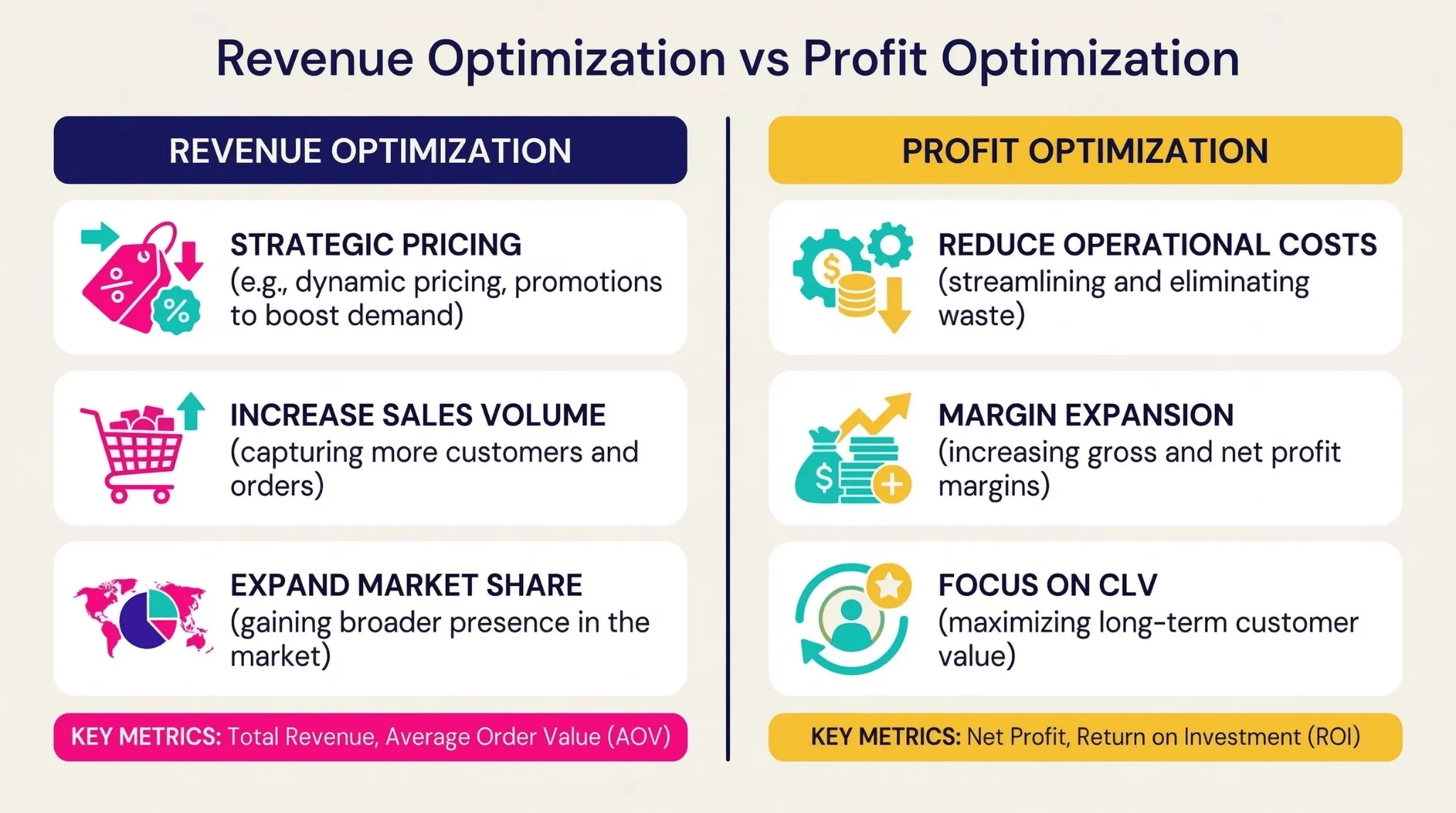
Consequently, you must familiarize yourself and your team with Contribution Margin (CM). Contribution Margin represents the money left from gross revenue after all variable costs have been paid, leaving only the funds available to cover fixed expenses and ultimately become net profit. If you ignore this metric, you are essentially flying blind. Furthermore, Contribution Margin is the truest indicator of whether your e-commerce unit economics are actually functioning.
However, many founders still look exclusively at Return on Ad Spend (ROAS). The problem is that ROAS can be a massive liar. For instance, if you achieve a 4.0 ROAS on a product with extremely low margins, your overall order profit is still negative. Your advertising might look efficient on the surface, but the business efficiency is broken.
Healthy DTC brands typically aim for a Contribution Margin of 40 to 50 percent after marketing spend is deducted. If your metrics fall significantly below this threshold, increasing your ad spend to scale will only magnify your losses. For this reason, shifting from monthly profit and loss checks to daily Contribution Margin tracking is a mandatory business practice.
Let us look deeper at the deception behind ROAS metrics. Consider selling a $50 hoodie where the combined Cost of Goods Sold (COGS) and fulfillment costs are $35. If you spend $10 to acquire a customer, your ROAS looks perfectly acceptable to an ad platform algorithm. That said, you only have $5 left to cover salaries, rent, and software subscriptions. In this context, the ad efficiency is actively destroying your company’s financial stability.
The true impact comes down to understanding COGS, shipping, and hidden fulfillment fees. Every time an order is placed, variable costs chip away at your perceived revenue. If your marketing team does not care about these costs, they will inevitably optimize for the wrong type of volume.
Similarly, relying on traditional monthly accounting reports means you find out about losses 30 days too late. E-commerce moves too quickly for retroactive financial adjustments. You must build dashboards that calculate daily profitability so you can pull the plug on losing campaigns immediately.
Therefore, marketing teams must be incentivized on profit, rather than purely on top-line ad metrics. When your media buyers understand the actual profit margin of the products they are pushing, they make fundamentally different decisions about campaign scaling and budget allocation.
To implement effective profit optimization strategies, you need to provide your team with actionable formulas. The basic calculation for Contribution Margin is simple: Net Revenue minus COGS, Shipping, Transaction Fees, and Ad Spend. When you calculate this for every single order, the health of your catalog becomes instantly clear.
We often see brands struggling because they miscategorize their expenses. You must clearly break down your variable costs. This includes the “pick and pack” fee charged by your warehouse, the percentage your payment gateway takes, and the variable costs of return shipping. Conversely, if you mix these variable costs with fixed overhead, your unit economics will always be skewed.
Fixed costs behave differently and require a separate strategy. Your office rent, salaried employees, and Shopify Plus subscriptions do not change whether you sell one order or one thousand. These static expenses slowly eat away at the Contribution Margin you accumulate throughout the month.
To maintain clarity, you must perform a strict break-even analysis. This calculation tells you exactly how many units you must sell just to keep the lights on before generating a single dollar of net profit. For a rapidly scaling DTC brand, knowing this number avoids the trap of scaling into unprofitability.
The hidden cost of “free shipping” is often the largest variable cost that founders ignore. Customers expect fast, complimentary shipping, but someone has to pay the carrier. If the shipping cost is not baked into the profit maximizing price of your product, it will erode your margin on every single order.
Payment processing fees present another significant leak. While 2.9 percent plus thirty cents may sound negligible, its cumulative impact across thousands of transactions is enormous. Furthermore, if a customer uses an installment payment service, those fees can jump significantly, lowering the transaction margin even further.
Warehousing and fulfillment also operate on variable rates that fluctuate based on item weight and size. If a lifestyle brand sells bulky wellness items, the fulfillment costs escalate rapidly. It is critical to include dimensional weight in your profit calculations to avoid unpleasant surprises at the end of the month.
Consequently, the necessity of tracking every cent becomes undeniable. In an era of rising customer acquisition costs (CAC), estimating your margins is no longer sufficient. You must establish rigorous tracking to uncover the actual margin per order and adjust your strategy accordingly.
| Cost Type | Description | Impact on Profit |
|---|---|---|
| COGS | Product manufacturing costs | High variable reduction |
| Fulfillment | Pick, pack, and shipping | High variable reduction |
| Transaction Fees | Credit card and payment gateways | Moderate variable reduction |
| Ad Spend (CAC) | Marketing acquisition cost | High marketing variable |
Pricing remains one of the fastest and most effective levers for business profit maximization strategies. Many founders operate with an intense fear of raising prices, assuming a price hike will instantly destroy their conversion rate. However, price elasticity is rarely as rigid as we fear, and small adjustments often yield disproportionate gains in net profit.
This brings us to the concept of the “profit maximizing price”. How do you find the profit maximizing price? It is the specific price point where your product margin multiplied by your total sales volume yields the highest absolute profit, regardless of whether your top-line revenue decreases slightly. Finding this sweet spot requires iterative testing and careful data analysis.
Premiumization acts as a strategic defense mechanism when raising prices. You cannot simply charge more for an identical commodity without backlash. Instead, you must upgrade the entire perceived value of the brand through superior packaging, compelling storytelling, and a premium unboxing experience.
Furthermore, integrating better storytelling allows you to justify higher price points effortlessly. When a consumer believes they are buying into a sustainable, high-quality, or exclusive ecosystem, price becomes a secondary concern. The narrative you construct around the product directly supports your pricing power.
Upgrading your creative assets is the first step in premiumization. If you want to charge luxury prices for a beauty serum or a fashion accessory, your website photography and ad creatives must look like they belong in a luxury magazine. High-resolution visuals immediately signal quality to the consumer.
You must also decide between “Charm” pricing and Prestige pricing. Charm pricing, such as $49.99, visually signals a bargain and is optimized for mass volume. Prestige pricing, represented as a solid $50.00, signals quality, confidence, and luxury. For premium DTC brands, adopting whole numbers often aligns better with their target audience.
| Strategy | Example | Best Used For |
|---|---|---|
| Charm Pricing | $49.99 | Clearance, high-volume fast fashion |
| Prestige Pricing | $50.00 | Luxury beauty, premium apparel |
Avoiding frequent discounts protects your brand equity over the long term. If your audience learns that you run a sale every month, they will refuse to buy at full price, permanently damaging your margins. You must train your customers to value the product itself, not the discount code.
On the other hand, dynamic pricing strategies can be used strategically. Adjusting prices based on seasonal demand spikes or using strategic bundles allows you to offer perceived value without compromising the core product’s prestige.
However, a discount strategy is not a one-size-fits-all approach. For one of our clients, we are running continuous discounts where products are always discounted on the website, and it works very well. Of course, any discount strategy needs to be tested, tried, and evaluated to see what fits your business best.
Increasing your Average Order Value (AOV) is a fundamental tactic to increase ecommerce AOV while protecting your margins against rising acquisition costs. When you increase the basket size, you dilute your static CAC across a larger volume of gross profit, instantly improving the unit economics of the transaction.

The math of acquisition clearly demonstrates this. In fact, as noted by Shopify, focusing purely on revenue without margin consideration is a critical pitfall. If your CPA is a flat $40, acquiring a customer who spends $80 leaves you with thin margins, while a customer spending $120 gives you massive profits and breathing room to scale your ad accounts safely. AOV optimization is the ultimate defense against platform volatility.
Setting strategic free shipping thresholds is one of the easiest ways to manipulate AOV. For instance, if your current median order value is $65, setting your free shipping threshold at $75 naturally forces the customer to add a small accessory to their cart. This behavioral nudge requires zero additional marketing spend.
We consistently recommend bundling as a core revenue optimization strategy. Bundles encourage customers to purchase complementary items together, raising the ticket price while solving multiple problems for the buyer simultaneously.
Product bundles are highly effective because they sell a complete outcome rather than a single tool. In the beauty space, offering a “Complete Nighttime Routine” bundle is far more compelling than asking the user to buy a cleanser, toner, and moisturizer separately.
Similarly, the logistical efficiency of shipping bundles is a massive advantage. You are packing multiple items into a single box, which means your fulfillment and shipping costs as a percentage of revenue drop dramatically. This operational efficiency flows directly to the bottom line.
You must also distinguish between pre-purchase and post-purchase upsells. Pre-purchase upsells occur in the cart, where you offer an additional item before checkout. While effective, they can sometimes distract the user from completing the primary transaction if overused.
Post-purchase upsells occur immediately after the credit card is charged. Because the customer has already completed the primary purchase, the conversion friction is incredibly low. We use Zipify to implement this functionality on Shopify projects, as their post-purchase upsell features are great. Any revenue generated from a post-purchase upsell carries a nearly 100 percent Contribution Margin, making it a critical tool for scaling profitability.
As acquisition costs continue to climb, retention acts as your ultimate profit firewall. Identifying and nurturing your most profitable customers is essential, as the cost to acquire a new buyer will always vastly exceed the cost of retaining an existing one. Building a business without retention is like trying to fill a leaky bucket.
You must shift your focus from First Purchase Profit to the 12-Month Lifetime Value (LTV). If you know a customer cohort will purchase from you three times over the next year, you can afford to break even on their first transaction. This long-term mindset unlocks aggressive scaling opportunities that your competitors cannot afford.
Conducting cohort analysis allows you to identify your best customers, often referred to as your “Whales.” These are the individuals who buy at full price, rarely return items, and act as brand advocates. Once you identify these segments, you can allocate resources to keep them engaged.
Designing specific, high-touch experiences for these high-value cohorts is a proven method to achieve profit maximization. Whether it is a dedicated customer service line, handwritten notes, or exclusive content, making your best customers feel valued guarantees their continued patronage.
We really love Lifetimely for this type of analysis, which we use mainly with Shopify projects. They have incredible reporting that simplifies complex customer data. With Lifetimely, you gain granular insights into Lifetime Value (LTV), repurchase rates, and the true profitability of different customer cohorts over time.
It allows you to track exactly how many days it takes to break even on acquisition costs, which specific products drive the highest long-term value, and how customer behavior shifts based on their first purchase. These deep insights remove the guesswork from scaling, empowering you to invest confidently in acquiring high-value customers.
Building lasting loyalty requires moving beyond simple point-based reward systems. Modern consumers want access, not just small discounts. VIP drops, early access to new collections, and exclusive community events create a sense of belonging that transcends transactional commerce.
Email and SMS automation flows serve as the backbone of these retention strategies. Automated welcome sequences, post-purchase education, and replenishment reminders ensure your brand stays top-of-mind without requiring constant manual intervention. For replenishment reminders, a great app to use is STOQ, which integrates seamlessly with Klaviyo, or you can use Klaviyo by itself. Both are amazing for managing replenishment reminders, especially when you have products with a certain level of hype. We strongly suggest these apps specifically for Shopify stores.
Furthermore, win-back campaigns targeted at lapsed buyers offer an incredible return on investment. If a past customer has not purchased in six months, a well-crafted email offering a slight incentive can reactivate them at a fraction of the cost of acquiring a new lead.
That said, the cumulative profit effect of retaining a customer for a second or third purchase is staggering, since according to Harvard Business Review increasing customer retention rates by 5% increases profits by 25% to 95%. Since the initial acquisition cost has already been absorbed, every subsequent purchase operates at a significantly higher Contribution Margin.
While marketing campaigns often capture the most attention, optimizing the back office and supply chain is where true business profit maximization strategies are executed. Supply chain efficiency is pure, unadulterated profit that goes straight to your bottom line.
The requirement of renegotiating third-party logistics (3PL) contracts is absolute. As your brand grows and shipping volumes increase, your leverage with fulfillment centers improves. You should be auditing your fulfillment agreements biannually to ensure you are receiving the best possible rates for pick, pack, and storage.
Scaling your sales volume should automatically translate to decreasing per-unit manufacturing costs. If you are selling ten times more product but paying the same unit price you did during your launch phase, you are leaving massive amounts of profit on the manufacturer’s table.
Similarly, the role of packaging weight and dimensions in shipping costs cannot be overlooked. Trimming an inch off your custom boxes or utilizing lighter packing materials can instantly drop your carrier fees, resulting in immediate profit gains.
Biannual audits of manufacturing terms keep your suppliers honest and your costs low. Do not be afraid to source secondary quotes and bring them to your primary manufacturer. In business, you rarely get what you deserve; you get what you negotiate.
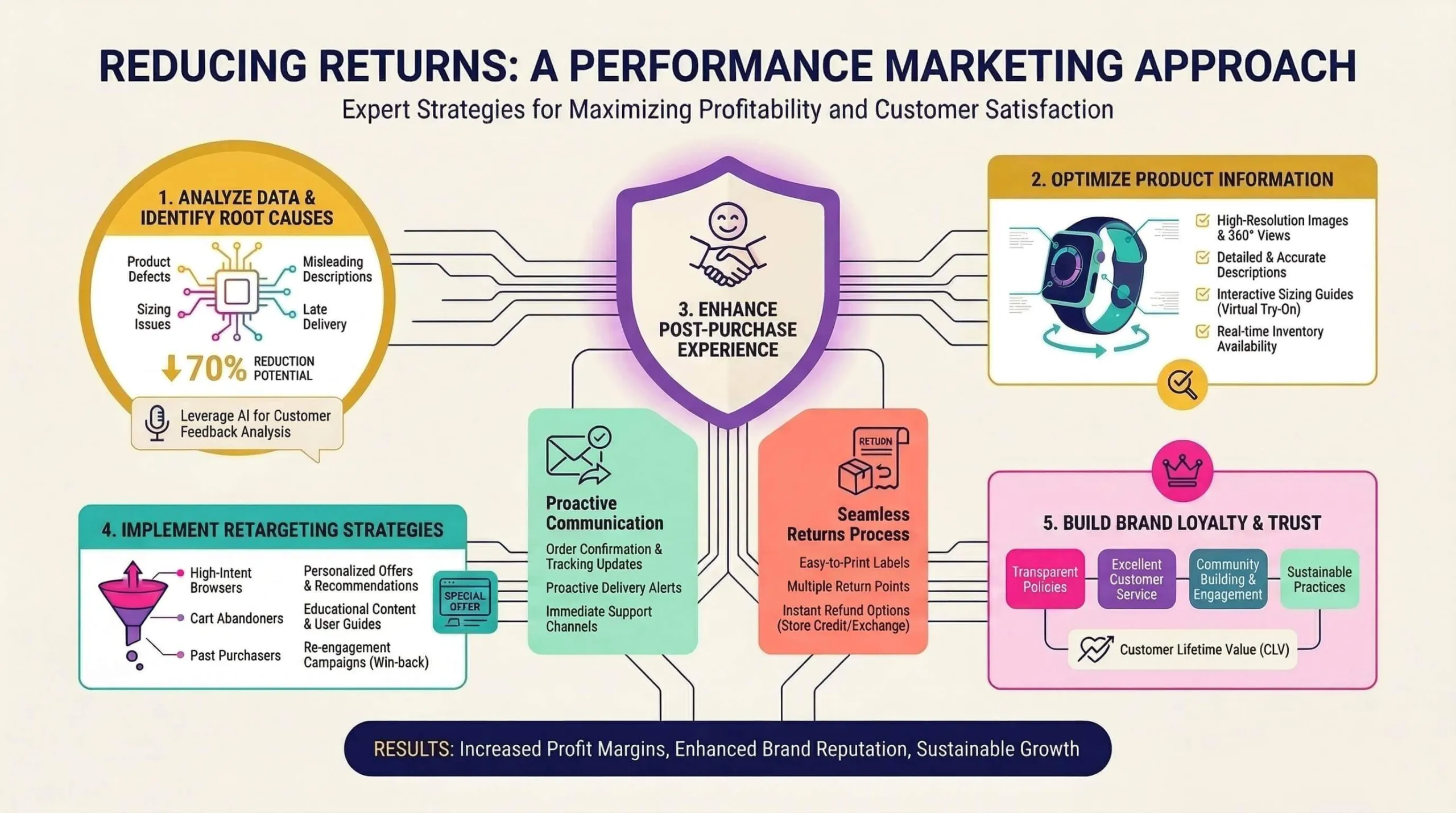
Returns act as the ultimate “Profit Assassin,” especially for fashion and apparel brands. A high return rate not only negates the revenue of the sale but incurs double shipping costs and requires additional labor to process the refunded merchandise.
To combat this, you must deploy aggressive tactics to reduce return rates before the purchase happens. Implement high-resolution video fit guides, extremely accurate sizing charts, and user-generated content that shows the product on diverse body types.
Finally, consider the holding costs associated with dead stock. Inventory sitting in a warehouse is simply trapped capital tying up your cash flow. You must be willing to aggressively liquidate slow-moving items to free up capital for high-margin, fast-moving hero products.
Ruthless prioritization requires implementing the Pareto Principle across your entire catalog. Usually, 80 percent of your profits come from just 20 percent of your products. Embracing this reality allows you to focus your resources where they generate the highest return.
The bottom tier of your product catalog often creates a massive distraction. These low-selling products tie up capital, complicate warehouse operations, and dilute your marketing focus. Managing them requires labor that could be better spent scaling your winners.
Conducting a channel audit is equally important for determining true CM profitability. You must evaluate whether platforms like TikTok Shop or Pinterest are actually generating profitable revenue, or if they are simply driving low-value traffic that looks good on top-line reports but bleeds money on the bottom line.
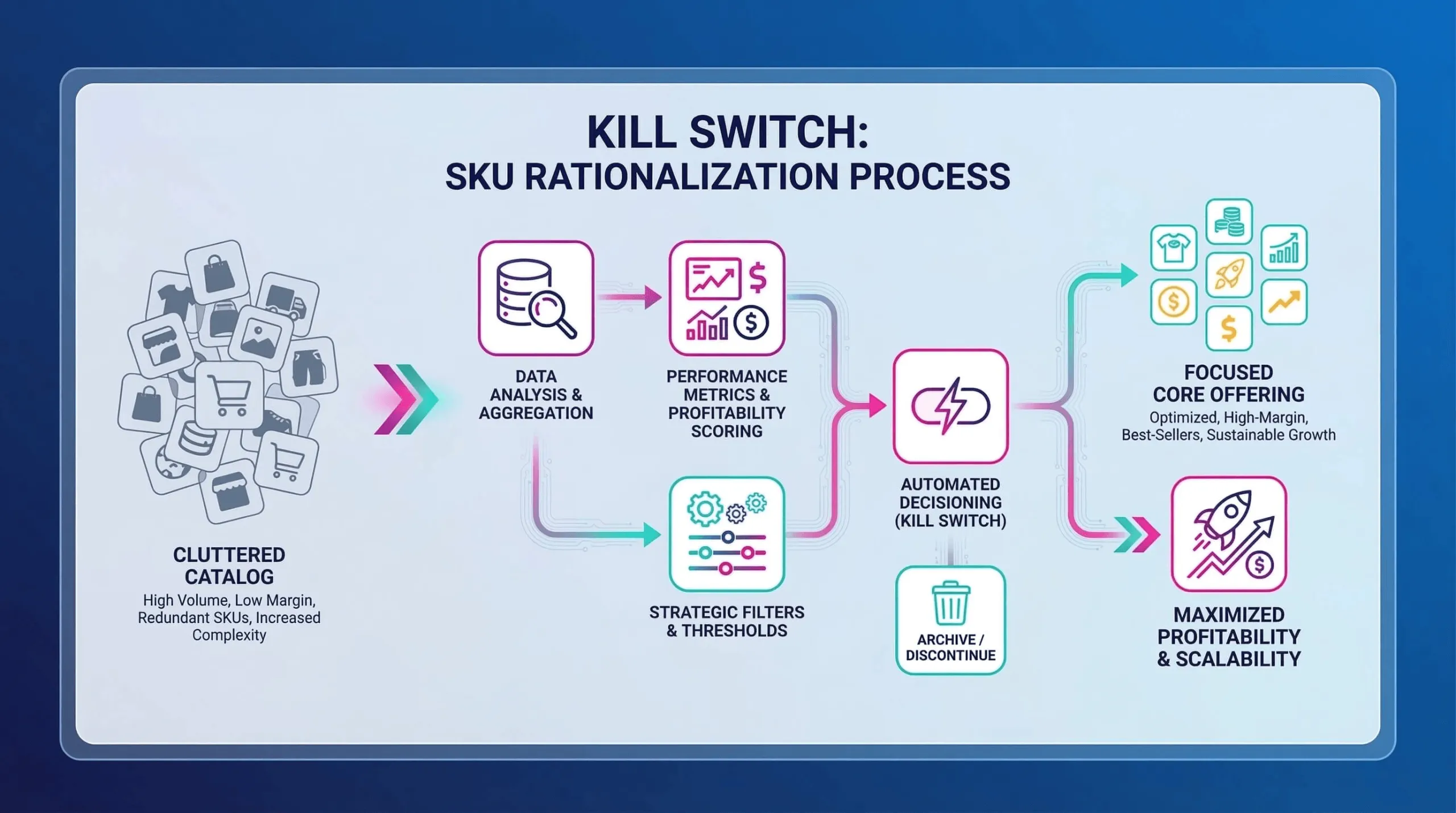
Consequently, you must develop the courage to execute the “Kill Switch” and shut down unprofitable channels without hesitation. If a traffic source consistently fails to deliver a positive Contribution Margin, cut the funding and reallocate it to proven winners. However, you should take the “Kill Switch” with a big pinch of salt if you do not have full insights into your business performance. Marketing Mix Modeling (MMM) is a great way to gain that comprehensive insight. MMM is a statistical analysis used to estimate the impact of various marketing tactics on sales, but you must keep in mind that you need a specific, large amount of historical data to utilize it effectively.
Identifying “Zombie Products” is the first step in SKU rationalization. These are items that sell just enough to stay in the catalog, but not enough to justify their ongoing production and holding costs. They survive purely due to inertia. To efficiently identify and manage these products, we use product bucketing in Google Ads.
We utilize scripts to bucket products based on their performance into five distinct categories: over index, index, near index, no index, and under index. Having these different buckets allows us to set up separate campaigns based on performance, where we can assign specific budgets and bids. This ensures we push the best sellers, avoid spending too much on products that just waste budget, while also focusing on the zombie products (which fall into the “no index” bucket). By structuring it this way, we can properly manage the overall performance.
Liquidating these products is essential to free up working capital. Run bundle clearances or dedicated sales events to push this inventory out the door. The cash recuperated can then be deployed into highly profitable acquisition campaigns or new product development.
You must also recognize when historical “Best Sellers” evolve into “Loss Leaders”. Sometimes, ad costs for a specific product become so prohibitive that they destroy the margin, even if the item still drives high volume. If the subsequent LTV does not compensate for the initial loss, you must stop the ads.
This reflects the core Midsummer Agency philosophy: we audit before we scale. We refuse to pour ad spend onto a broken foundation. Validating the unit economics of a product or channel is a strict prerequisite for any growth campaign.
At Midsummer Agency, our approach to profit optimization involves a deep dive into your entire business model, not just your ad accounts. We understand that tweaking a headline will not save a brand with a broken supply chain or upside-down unit economics.
Our first step is implementing advanced trackers and analytics tools to visualize your true Contribution Margin in real-time. We help you move beyond platform-reported ROAS to build dashboards that reflect your actual bank account. We scrutinize pricing, shipping thresholds, and post-purchase funnels to ensure every transaction is maximized for value.
From there, we integrate Paid Social and Search strategies designed exclusively around high-margin SKUs and high-LTV customer cohorts, including strategies such as Meta Catalog Ads. We execute SKU rationalization alongside you, applying our “Kill Switch” methodology to trim the fat from your catalog and your ad campaigns.
Profit is a deliberate design choice that requires cross-team alignment. Moving forward, the most successful e-commerce brands will blur the lines between marketing, finance, and operations. The goal is no longer just driving traffic, but engineering sustainable profitability.
You must shift your internal dialogue from “How much did we sell today?” to “How much did we actually keep today?”. This mindset shift is the fundamental difference between building a fleeting brand and building a resilient, cash-flowing business.
Using real-time visualization tools is no longer optional; it is a necessity for survival. As the e-commerce landscape becomes increasingly competitive, those who understand their numbers down to the cent will consistently outmaneuver those relying on vanity metrics.
Ready to step away from vanity metrics and build a genuinely profitable growth engine? Check out our Web Analytics services or request a personalized performance audit today! We’ll analyze your account, fix what’s holding your margins back, and make sure your e-commerce ecosystem starts delivering real, bottom-line results. Let’s turn your audience into sustainable revenue, side by side!