How Landing Pages Affect Ad Conversion Rate: The Ultimate Guide
Struggling with low conversions despite high traffic? Understanding how landing pages affect ad conversion rate is key to turning visitors into customers. Explore essential strategies, testing…
Imagine you’ve invested heavily in PPC ads, social media campaigns, and content marketing. Your targeting is precise, your offers irresistible, and your visuals stand out. The traffic flows in, but conversions remain disappointingly low. It’s as though you have a luxury boutique in the busiest mall, yet customers browse and leave without making a purchase.
So, what’s going wrong? The answer often lies in the landing page. Landing pages act as the link between your ads and conversions. Without an effective landing page, all the traffic in the world won’t help you achieve your desired outcomes.
In this guide, we’ll explore the connection between landing pages and ad conversion rates. From what makes a high-converting landing page to common mistakes that can drag down performance, you’ll learn actionable strategies to optimize your landing pages and maximize your ROI.
What Is Ad Conversion Rate?
Understanding how landing pages affect ad conversion rate begins with knowing exactly what an ad conversion rate is. Conversion rate measures the percentage of visitors who complete a desired action after clicking an ad. This action could be a purchase, a form submission, or a download.
Ad Conversion Rate Formula
To calculate your ad conversion rate, use this formula:
Ad Conversion Rate (%) = (Conversions / Total Clicks) × 100
For example, if your ad receives 1,000 clicks and results in 50 conversions, your ad conversion rate would be:
Ad Conversion Rate = (50 / 1000) × 100 = 5%
This means that 5% of the visitors who clicked your ad took the desired action.
Conversions can vary depending on your campaign objectives, such as:
E-commerce: Making a purchase, adding an item to a cart, initiating checkout.
Lead Generation: Filling out a contact form, requesting a quote, or booking a consultation.
Content Marketing: Subscribing to a newsletter, downloading a resource, or watching a video.
App Marketing: Installing an app or completing specific in-app actions.
SaaS Marketing: Signing up for a free trial or upgrading to a paid plan.
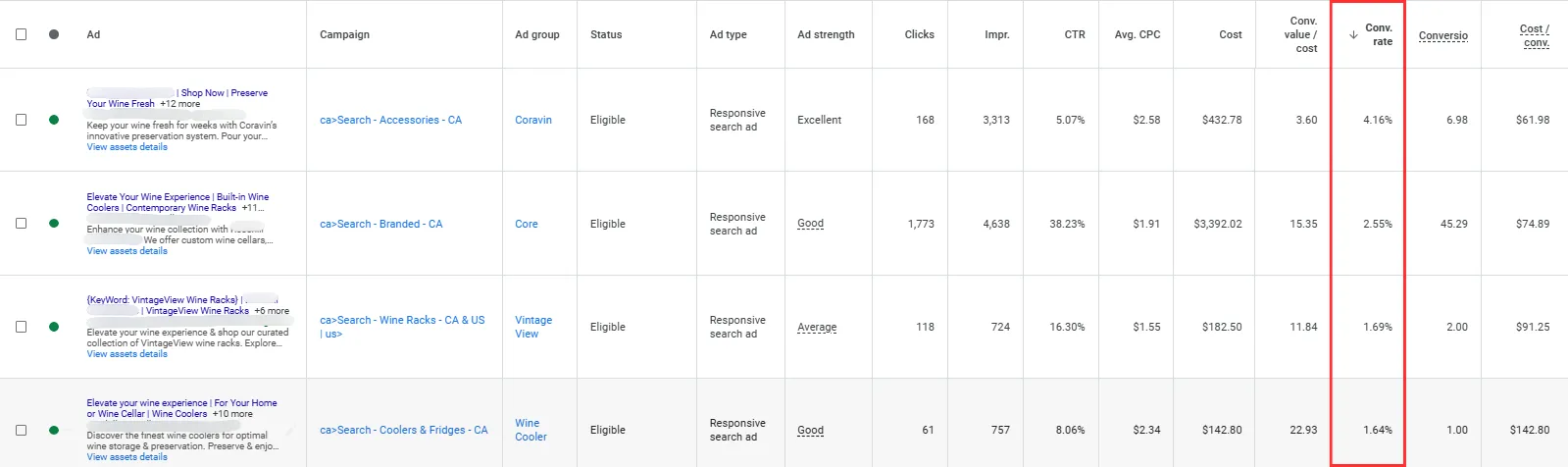
A Google Ads account insights report showing conversion rate.
Why Ad Conversion Rate is Important
Your ad conversion rate is essential because it directly measures how well your landing pages convert traffic into meaningful results. Here’s why it’s essential:
Maximizes ROI: Higher conversion rates mean you’re getting more out of your existing traffic, leading to a better return on investment.
Improves Quality Scores: Platforms like Google Ads evaluate landing page relevance and user experience, affecting your Quality Score. A high conversion rate can lower your advertising costs by improving these scores.
Guides Optimization Efforts: By analyzing conversion rates, you can identify which landing pages perform well and which need improvement, guiding your optimization strategy.
How Landing Pages Affect Ad Conversion Rate
Your landing page is often the first point of interaction between a user and your brand. It’s where the magic of turning traffic into conversions happens. If the landing page isn’t optimized for conversions, your efforts will fall flat.
Here’s how landing pages affect conversion rates:
Relevance and Message Matching
Relevance is critical to conversion rate optimization. Users clicking on your ad expect the landing page to deliver exactly what the ad promised. If there’s a disconnect, visitors will likely bounce without converting.
For instance, if a user clicks on a Google ad promoting a “50% off summer dress” sale, they expect to see a landing page dedicated to that offer. A generic homepage or unrelated product page won’t meet expectations, causing visitors to leave.
User Experience (UX) and Design
A positive user experience plays a major role in conversion rates. The design of your landing page should be clean, easy to navigate, and intuitive. If users are faced with clutter or difficulty finding information, they are more likely to leave.
Key UX considerations include:
Simple Layout: prioritize essential information and clear CTAs.
Visual Hierarchy: use contrast, font sizes, and color to guide users toward important actions.
Mobile Responsiveness: with over 50% of web traffic coming from mobile, ensuring your page functions well across all devices is a must.
Accessibility: ensure the page is accessible to all users, including those with disabilities.
Technical Performance
Slow-loading pages can severely affect conversion rates. In fact, Google found that 53% of mobile users abandon a page that takes longer than three seconds to load. Optimizing technical performance is essential for reducing bounce rates and improving conversions.
Areas to optimize:
Page Load Speed: compress images, reduce HTTP requests, and use CDNs for faster load times.
Security: use HTTPS to build trust and enhance user confidence.
Browser Compatibility: ensure your page works seamlessly across different browsers.
Call-to-Action (CTA) Optimization
The CTA is often the final step in a user’s journey toward conversion. Its design, placement, and wording significantly impact conversion rates.
Best practices for CTA optimization:
Clarity and Action-Oriented: use verbs like “Buy Now,” “Download Free Guide,” or “Get Started.”
Visual Contrast: use colors and placement to make CTAs stand out.
Relevance: ensure CTAs align with the user’s intent at each stage of the customer journey.
Why Mismatch Between Ads and Landing Pages Leads to Poor Conversion Rates
A mismatch between ad messaging and the landing page is one of the biggest causes of poor conversion rates. If users click on an ad that promises a specific offer but land on a generic page, they will likely feel confused and frustrated.
Common causes of this mismatch:
Inconsistent Messaging: the tone and language of the landing page don’t align with the ad.
Unclear Value Proposition: if the page doesn’t deliver on the ad’s promise, users will lose interest quickly.
Lack of Relevance: generic landing pages that try to serve multiple purposes dilute the effectiveness of the campaign.
For example, if an ad promotes a “Buy One, Get One Free” offer but directs users to a generic product page, visitors will have to search for the deal themselves, causing frustration and a high bounce rate. A dedicated landing page featuring the offer would significantly improve conversion rates.
Key Elements of High-Converting Landing Pages
To optimize your landing page, focus on the following elements:
Relevance and Message Matching
Ensure your landing page reflects the message in the ad. If the ad offers a discount, the landing page should highlight that deal prominently. Consistency increases user trust and encourages conversions.
Design and User Experience
Design your page with simplicity and clarity. Use white space to highlight key elements like CTAs and ensure navigation is easy. A cluttered page will detract from the user experience and hurt conversions.
Compelling Copy and Clear CTAs
To drive conversions, it’s essential to write persuasive, benefit-driven copy that resonates with your audience. Instead of using generic statements, focus on the value users will gain from completing the desired action. This approach not only connects with your audience but also encourages immediate engagement. A strong CTA should be clear, concise, and compelling, guiding users effortlessly toward the next step.
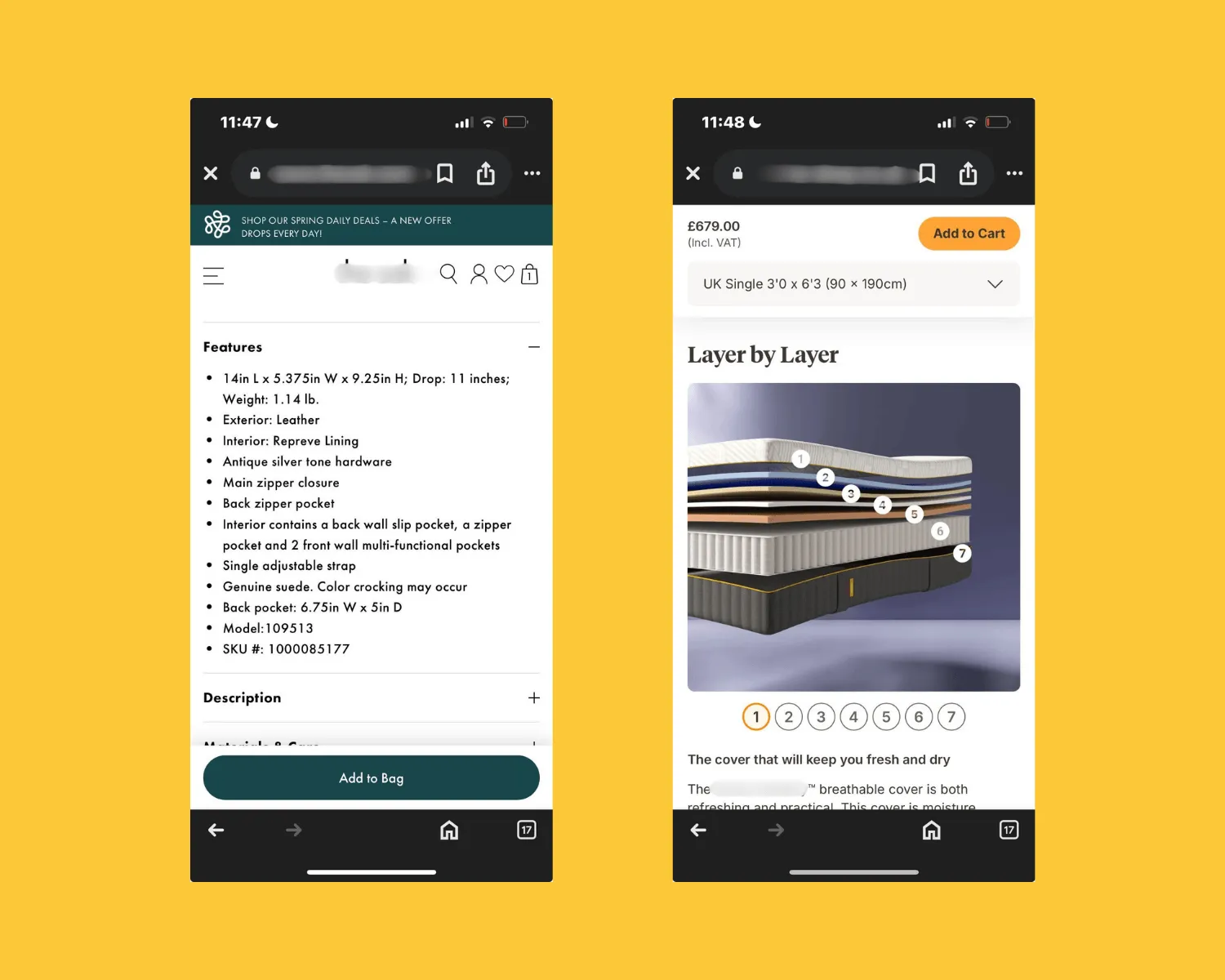
It’s also important to consider Fitt’s Law, which explains how the time required to move to a target is directly related to the size of the target and its distance from the starting point. In the context of CTAs, this means that larger, more prominent buttons, positioned where users can easily access them, will lead to faster and more accurate actions.
Two examples of eCommerce mobile landing pages with CTAs following Fitt’s Law.
Page Load Speed and Technical Performance
Speed is crucial for retaining visitors. A slow page can quickly derail conversions. Use tools like Google PageSpeed Insights to monitor and improve load times. Ensure your page is mobile-optimized and free of technical errors.
Best Practices for Improving Landing Page Conversion Rates
A/B Testing
A/B testing is one of the most powerful tools for improving conversion rates. Test different headlines, CTAs, and layouts to see which version performs best.
Personalization and Targeting
Personalized experiences increase relevance and engagement. Use Dynamic Text Replacement (DTR) to tailor content to match search queries or ad keywords.
Social Proof and Trust Signals
Including testimonials, case studies, and industry certifications is a powerful way to boost credibility and trust. These elements can dramatically improve conversion rates, as users are more likely to convert when they feel reassured by the experiences of others.
The more specific the reviews, the better. Online, it can be difficult for users to identify with others and fully trust their feedback. By encouraging reviewers to provide detailed information (such as whether a product fits true to size, the size they purchased, their height, or even photos of the product), you can help other shoppers relate better to their experiences and drive higher conversion rates.
Example of a “reviews section”, complete with options to search for and filter reviews by topic.
Content Optimization
Make sure your content is concise and easy to scan. Use bullet points and headings to break up text, and highlight the benefits of your offer to make it easier for users to understand the value.
Common Mistakes That Hurt Ad Conversion Rates
Poor Message Matching
If your ad promises one thing but the landing page delivers another, your conversion rate will suffer. Ensure messaging is aligned across the ad and landing page.
Cluttered or Confusing Design
A cluttered landing page makes it difficult for users to focus on what matters. To ensure your page remains clean and effective, keep the design simple, with clear CTAs and minimal distractions.
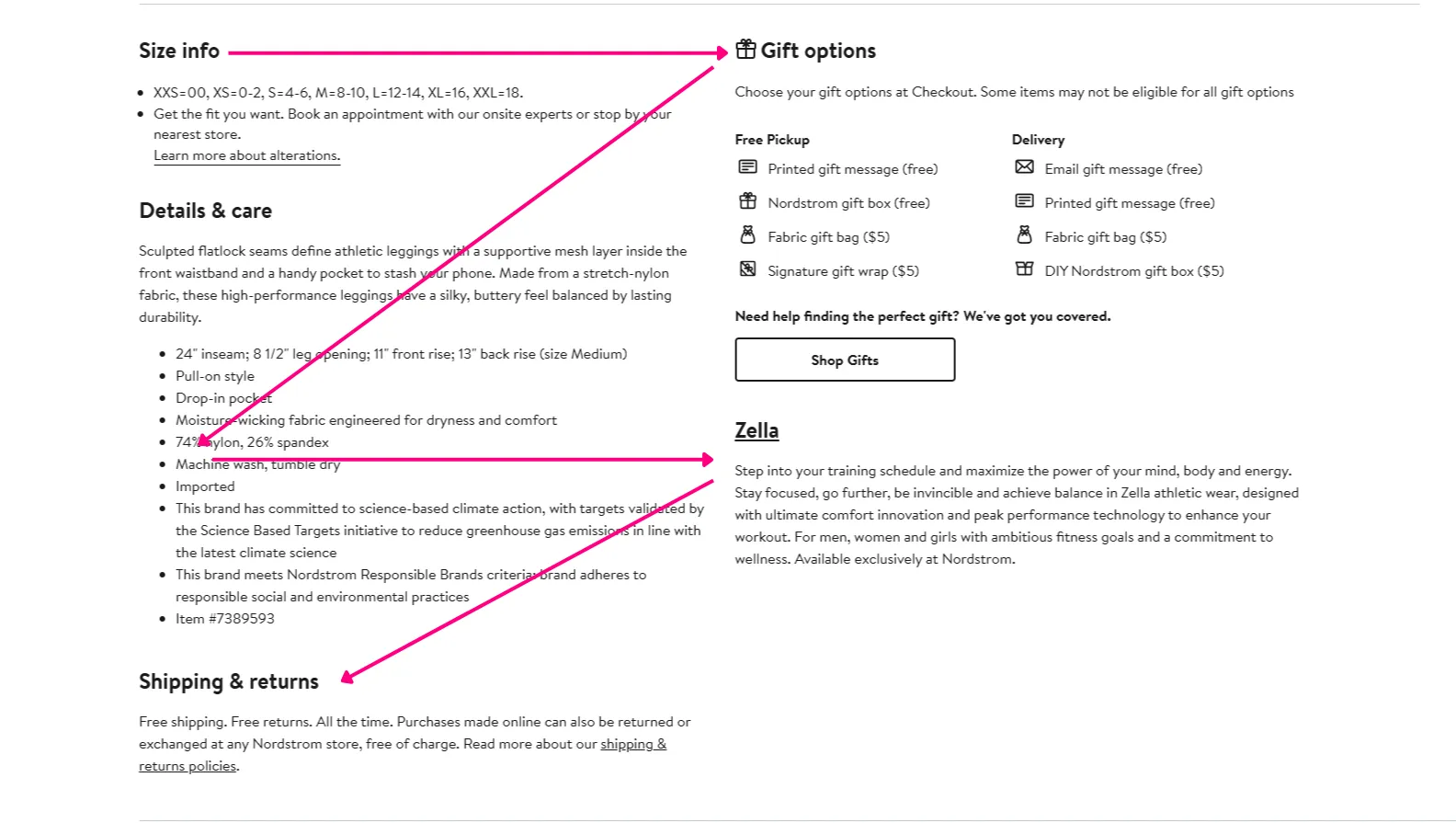
One way to achieve a well-organized layout is by utilizing F and Z patterns, which are common visual patterns that guide the user’s eye in a natural and intuitive way. The F pattern typically focuses on the top left of the page, where key information and CTAs are placed, while the Z pattern guides the user’s eye in a zigzag motion, ensuring that they absorb the most important elements without feeling overwhelmed by clutter.
Z pattern layout.
Overly Complicated Forms
Forms that ask for too much information can discourage users from converting. Only ask for essential details and consider multi-step forms for longer processes.
Lack of Mobile Optimization
Ensure your landing pages are optimized for mobile devices. A poor mobile experience will lead to high bounce rates and missed conversions.
Ignoring User Intent
Make sure your landing page aligns with the user’s expectations based on the ad. Misunderstanding user intent can result in high bounce rates and low conversions.
Case Studies: How Landing Page Optimization Improved Conversion Rates
Slow Fashion eCommerce Case Study: A sustainable fashion brand saw a 3600% increase in conversions by aligning the product page with the ad’s eco-friendly message and optimizing page load speed. Through behavioural analysis, friction points were found on the website, such as users trying to zoom in on the products, but being unable to do so.
Conversion Rate Optimization for Ecommerce Case Study: A document inspection company improved conversions by 45% by enhancing clarity on available document types, pricing, and processing times to reduce uncertainty for users.
Lessons Learned from These Case Studies
Relevance is Key: Matching the landing page content with the ad message is crucial for improving conversion rates.
Mobile Optimization is Essential: With increasing mobile traffic, optimizing for mobile is no longer optional.
Simplify the User Journey: Reducing friction through simplified forms and clearer CTAs leads to better conversion rates.
A/B Testing Yields Valuable Insights: Constantly testing and refining landing page elements helps optimize performance.
Conclusion
Landing page optimization is crucial for improving ad conversion rates. By focusing on relevance, design, technical performance, and user experience, you can maximize your ROI and achieve your desired business outcomes. Want to improve your conversion rates?
Let Midsummer Agency help you optimize your landing pages for success!